I'm having trouble understanding their explanation. I follow everything up to "The Set $A_2$ contains $(1/2)(n^2 - n)$ subsets..." could someone please help explain this to me?
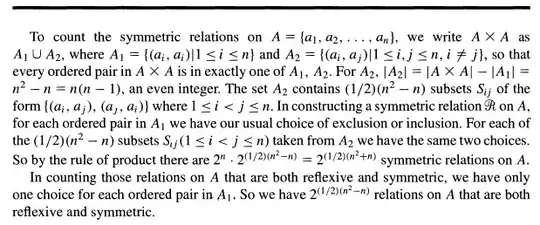
Source: Discrete and Combinatorial Mathematics, Ralph P. Grimaldi
I'm having trouble understanding their explanation. I follow everything up to "The Set $A_2$ contains $(1/2)(n^2 - n)$ subsets..." could someone please help explain this to me?
Source: Discrete and Combinatorial Mathematics, Ralph P. Grimaldi

Drawing a picture might help here. There are $n^2$ total elements of $A \times A$. Of these, $n$ of them lie on the diagonal, and the remaining $n^2 - n$ are not. Of the elements not on the diagonal, half of them are above the diagonal and half of them are below, so $\frac{n^2 - n}{2}$ are below. To make a relation reflexive, we must choose all of the diagonal elements to be in our relation. Then we can choose any subset of the elements below the diagonal to be in our relation, and this determines our relation since we must also choose the corresponding elements mirrored above the diagonal if the relation is to be symmetric. This gives $2^{(n^2 - n)/2}$ choices.

Clarification on the number of $S_{ij}$'s:
There are $n^2-n$ total elements in $A_2$. To count the number of subsets of $A_2$ of the form:
$$
S_{ij}=\{(a_i,a_j), (a_j, a_i)\}
$$
with $j\ne i$, there are $n^2-n$ ways to choose $(a_i,a_j)$, and once we've chosen $(a_i,a_j)$, the two element subset is determined. However, this means we have counted each $S_{ij}$ exactly twice, once for when we chose $(a_i, a_j)$ and once for when we chose $(a_j, a_i)$. Thus the total number of unique $S_{ij}$ is $\frac{1}{2}(n^2-n)$
