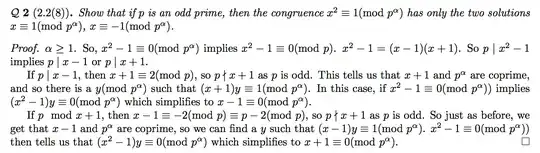
Personally, I feel the proof is formulated a bit awkwardly; some of the implications are, as you stated, not quite clear.
In your first two congruences, you do not actually need $y$. The existence of your $y$ is merely a side-product of the statement that $x+1$ and $p^\alpha$ are coprime.
This does not immediately yield $p^\alpha|(x^2-1)y$. Note that in your proof the line is "In this case, if $(x^2-1)y=0 \mod p^\alpha$, ..."
So this is another assumption - it is actually equivalent to your proposition (since $GCD(y,p)=1$).
To gain $x-1|p^\alpha$, we need the above fact that $GCD(y,p^\alpha)=GCD(x+1,p^\alpha)=1$.
Using that, the relation $p^\alpha|(x^2-1)=(x+1)(x-1)y$ simplifies directly to $p^\alpha|x-1$, which is what you want to show.
Frankly, looking at your proof, I am not entirely sure what the point of introducing $y$ is. It doesn't hurt, sure, but I cannot see how it makes anything easier, either.