I'm not a mathematician, but a geographer trying to get a grasp on some network analysis I'm experimenting with. I have a few questions related to spectral graph theory that a mathematician could help me with:
I'm generating random graphs of 50 nodes and density 0.17 that have particular average path length, modularity, etc. Each of these graphs produce spectra (distribution of eigenvalue) resembling this:
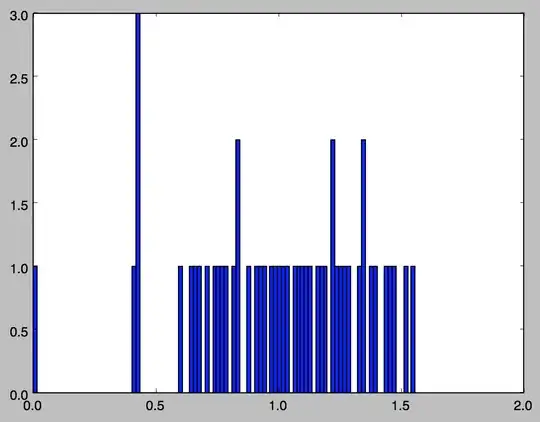
From a novice point of view, I am tempted to tell that a semi-circle shape, if weak, is forming between eigenvalues 0.6 and 1.55.
- What would that mean? Is this related to the typical semi-circle seen in random graphs?
- What about the peak at eigenvalue 0.4? Could it be the second eigenvalue, which is often related to algebraic connectivity?
- Are the values close to zero typical of anything?
To broaden the question, how much can one conclude, in terms of graph structure, from looking at the spectrum of a graph (laplacian or otherwise)? This may seem naive, but can one ever use a graph spectra (perhaps averaged over many graphs) as a structural signature?


BernoulliGraphDistribution[n,p]and (2) the spectrum, eg Adjacency, signed or unsigned Laplacian - can even interpolate between these 2 extremes, and really should also consider SVD of the incidence matrix. Each of these measures a different aspect of graph topology. – alancalvitti Jan 15 '15 at 19:02