8

Knot theory was likely originally motivated by the study of real-world knots such as these:
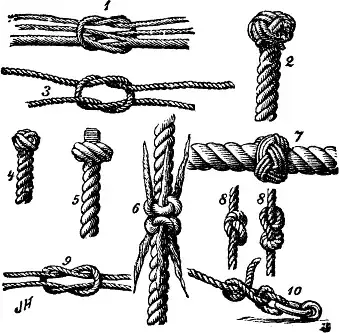
enter image description here


Indeed, mathematical knot tables to this day look not too dissimilar from the familiar "age of sail"-style knot collections that decorate the walls of countless homes and restaurants around the world:

enter image description here


So, has knot theory as a purely topological discipline taught us anything about knots?

In particular

  • have practical knots been developed based on topological results?
  • has the discipline of knot tying benefited from results such as knot equivalence (e.g. simpler procedures for tying certain knots due to topological insight)?
  • are there any other applications of mathematical knot theory to physical knots?
  • 1
    Knot Theory was born out of the (mistaken) idea that atoms were "knotted ether," by Lord Kelvin. Different knots meant different atoms. Naturally, we found out this is wrong, but physical knots were not the original motivation. This can all be found in a number of places, including Colin Adam's book, The Knot Book. – N. Owad Sep 28 '14 at 23:01
  • 3
    ... and then there was string theory. – Dan Rust Sep 30 '14 at 22:40
  • Related: Is there a mathematical theory of physical knots? “From the point of view of people tying real knots (canonically, sailors) mathematical knot theory ignores much of what makes the problem of knot-tying interesting.” – MJD Jun 08 '15 at 17:11
  • @DanRust String theory has these strings in many dimensions. Knots can't exist in dimensions greater than three. – Akiva Weinberger Nov 10 '17 at 19:17

0 Answers0