7

How do we find the area that the cow can graze?

The question goes as follows--

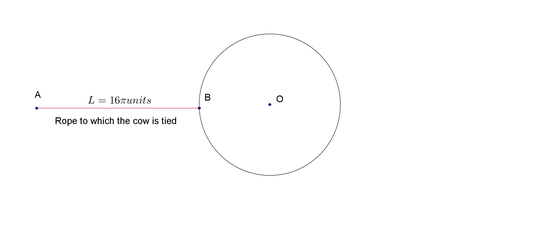
There is a circular barn house surrounded by a huge grazing field. A cow is tied to the rope ($AB$) at the end $A$ as shown. The length of the rope is half the circumference of the barn. Find the area that the cow can graze. The left side of the area is obvious but i cannot get a hang of what is happening on the right side..all i can say is that the rope starts to wrap around the barn when the cow goes to the right.

The length of the rope is $16\pi$ units.

enter image description here

enter image description here

user1001001
  • 5,236
  • You have to inteersect both circles. Can you proceed? – chubakueno Jul 12 '14 at 15:36
  • 1
    No..The cow isn't to be considered as a circle.. – user1001001 Jul 12 '14 at 15:40
  • See http://math.stackexchange.com/questions/413378/trig-word-problem – rogerl Jul 12 '14 at 15:42
  • Yes, I know. But the rope forms a circle of possible area that the cow can graze, except for the intersection of that circle and the barn. – chubakueno Jul 12 '14 at 15:42
  • 5
    The rope starts to wrap around the barn when the cow goes east. – Empy2 Jul 12 '14 at 15:53
  • The barn has radius 16. When the rope has wrapped around an angle $\theta$, it has $16(\pi-\theta$) rope left, so the furthest the cow can reach is $16(-\cos\theta,\sin\theta)+16(\pi-\theta)(\sin\theta,\cos\theta)$ – Empy2 Jul 12 '14 at 15:56
  • 5
    You want to work with what is called the involute of the circle. There is an animation of what you are doing here: http://mathworld.wolfram.com/Involute.html . The curve for the circle and information on it can be found here: http://mathworld.wolfram.com/CircleInvolute.html . Have you covered areas for parametric curves? – colormegone Jul 12 '14 at 16:16
  • Considerin Michael's interpretation, the area covered by the circle involute is actually less than we are looking for, since we could wrap the rope around clockwise or anticlockwise. – chubakueno Jul 12 '14 at 16:27
  • @chubakueno Yes, you need to use a symmetrical pair of involutes, as coffebelly's diagram suggests. – colormegone Jul 12 '14 at 17:32

4 Answers4

2

The area of the half circle should be no problem. The shape that is made when the cow wraps around is called the involute of a circle. Using some trig/geometry you can parametrize the curve as $x=r\cos t+tr\sin t$ and $y=r\sin t-tr\cos t$. Then use Green's theorem for area $A=\frac{1}{2}\int_C-ydx+xdx.$ This is actually a great problem and can be solved a couple of other ways as well.

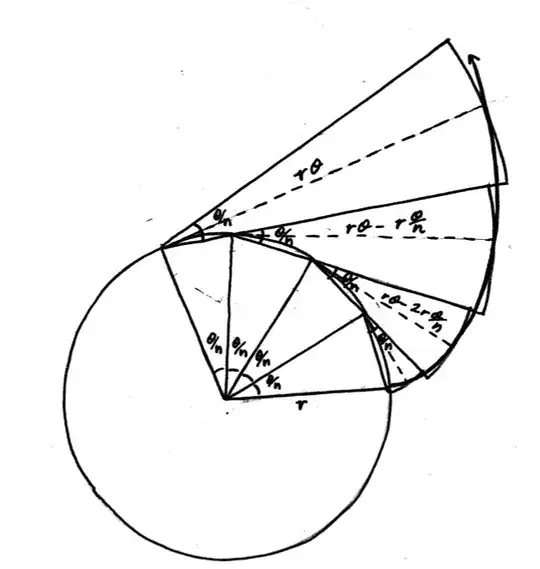
If you want to use Riemann sums you will be summing up the area of circular sectors as the angle gets smaller and smaller. Here is a crude picture whenenter image description here $n=4$ and $r$ is the radius of the barn. Taking the limit of the sum as $n\rightarrow\infty$ will get you the answer.

1

Try to do a Riemann sum. For $0<\theta<\pi/2$, consider the strip of land covered as the contact angle moves from $\theta$ to $\theta+d\theta$. Integrate that. Then, for $\pi/2<\theta<\pi$, the end of the rope is coming back west, and the strip of land you measure is the inaccessible part. Integrate that and subtract from the first answer.

When the contact angle is $\theta$, a bound on the region is $$P1(-16\cos\theta+16(\pi-\theta)\sin\theta,16\sin\theta+16(\pi-\theta)\cos\theta)$$ Another bound is on the south side, $$P2(-16\cos\theta+16(\pi-\theta)\sin\theta, -16\sin\theta-16(\pi-\theta)\cos\theta)$$ Then, allowing just a bit more contact on the barn, to $\theta+d\theta$, you get $$P3(-16\cos(\theta+d\theta)+16(\pi-(\theta+d\theta))\sin(\theta+d\theta),16\sin(\theta+d\theta)+16(\pi-(\theta+d\theta))\cos(\theta+d\theta))$$ and similar for P4. There is a region P1P2P4P3 which is a trapezoid, whose height is $P1y$ and whose width is $d\theta$ times $dP1x/d\theta$

Sorry I don't know how to do pictures on this.

Empy2
  • 52,372
1

The length of the rope ($16\pi$) is half the circumference of the barn($2\pi r/2=\pi r$).

$\therefore \pi r =16 \pi\Rightarrow r=16$, this is the radius of the barn. Radius of the cow's grazing area is $16\pi$ which is greater than $32$, $\hspace{30 pt}\therefore$ cow's grazing area encompasses the circular barn.

Also, length of the rope=half the circumference of the barn, which means that cow can just reach the rightmost point in your diagram.

The difference of area of circle formed by cow minus the area of barn will give you the answer.

Vikram
  • 5,808
0

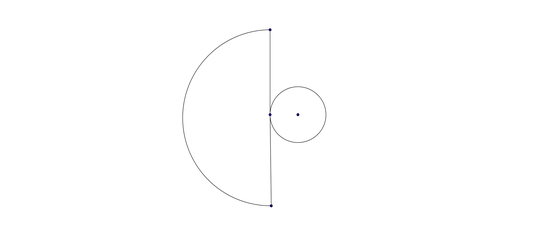
Coffeebelly was very close to the complete answer - you have to use a method similar to that one and integrate the polar area around the barn. Shamelessly stealing coffeebelly's picture:

https://i.sstatic.net/LYcMg.jpg

So - we know that the area to the left of the barn is easy - a semicircle with radius 16π, or A = 1/2 π(16π)^2 = 128π^3. Now for the hard part.

The area that the cow can graze around the barn is more complicated. The length of the rope shrinks as it goes around the barn. But we can integrate this area, using the regions shown in coffeebelly's picture. If we use an angle θ equal to the distance around the barn the cow's rope goes (where it departs the barn at a tangent), we get the following integral:

∫(from π to 0) (1/2 r^2 dθ), where r is the distance of rope left after departing the side of the barn, and dθ is the incremental angle.

Now, r = 16π - θ * (2πR / 2π radians) = 16π - θR = 16π - 16θ.

So the area to the right equals the integral:

A = ∫(from π to 0) (1/2 (16π - 16θ)^2 dθ) = 128 ∫(π to 0) (π - θ)^2 dθ A = 128∫(π to 0) (θ^2 - 2πθ + π^2) dθ = 128 (1/3 θ^3 - π θ^2 + π^2 θ)|(π to 0) A = 128(1/3 π^3 - π^3 + π^3) = 128/3 π^3

So the total area is (128 + 128/3) π^3 = 512/3 π^3.

Or exactly 2/3 the area of the entire circle.