$$\frac{1}{\sqrt{2\pi}} \int^0_{z_a} e^{\frac{-z^2}{2}} \, dz = 0.48 $$
How would I solve for the value of $z_a$ using a calculator?
$$\frac{1}{\sqrt{2\pi}} \int^0_{z_a} e^{\frac{-z^2}{2}} \, dz = 0.48 $$
How would I solve for the value of $z_a$ using a calculator?

Define
$$ f(z) = \frac{1}{\sqrt{2\pi}} \int_z^0 e^{-t^2/2}\,dt. $$
Here's a plot of $f(z)$:
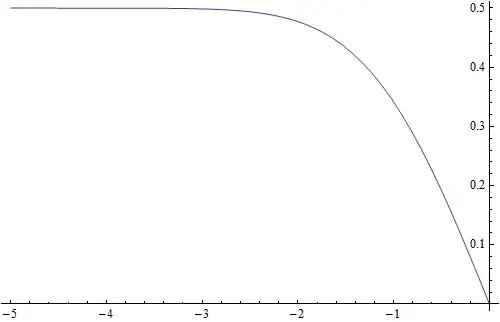
There are two notable features of this plot:
When $z$ is close to zero, $f(z)$ is very close to $-\sqrt{2\pi} z$. Indeed, by calculating the derivatives using the fundamental theorem of calculus we can show that $$\begin{align} f(z) &= f(0) + f'(0)z + \frac{f''(0)}{2}z^2 + O(z^3) \\&= -\sqrt{2\pi}z + O(z^3) \end{align}$$ as $z \to 0$.
When $z$ is away from zero, $f(z)$ is very close to $$\frac{1}{\sqrt{2\pi}}\int_{-\infty}^0 e^{-t^2/2}\,dt = \frac{1}{2}.$$
You're interested in solving the equation
$$ f(z) = 0.48, $$
and since $0.48$ is very close to $1/2$ we would expect that $z$ falls into the second category. Let's calculate an initial guess $z_0$ for $z$.
Splitting the integral then integrating by parts we get
$$ \begin{align} f(z) &= \frac{1}{\sqrt{2\pi}} \int_{-\infty}^0 e^{-t^2/2}\,dt - \frac{1}{\sqrt{2\pi}} \int_{-\infty}^z e^{-t^2/2}\,dt \\ &= \frac{1}{2} - \frac{1}{\sqrt{2\pi}} \int_{-\infty}^z e^{-t^2/2}\,dt \\ &= \frac{1}{2} + \frac{1}{\sqrt{2\pi}} \int_{-\infty}^z t^{-1} d\left(e^{-t^2/2}\right) \\ &= \frac{1}{2} + \frac{1}{\sqrt{2\pi}}\left(\left. t^{-1} e^{-t^2/2} \right|_{t=-\infty}^{t=z} + \int_{-\infty}^{z} t^{-2} e^{-t^2/2}\,dt\right) \\ &= \frac{1}{2} + \frac{1}{\sqrt{2\pi}} z^{-1} e^{-z^2/2} + \frac{1}{\sqrt{2\pi}} \int_{-\infty}^{z} t^{-2} e^{-t^2/2}\,dt. \end{align} $$
This new integral with its factor of $t^{-2}$ in the integrand is surely much smaller than the original when $z$ is large and negative, so our first approximation to $f(z)$ in this case would be
$$ f(z) \approx \frac{1}{2} + \frac{1}{\sqrt{2\pi}} z^{-1} e^{-z^2/2}. $$
Here's a plot of $f(z)$ in blue versus this approximation in red:
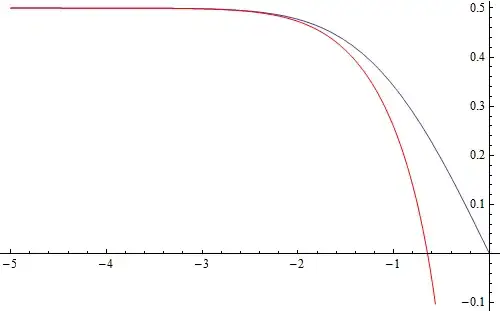
So, if we wanted to solve an equation like
$$ f(z) = \frac{1}{2}-\epsilon $$
(like we do, with $\epsilon = 0.02$), then we could get an approximate solution by instead solving
$$ \frac{1}{2} + \frac{1}{\sqrt{2\pi}} z^{-1} e^{-z^2/2} = \frac{1}{2}-\epsilon, $$
which is the same as
$$ -\frac{1}{\sqrt{2\pi} \epsilon} = z e^{z^2/2}. $$
Squaring this yields
$$ \frac{1}{2\pi \epsilon^2} = z^2 e^{z^2}, $$
which can be solved using the Lambert W function as
$$ z^2 = W(1/(2\pi \epsilon^2)). $$
Finally, taking the negative square root (remember we want $z$ to be negative) yields
$$ z = -\sqrt{W(1/(2\pi \epsilon^2))}. $$
For large $x$ it's known that $W(x) \approx \log x - \log\log x$ (for a proof see this answer), so for small $\epsilon$ we have
$$ z \approx -\sqrt{\log \frac{1}{2\pi \epsilon^2} - \log\log \frac{1}{2\pi \epsilon^2}}. $$
Thus our initial approximation $z_0$ for the solution to the equation
$$ f(z) = 0.48 = \frac{1}{2} - 0.02 = \frac{1}{2} - \epsilon $$
is
$$ z_0 = -\sqrt{\log \frac{1}{2\pi \epsilon^2} - \log\log \frac{1}{2\pi \epsilon^2}}{\Bigg |}_{\epsilon = 0.02} \doteq -2.04859. $$
Now, using this initial guess $z_0 = -2.04859$, we can obtain a more precise value for the root of
$$ f(z) = 0.48 $$
by using Newton's method. Let's define $g(z) := f(z) - 0.48$, so that the equation we want to solve is
$$ g(z) = 0. $$
Using the fundamental theorem of calculus we can calculate
$$ g'(z) = - \frac{1}{\sqrt{2\pi}} e^{-z^2/2}, $$
so the iteration for Newton's method,
$$ z_{n+1} = z_n - \frac{g(z_n)}{g'(z_n)}, $$
is
$$ z_{n+1} = z_n + e^{z_n^2/2} \left(\int_{z_n}^0 e^{-t^2/2}\,dt - 0.48\sqrt{2\pi}\right). $$
We then iterate this recurrence using the starting value $z_0 = -2.04859$ to obtain better approximations for the root. Mathematica produces the iterates
$$ \begin{align} z_1 &= -2.05372, \\ z_2 &= -2.05375, \\ z_3 &= -2.05375, \end{align} $$
so it looks like the root is $z \doteq -2.05375$ to six significant figures. Indeed, the root is approximately
$$ z \doteq -2.05374\ 89106\ 31823\ 05294. $$
The Casio fx-991EX PLUS has a button for numerical integration so this iteration process should be doable on your hand calculator.

