3

I'm having some difficulties to execute this integral: $$\int_{1}^x \frac{t+\log(t)}{1+t^2} \,dt = \int_{1}^x \frac{t}{1+t^2} \,dt + \int_{1}^x \frac{\log(t)}{1+t^2} \,dt = ... = \frac{1}{2}\log|1+x^2| - \frac{1}{2}\log(2) + ... $$

Could you please give me some hints to solve the following: $$ \int_{1}^x \frac{\log(t)}{1+t^2} \,dt $$

I get something similar to the Catalan constant but I'm not sure I'm doing it in the correct way: http://en.wikipedia.org/wiki/Catalan%27s_constant

Edward
  • 420
  • It's not clear to me what you are asking. I don't think you can expect an analytic solution to the integral, since you get Catalan's constant $G$ when $x=0$, and that would imply the existence of a (fairly) simple expression for $G$. But perhaps you want something else, like a nice series expansion for the integral? – Harald Hanche-Olsen Jun 01 '14 at 13:53
  • Thanks Harald, tbh I need to calculate $$ \lim_{x \to inf} \frac{\int_{1}^x \frac{t+\log(t)}{1+t^2} ,dt}{x}$$ and I was hoping to get an analytic solution or something simpler respect to what I've got. – user138859 Jun 02 '14 at 16:23
  • Ah, but that integrand is asymptotically equal to $1/t$, so the integral in the numerator should behave like $\ln t$, with the result that the limit is zero. Or to put it differently, just treat the limit directly with L'Hôpital's rule. Poof, no integral! And the limit is zero. – Harald Hanche-Olsen Jun 02 '14 at 20:01
  • Ah, that sounds a lot easier! Many thanks again Harold. – user138859 Jun 04 '14 at 06:26

2 Answers2

5

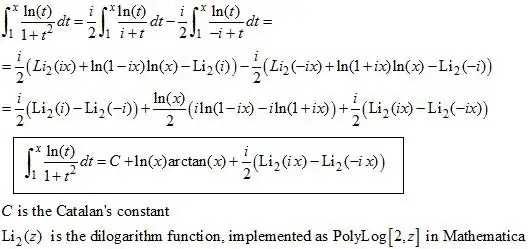
It is probably impossible to obtain a closed form without dilogarithm function (or other special functions such as Lerch's function for example)

enter image description here

JJacquelin
  • 68,401
  • 4
  • 40
  • 91
2

There is an analytical solution for the integral but its expression involves polylogarithms $$\int_{1}^x \frac{\log(t)}{1+t^2} \,dt=C-\frac{1}{2} i \text{Li}_2(-i x)+\frac{1}{2} i \text{Li}_2(i x)+\log (x) \tan ^{-1}(x)$$ As told by Harald Hanche-Olsen, you can have a nice series expansion from the Taylor expansion of $$\frac{1}{1+t^2}=1-t^2+t^4-t^6+...$$ and then the problem reduces to $$I_n=\int_{1}^x t^n \log(t) dt=\frac{x^{n+1} ((n+1) \log (x)-1)+1}{(n+1)^2}$$