How can I find the solution for the following equation in $a,b \mbox{ and } c$.
$$\frac{a}{c-b+1}+\frac{b}{a-c+1}+\frac{c}{b-a+1}=0.$$ Also $b-c \neq 1$, $c-a \neq 1$ and $a-b \neq 1$.
Thanks!
How can I find the solution for the following equation in $a,b \mbox{ and } c$.
$$\frac{a}{c-b+1}+\frac{b}{a-c+1}+\frac{c}{b-a+1}=0.$$ Also $b-c \neq 1$, $c-a \neq 1$ and $a-b \neq 1$.
Thanks!


In order to avoid definiteness problems, I will consider $a$, $b$ and $c$ as independent variables in the field of rational fractions $\mathbb{C}(a,b,c)$, and I will seek some kind of a parametric representation of the solutions $(a,b,c)$ of the proposed equation as rational functions from $\mathbb{C}(u,v)$ where $u$ and $v$ are independent variables. Precisely, I will prove that $$ \frac{a}{c-b+1}+\frac{b}{a-c+1}+\frac{c}{b-a+1}=0, $$ If and only if $$\eqalign{ a&=\frac{u \left(3 u v+u+3 v^2+2 v-1\right)}{u^2+u v+v^2-1}\cr b&=\frac{v \left(3 u^2+3 u v-2 u-v-1\right)}{u^2+u v+v^2-1}\cr c&=\frac{(u+v) (3 u v-u+v+1)}{u^2+u v+v^2-1}\cr } $$ To see this, let $$u=\frac{a}{c-b+1}, v=\frac{b}{a-c+1},w=\frac{c}{b-a+1}.\tag{1}$$ The proposed equation is, then, equivalent to $w=-u-v$. Now $(1)$ is equivalent to $$ \left[\matrix{1&u&-u\cr-v&1&v\cr w&-w&1 }\right]\cdot\left[\matrix{a\cr b\cr c}\right]=\left[\matrix{u\cr v\cr w}\right] $$ or $$ \left[\matrix{a\cr b\cr c}\right]=\left[\matrix{1&u&-u\cr-v&1&v\cr w&-w&1 }\right]^{-1}\cdot\left[\matrix{u\cr v\cr w}\right] $$ This yields, after some algebra, $$\eqalign {a&=\frac{u (3 v w-v+w+1)}{u v+u w+v w+1}\cr b&=\frac{v (3 u w+u-w+1)}{u v+u w+v w+1}\cr c&=\frac{w (3 u v-u+v+1)}{u v+u w+v w+1} } $$ Now, the condition $w=-u-v$ yields (after substitution) the announced parametrization of the solutions.
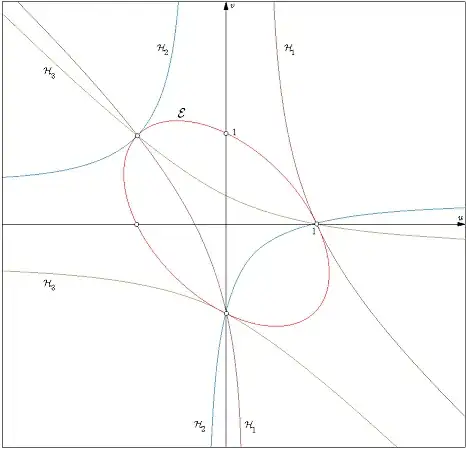
Edit. If we want to substitute $u$ and $v$ by real numbers then $$(u,v)\in\mathbb{R}\times\mathbb{R}\setminus\left(\mathcal{E}\cup\mathcal{H}_1\cup\mathcal{H}_2\cup\mathcal{H}_3\right)$$
where $\mathcal{E}$ is the ellipse of equation $u^2+uv+v^2=1$, and $\mathcal{H}_k$ ($k=1,2,3$) are the hyperbola corresponding to the conditions $a-c=1$ (or equivalently $3uv-v-2u+3u^2=1$), $b-a=1$ (or equivalently $3uv+v-u=-1$), and $c-b=1$ (or equivalently $3uv+u+2v+3v^2=1$).
$$
\eqalign{\mathcal{E}:& \quad u^2+uv+v^2=1\cr
\mathcal{H}_1:& \quad 3uv-v-2u+3u^2=1\cr
\mathcal{H}_2:& \quad 3uv+v-u=-1\cr
\mathcal{H}_3:& \quad 3uv+u+2v+3v^2=1
}$$
The next figure depicts this set: