On why the # of choices of an $n$ set with $k$ kiwis is $\dbinom{n}{k}\dbinom{n}{n - k} = \dbinom{n}{k}^2$, AlexR wrote:
No, picking exactly $k$ kiwis means you discount the $n-k$ remaining kiwis, but you still have to chose $n-k$ figs out of $n$, which is the second factor.
$1.$ I don't understand AlexR's answer. So I add a picture: 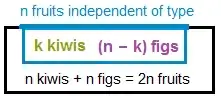
Why isn't the # of ways of choosing an $n$ set with $k$ kiwis $ \dbinom{n}{k}$?
I know that $\dbinom{n}{k} = \dbinom{n}{n - k}$, which signifies: Out of any selection of $n$ fruits, as soon as you select $k$ kiwis, you simultaneously (de)select the $n - k$ figs.
But doesn't $\dbinom{n}{k}$ signify both the selection of kiwis and deselection of figs? So isn't multiplying $\dbinom{n}{k}$ by $\dbinom{n}{n - k}$ redundant?
$2.$ Moreover, how would you determine whether to use $\dbinom{n}{k}\dbinom{n}{n - k}$ or $\dbinom{n}{k}$ ?


