I'm not familiar with such line integrals, but I would think that one could interpret
$$\int_{\gamma} f(x,y)\, dx$$
as the area of the projection on the x-axis of the sheet defined by $f(x,y)$ evaluated along $\gamma$. Similarly, I would interpret
$$\int_{\gamma} f(x,y)\, dy$$
as the area of the projection on the y-axis of the sheet defined by $f(x,y)$ evaluated along $\gamma$.
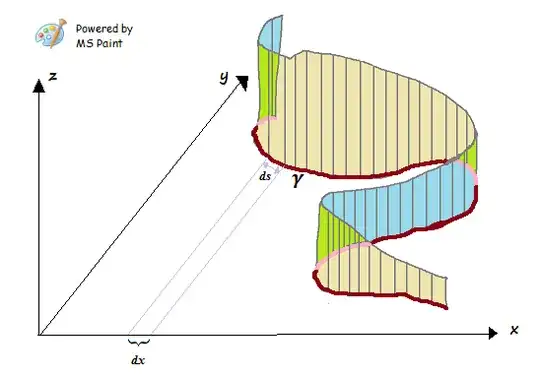
Assuming that we follow $\gamma$ from the lower right (see diagram), integrating with respect to $dx$ (along $\gamma$) will yield negative areas if the yellow side is exposed (to the $x$-axis), and positive areas if the blue side is exposed. Of course portions of $\gamma$ that run parallel to the $y$-axis wouldn't contribute anything to
$$\int_{\gamma} f(x,y)\, dx$$


