I'm suppose to proof the following with combinatorial proofs.
1)$$\sum_{i=0}^{n} {a+i \choose i} = {a+n+1 \choose n}$$
2)$$\sum_{i=0}^{n} i{n \choose i} = n2^{n-1}$$
3)$$\sum_{i=0}^{n} {n \choose i}^2 = {2n \choose n}$$
Any ideas how this is done ?
I'm suppose to proof the following with combinatorial proofs.
1)$$\sum_{i=0}^{n} {a+i \choose i} = {a+n+1 \choose n}$$
2)$$\sum_{i=0}^{n} i{n \choose i} = n2^{n-1}$$
3)$$\sum_{i=0}^{n} {n \choose i}^2 = {2n \choose n}$$
Any ideas how this is done ?
For the first one:
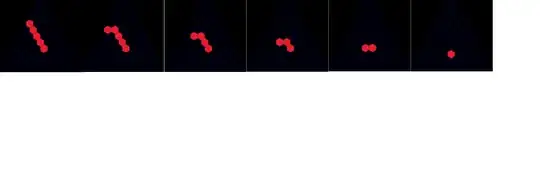
For the second one check out this other post: Combinatorial proof of $\sum^{n}_{i=1}\binom{n}{i}i=n2^{n-1}$.
For the third just write the summand as $\binom{n}{i}\binom{n}{n-i}$. Imagine you have $2n$ students and you split the class into two chunks of $n$. You want to pick $n$ to go on a trip. You can choose first $0$ from one half, and the take other half, or one from one half and $n-1$ from the other half and so on. Or you could just straight up pick them without the partition in $\binom{2n}{n}$ ways.


