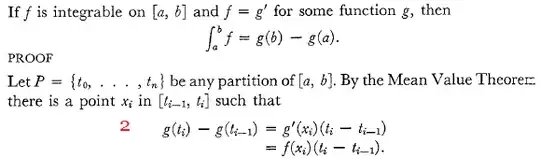
The intuition for the (second) fundamental theorem of calculus is that
\begin{equation}
\text{"the total change is the sum of all the little changes".}
\end{equation}
The total change is $g(b) - g(a)$. The little changes are
\begin{equation*}
g(t_i) - g(t_{i-1}) \approx g'(\xi_i)(t_i - t_{i-1})
\end{equation*} (where $\xi_i$ is any point in $[t_{i-1},t_i]$.)
By adding up all the little changes, you get the total change.
\begin{align*}
g(b) - g(a) &= \sum g(t_i) - g(t_{i-1}) \\
&\approx \sum g'(\xi_i)(t_i - t_{i-1}).
\end{align*}
Notice that this last expression is a Riemann sum for the integral $\int_a^b g'(t) \, dt$.
It's wonderful that the mean value theorem allows us to replace the approximate equalities with exact equalities, which helps us turn this intuitive argument into a rigorous proof.