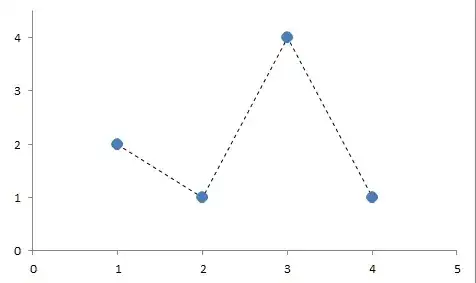
If you want to interpolate values $y_1$, $y_2$, $y_3$, $y_4$ at values $x = 1,2,3,4$, then the required "blending" or "basis" functions are:
$$
\begin{align}
g_1(x) &= \tfrac16 (24 - 26 x + 9 x^2 - x^3) \\
g_2(x) &= \tfrac12 (-12 + 19 x - 8 x^2 + x^3) \\
g_3(x) &= \tfrac12 (8 - 14 x + 7 x^2 - x^3) \\
g_4(x) &= \tfrac16 (-6 + 11 x - 6 x^2 + x^3)
\end{align}
$$
These give the curve
$$
C(x) = g_1(x)y_1 + g_2(x)y_2 + g_3(x)y_3 + g_4(x)y_4 = \sum_{i=1}^4 y_i g_i(x) \qquad (*)
$$
You can easily check that $C(i) = y_i$ for $i=1,2,3,4$.
In your particular case, you have $y_1=0$, $y_2=-1$, $y_3=3$, $y_4=2$, and the curve becomes
$$
C(x) = \tfrac16 (96 - 161 x + 75 x^2 - 10 x^3)
$$
Again, you can easily check that this has the right properties.
In some sense, this is not a very interesting "spline" because it has only one cubic segment. But, if you insist on using a linear combination of simple cubic basis functions, then this is what you'll always get. The "$g$" functions given above are the only basis functions that will give the sort of interpolation you seem to want.
Where do the basis functions $g_1$, $g_2$, $g_3$, $g_4$ come from? They are actually the Lagrange polynomials for the nodes $x_1 = 1$, $x_2 = 2$, $x_3 = 3$, $x_4 = 4$. There are (at least) two ways to construct them. The most elementary approach is to assume that $C$ has the form
$$
C(x) = ax^3 + bx^2 + cx + d \qquad (**)
$$
The requirement that $C(x_i) = y_i$ for $i=1,2,3,4$ gives us four linear equations, which we can solve to get $a$, $b$, $c$, $d$ in terms of $y_1$, $y_2$, $y_3$, $y_4$. We plug the solutions back into equation $(**)$, and rearrange terms, and we'll get something in the form of (*), from which we can identify $g_1$, $g_2$, $g_3$, $g_4$. This is a very simple special case of the "interpolating spline" technique that several people have suggested to you.
The more clever approach uses the concept of Lagrange polynomials. A little thought shows that $(*)$ will give us the interpolation we need if the functions $g_i$ have the property $g_i(x_j) = \delta_{ij}$. In other words, $g_i(x_j) = 1$ if $i=j$ and $g_i(x_j) = 0$ if $i \ne j$. We can construct polynomials with this property quite easily. For example, we can define $g_2$ by:
$$
g_2(x) = \frac{(x-x_1)(x-x_3)(x-x_4)}{(x_2-x_1)(x_2-x_3)(x_2-x_4)}
$$
It's clear that this is a cubic polynomial that has the desired properties. If you plug in $x_1 = 1$, $x_3 = 3$, $x_4 = 4$, you'll get $g_2(x) = \tfrac12 (-12 + 19 x - 8 x^2 + x^3)$. The other three $g_1$, $g_3$, $g_4$ can be constructed similarly.