2

Good evening,

I have found this exercise (https://math.stackexchange.com/questions/633509/which-methods-different-than-the-natural-lim-n-to-infty-frac-cos1-cos)

What is the limit of: $$\lim_{n\to\infty}\dfrac{|\cos{1}|+|\cos{2}|+|\cos{3}|+\cdots+|\cos{n}|}{n}$$

I am trying to solve it (without Probability, I have no knowledge on these subjects) but I didn't succeed, is it possible to solve it? If so, how to find the limit?

Thanks in advance.

2 Answers2

3

It seems like the consensus here is that the easiest way to approach the problem would be to use Weyl's Equidistribution Theorem (the technique used to get the answer given on the MIT website). Though here is another approach I wrote up yesterday, based on the fact that the partial sum in question can be decomposed into a Fourier series expansion and some additional terms:

$$\sum_{k=1}^N|\cos(k)|=\frac{2N}{\pi}+\frac{|\cos(N)|-1}{2}-\frac{2}{\pi}\sum_{m=1}^\infty\frac{(-1)^m}{4m^2-1}\frac{\sin(2mN)}{\tan(m)}$$

The proof I wrote went as follows:
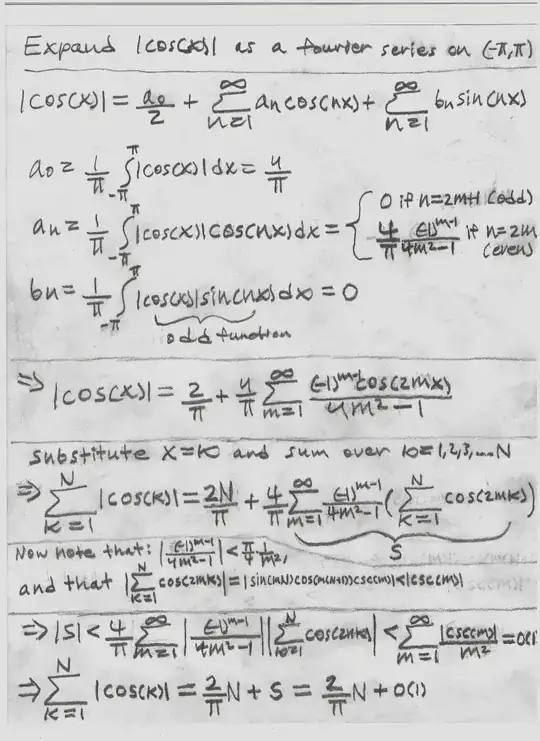
enter image description here

Though unfortunately I made an error when I assumed $\sum_{m=1}^\infty\frac{1}{m^2|\sin(m)|}$ converges, because whether or not the sum actually does converge is still an open problem. Which if you happen to be interested in, you could look at: Are there any series whose convergence is unknown? for a more thorough discussion. Though even proving that the full error term converges in the original series seems to require more advanced knowledge about facts concerning the Diophantine approximation of $\pi$. Though if it can be proven then as seen above this would give the much stronger result:

$$\sum_{k=1}^N(|\cos(k)|-\frac{2}{\pi}) \text{ } \text{ Is bounded as } N \text{ tends to infinity}$$

So I would guess that probably the only simple way of attacking this problem would be using Weyl's Theorem or at least something similar because it doesn't seem all that straight forward to solve using other techniques.


EDIT : The problem actually can be solved this way. If you divide both sides by $N$ and apply the dominated convergence theorem, the error term $\text{S}$ will tend to zero, giving your required result. Though this just wont give you the stronger expression I posted above.

Ethan Splaver
  • 10,812
  • Waw, Very interesting and clear.I'll try your idea and try to work on the series. I'll let you know if I get something interesting. Thank you for your time and "investment". –  Jan 27 '14 at 10:02
  • Anyway even if we had $\sum_{k=1}^N|\cos(k)|=\frac{2N}{\pi}+O(1)$ When $N \rightarrow \infty$ we have $lim \sum_{k=1}^N|\cos(k)| = \infty$ right ?:) –  Jan 27 '14 at 10:40
  • Yes, but I thought we were trying to show that $\lim_{N\to\infty}\frac{1}{N}\sum_{k=1}^N|\cos(k)|=\frac{2}{\pi}$ – Ethan Splaver Jan 27 '14 at 10:45
  • oups,here I have not thought .. –  Jan 27 '14 at 10:46
  • @Nico If I had to make a guess I would say $\sum_{k=1}^N|\cos(k)|=\frac{2N}{\pi}+O(1)$ is indeed true, even numerical evidence verifies this for very large $N$. Though this is a much stronger claim, and although it would imply the proof of your limit, its full strength is not required. – Ethan Splaver Jan 27 '14 at 10:47
  • Yes, I think you're right on the fact that ' the only simple way of attacking this problem (...) techniques.' Thank you once again. –  Jan 27 '14 at 12:32
  • @Julien I'm not sure what your referring to, could you elaborate please. – Ethan Splaver Jan 27 '14 at 23:20
  • @Julien I am not sure if I am misunderstanding you, but the inner sum can be calculated explicitly and is not bounded by $2$ for large $N$. – Ethan Splaver Jan 28 '14 at 00:18
2

Hint: If one replaces $n$ with $n\bmod {2\pi}$, the quotient tuens into something like a "distorted" Riemann sum. How distorted can it be? What does it mean of $n_1\bmod {2\pi}$ and $n_2\bmod{2\pi}$ are "unusually" close to each other?