The powers of the roots $\lambda$ of these polynomials $$p_n(x):=\sum_{k=1}^{n-1}\frac{n!}{(n-k)!}x^{k-1}$$ (compare with the $p_n$ here) sum to these values $$\sum_\lambda \lambda^k=-(-1)^k\frac{B_k}{k!} \textrm{for } k=1..n-2$$ The $B_k$ are the $k$th Bernoulli numbers $-\frac{1}{2}, \frac{1}{6}, 0, -\frac{1}{30}...$ Since $|\lambda|<1$ (fine to just assume) we have the geometric series $$\sum_{k=0}^\infty(\lambda x)^k=\frac{1}{1-\lambda x}$$ at least for $|x|\leq1$ but most of the $\lambda$ go to zero as $n$ increasesso the radius of convergence also may increase.
By summing over all $n-2$ roots $\lambda$ we get for the first $n-2$ terms of the left hand side. $$\sum_{k=1}^{n-2}(\lambda_1 x)^k+\sum_{k=1}^{n-2}(\lambda_2 x)^k+...=-\sum_{k=1}^{n-2}(-1)^kB_k\frac{x}{k!}^k$$ Which if you start at $k=0$ and go to $\infty$ converges to $-x/(1-\exp(-x))$ see here.
Question: Is $$-x/(1-\exp(-x))=\lim_{n\rightarrow \infty} \left (\sum_{p_n(\lambda)=0}\frac{1}{1-\lambda x}-n+1 \right)$$ at least for $|x|<1$? Here is a plot for $-x/(1-\exp(-x))$ (green) and $\sum_\lambda \frac{1}{1-\lambda x}-n+1$ (blue) for $n=16$
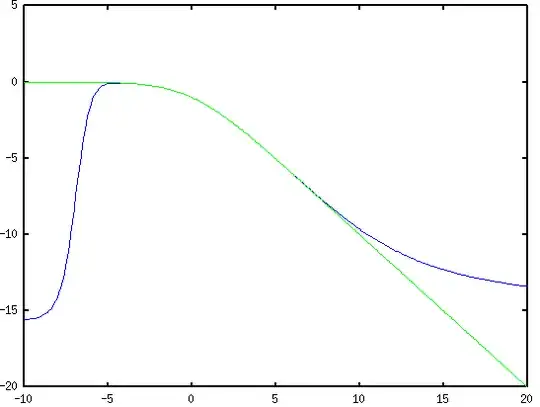
and the octave code to generate it
n = 16;

lambda = roots(factorial(n)./factorial(n - [n-1:-1:1]));

x = -10:1/10:20;

y = zeros(1,length(x));
for i = 1:length(x)
  y(i) = sum(1./(1-lambda*x(i)));
end

plot(x, y-n+1, 'b-', x, -x./(1-exp(-x)), 'g-')

axis([-10 +20 -20 +5])

