0

I am looking at two systems of differential equations:

$$ \frac{1}{x} \frac{dx}{dt} = 1 - \frac{x}{2} - \frac{y}{2} $$ $$ \frac{1}{y} \frac{dy}{dt} = 1 - x - y $$ $$ x(0)=1, y(0)=3.5 $$

How would one figure out the behavior of this system as time approaches infinity? Do you need to use a calculator?

Bob Shannon
  • 1,571
  • haven't looked at it very much but you can assume x > 0 and y > 0 (since there is the 1/x and 1/y) and do 2 * equation 1 - equation 2 to get a first relation between x and y – Thomas Nov 10 '13 at 20:27
  • You should look at concepts of stability, and for phase portraits you need a calculator. – Ömer Nov 10 '13 at 20:44
  • I'm not sure how to enter this into a calculator in dy/dx form. – Bob Shannon Nov 10 '13 at 21:06
  • 1
    I don't mean hand calculator by calculator, i mean a CAS such as Maple, Mathematica,...even there are online sites that you can plot phase portraits, i also recommend you to look at here http://math.stackexchange.com/questions/457102/stability-of-nonlinear-system-with-borderline-linearization/457329#457329 and – Ömer Nov 10 '13 at 21:38

3 Answers3

2

You have two options:

  • (1) Use a numerical scheme (are you currently working on those)
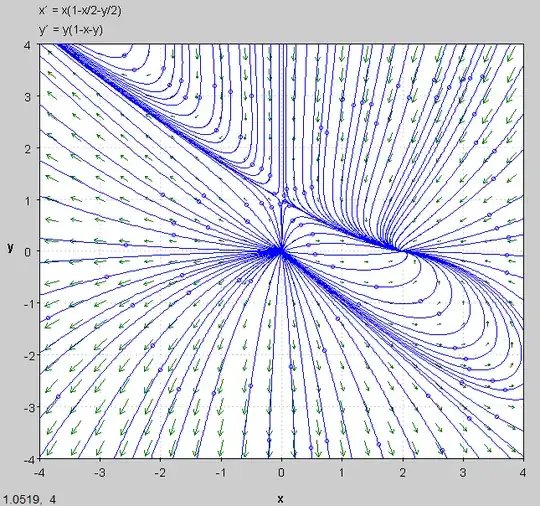
  • (2) Plot a phase portrait and look at the behavior for that initial condition. In this case you can find the critical points and analyze them.

Here is the phase portrait (notice the long term behavior is broken into stable and unstable regions):

enter image description here

Amzoti
  • 56,629
0

You need to transform the system to the Laplace domain, then use the final value theorem: http://en.wikipedia.org/wiki/Final_value_theorem

0

What level is the question being asked at? It may be as simple as you are allowed to assume $dx/dt$ and $dy/dt$ tend to $0$ as $t\rightarrow \infty$.

Matt Rigby
  • 2,374