Hint 1: Integration by parts gives
$$
\begin{align}
\int_a^\infty f'(x)^2\,\mathrm{d}x
&=\int_a^\infty f'(x)\,\mathrm{d}f(x)\\
&=\lim_{b\to\infty}f'(b)f(b)-f'(a)f(a)-\int_a^\infty f(x)f''(x)\,\mathrm{d}x\tag{1}
\end{align}
$$
Hint 2: As Giraffe points out, if $\int_a^\infty f'(x)^2\,\mathrm{d}x$ diverges, then by $(1)$, $\lim\limits_{x\to\infty}f'(x)f(x)=\infty$. Since
$$
f(b)^2=\int_a^bf'(x)f(x)\,\mathrm{d}x\tag{2}
$$
we get that $\int_a^\infty f(x)^2\,\mathrm{d}x$ diverges.
By the comments, this seems to be a bit more involved than befits a hint, so I will explain in more detail. Note that what follows is not needed due to Hint 2, but the ideas used are more generally applicable, so I will leave it.
Claim 1: $\displaystyle\lim_{x\to\infty}f'(x)=0$
Proof: Suppose not; then, for some $\epsilon\gt0$ and all $x_0$, there is an $x\ge x_0$ so that $|f'(x)|\ge\epsilon$.
Since $\|f''\|_{L^2}\lt\infty$, we can choose a $b$ so that
$$
\int_b^\infty f''(x)^2\,\mathrm{d}x\le\epsilon^4\tag{1}
$$
Then, for any $x,y\ge b$ so that $|x-y|\le1$, Cauchy-Schwarz says
$$
\begin{align}
|f'(x)-f'(y)|
&\le\int_x^y|f''(x)|\,\mathrm{d}x\\
&\le\left(\int_x^y|f''(x)|^2\,\mathrm{d}x\right)^{1/2}|x-y|^{1/2}\\[9pt]
&\le\epsilon^2\tag{2}
\end{align}
$$
For any $x_0\ge b+1$, we can choose an $x\ge x_0$ so that $|f'(x)|\ge\epsilon$. If $f'(x)$ and $f(x)$ have the same sign, let $I=[x,x+1]$, otherwise, let $I=[x-1,x]$.
$\hspace{2cm}$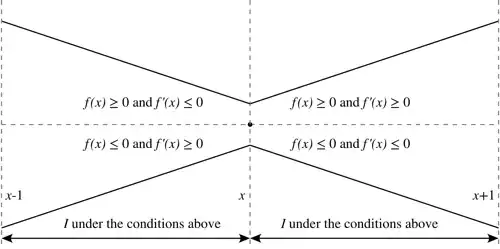
By $(2)$, for $t\in I$, $|f'(t)|\ge\epsilon-\epsilon^2$ and $|f(t)|\ge\left(\epsilon-\epsilon^2\right)|t-x|$. Thus,
$$
\int_If(x)^2\,\mathrm{d}x\ge\frac13\left(\epsilon-\epsilon^2\right)^2\tag{3}
$$
By supposition, we can find infinitely many points so that $|f'(x)|\ge\epsilon$. Therefore,
$$
\int_b^\infty f(x)^2\,\mathrm{d}x\quad\text{diverges}\tag{4}
$$
giving us a contradiction. QED
Claim 2: $\displaystyle\lim_{x\to\infty}f(x)=0$
Proof: Suppose not; then, for some $\epsilon\gt0$ and all $x_0$, there is an $x\ge x_0$ so that $|f(x)|\ge\epsilon$.
Since $\displaystyle\lim_{x\to\infty}f'(x)=0$, we can choose a $b$ so that for all $x\ge b$,
$$
|f'(x)|\le\epsilon^2\tag{5}
$$
Then, for any $x,y\ge b$ so that $|x-y|\le1$, the Mean-Value Theorem says
$$
\begin{align}
|f(x)-f(y)|
&\le\max_{t\in[x,y]}|f'(t)||x-y|\\
&\le\epsilon^2\tag{6}
\end{align}
$$
For any $x_0\ge b+1$, we can choose an $x\ge x_0$ so that $|f(x)|\ge\epsilon$. For any $t\in[x-1,x+1]$, $|f(t)|\ge\epsilon-\epsilon^2$. Thus,
$$
\int_{x-1}^{x+1}f(t)^2\,\mathrm{d}t\ge2\left(\epsilon-\epsilon^2\right)^2\tag{7}
$$
By supposition, we can find infinitely many points so that $|f(x)|\ge\epsilon$. Therefore,
$$
\int_b^\infty f(x)^2\,\mathrm{d}x\quad\text{diverges}\tag{8}
$$
giving us a contradiction. QED


