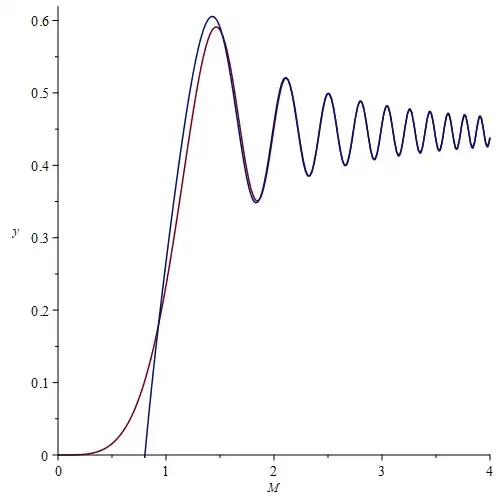
Here's a different flavor of approximation that's much more efficient: Expanding the integral in a series at $M = \infty$ (see below for the derivation) gives
$$\int_0^M \sin(x^3) \,dx = \frac16 \Gamma\left(\frac13\right) - \frac1{3 M^2} \cos (M^3) + \cdots ,$$
where $\cdots$ denotes a remainder decaying as $O(M^{-5})$. Already for $M = \pi$ truncating after the first nonconstant term gives an absolute error $<10^{-3}$:
\begin{align}
\int_0^\pi \sin(x^3) \,dx &= \color{#007f00}{0.4158338146\ldots} \\
\frac16 \Gamma\left(\frac13\right) - \frac1{3 \pi^2} \cos (\pi^3) &= \color{#007f00}{0.415}5104547\ldots .
\end{align}
Figure 1. Graphs of $\color{#7f0000}{\int_0^M \sin (x^3) \,dx}$ (red) and the approximation $\color{#00007f}{\frac16 \Gamma\left(\frac13\right) - \frac1{3 M^2} \cos (M^3)}$ (blue):
This computation reduces the problem to evaluating or looking up $\operatorname{\Gamma}\left(\frac13\right) = 2.6789385347\ldots$ to adequate accuracy. This can be accomplished, e.g., with the approximation https://dlmf.nist.gov/5.11#E14, a truncation of which gives
$$\operatorname{\Gamma}\left(\frac13\right) \approx \frac{6!}{\frac13 \cdot \frac43 \cdot \cdots \cdot \frac{16}3 \cdot \frac{19}3} \left(7 + \frac{\frac13 - 1}{2}\right)^{\frac13} = \frac1{1729}\left(\frac{3^{26} 5}{2^7}\right)^{\frac13} = \color{#007f00}{2.678}1972464\ldots ,$$ or a method of Borwein and Zucker, giving (where $m = \frac{2 - \sqrt 3}{4}$)
$$\operatorname{\Gamma}\left(\frac13\right) = \frac{2^{\frac49} \pi^{\frac23}}{3^{\frac1{12}} \operatorname{AGM}\left(1, \sqrt{1 - m}\right)} \approx \frac{2^{\frac49} \pi^{\frac23}}{3^{\frac1{12}} (1 - m)^{\frac14}} = \frac{2^{\frac{25}{36}} \pi^{\frac23}}{3^{\frac1{12}} (1 + \sqrt{3})^{\frac16}} = \color{#007f00}{2.67}90056121\ldots ,$$ either of which would contribute $< 10^{-4}$ to the error in the approximation of $\int_0^\pi \sin(x^3) \,dx$. See answers to this question for more details of both of these approximations. Alternatively, since $e^{-u^3}$ decays rapidly enough, we have
$$\Gamma\left(\frac13\right) = 3\int_0^\infty e^{-u^3} \,du \approx 3 \int_0^2 e^{-u^3} \,du,$$ and already for $n = 3$ Simpson's rule gives $\color{#007f00}{2.67}98249579\ldots$, an absolute error $< 10^{-3}$ ($n = 5$ gives an absolute error $< 10^{-4}$).
To establish the above terms of the series (and the decay of the remainder term), we first write the integral as
$$\int_0^M \sin(x^3) \,dx = \int_0^\infty \sin(x^3) \,dx - \int_M^\infty \sin(x^3) \,dx .$$
Using residue calculus or the Laplace transform gives that the first integral on the right, which gives the constant term of the series, has value $$\int_0^\infty \sin(x^3) \,dx = \frac16 \Gamma\left(\frac13\right) .$$ Applying integration by parts to the second integral on the right with $u = \frac1{x^2}$, $dv = x^2 \sin(x^3) \,dx$ gives
$$- \int_M^\infty \sin(x^3) \,dx = - \frac1{3 M^2} \cos (M^3) + \frac23 \int_M^\infty \frac{\cos(x^3)}{x^3} \,dx ,$$
and again applying integration by parts to the integral on the right gives that it decays as $O\left(M^{-5}\right)$.


simpsons ruleto approximate the integral. As seen it does not converge successfully to three correct digits neither after 36 or 100 iterations. – N3buchadnezzar Oct 11 '13 at 15:17