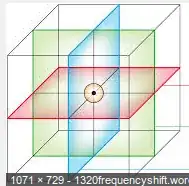
The theorems are stated purely algebraically or arithmetically (number of subgroups). Thus, I found it difficult to get geometirc intuition behind this one. However, I would say at least, that these theorems can be very nicely understood with some very concrete examples. The one I will illustrate is $S_4$.
The group $S_4$ has order $2^3.3$. Instead of thinking this group as permutation group, we can geometrically understand it in more interesting way: it is the group of rotational symmetries of cube. The cube has four diagonals, and the group of rotations of cube permutes these diagonals, which allows us to understand the group as $S_4$. What next?

Consider the rotational symmetries of cube through each diagonal: there will be three such rotations, forming a subgroup of order $3$; this is then a Sylow-$3$ subgroup. Thus, four diagonals will give four Sylow-$3$ subgroups (their cardinality is $\equiv 1(\pmod 3)$. What about conjugacy? If $\rho$ is a rotation taking diagonal $D_1$ to another diagonal $D_2$, then the rotation subgroup corresponding to $D_1$, which form Sylow-$3$ subgroup, is conjugate to the rotation subgroup corresponding to $D_2$, the conjugation is obtained by $\rho$. This proves conjugacy of Sylow-$3$ subgroups. Thus, the three Sylow theorems verified for prime $p=3$.
What about Sylow-$2$ subgroups? They also can be seen in interesting way: there are three planes which bisect cube, and are parallel or perpendicular to planes of cube. The rotations of cube which take, say blue plane to itself, form dihedral group of order $8$, and thus, three planes give three Sylow-$2$ subgroups, so they are in number $\equiv 1\pmod 2$. Since blue plane can be moved to green or red plane by some rotational symmetry of cube, this gives the conjugacy of Sylow-$2$ subgroups.