Hexagonal patterns occur in two dimensions essentially.
Consider an infinte set of points (vertices) in the plane joined by edges, forming an infinite graph.
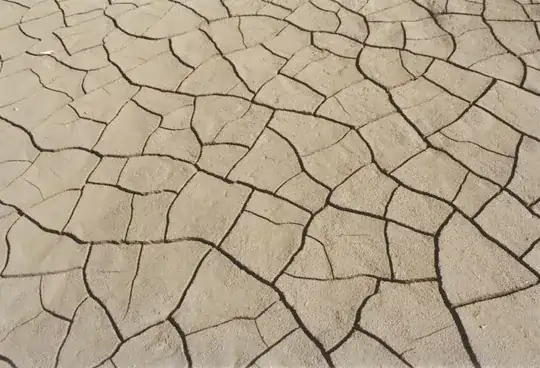
We can ignore vertices of degree 1 (dead ends) and of degree 2 (not distinguished from a point of an edge).
We can also ignore the case of degree $\ge 4$ as so many edges incident with one vertex would be highly coincidental.
Thus all vertices have degree $3$.
Now if we cut out some large but finite portion of this infinite graoh with $v$ vertices, $e$ edges and $f$ faces, then Euler says that $v+f=e+2$.
The cutting will turn about $\sqrt v$ vertices (say $c\sqrt v$ for some small $c$) into degree $2$ vertices.
By counting edge-vertex incidences, we find $3v-c\sqrt v=2e$.
The cutting produced one outer face that is a $c'\sqrt v$-gon for some small $c'\ge c$.
For $\nu=3,4,\ldots$, let $f_\nu$ be the number of $\nu$-gonal faces apart from that outer face. Then $1+\sum f_\nu=f$ and $c'\sqrt v+\sum\nu f_\nu=2e$.
Plug this into Euler to obtain
$$ 12 = 6f+6v-6e=\sum(6-\nu)f_\nu+6+(2c-c')\sqrt v.$$
Especially, $f\approx \frac12v$ as $v$ gets large and each $\nu$-gon with $\nu>6$ must be "cancelled" by a $5$-gon or lower. In fact, any $\nu>10$ requires at least two small-gons and thus should be somewhat unusual.
So even in irregular patterns (as oppoesed to honeycombs), the (irregular) hexagon is the average and (though that does not follow immediately from the above) the dominant/typical shape.

