The key insight is this picture:
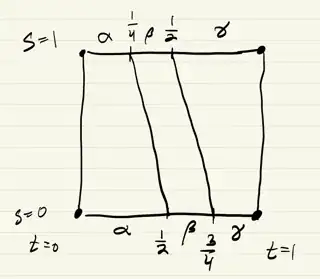
The $s=0$ part of the homotopy (the bottom edge of the square) is the path $\alpha \star (\beta \star \gamma)$, and the $s=1$ part of the homotopy (the top edge of the square) is the path $(\alpha \star \beta) \star \gamma$.
On a particular slice $s=s_*$ we have the path that squeezes $\alpha$ into the first section, $\beta$ into the second, and $\gamma$ into the third section, where these sections have lengths $\ell_1$, $\ell_2$, and $\ell_3$ as shown here:
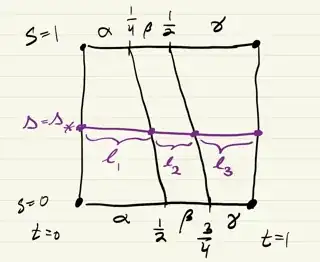
Now it's easy to see what our path should be at $s=s_*$, since we have to make $\alpha,\beta,\gamma : [0,1] \to X$
fit into intervals (respectively) $[0,\ell_1] \to X$, $[\ell_1, \ell_1 + \ell_2] \to X$, and $[\ell_1 + \ell_2, 1] \to X$. We do this by just rescaling and shifting our intervals -- for instance to get from $[\ell_1, \ell_1 + \ell_2]$ to $[0,1]$ (so we can plug into $\beta$) we first subtract off $\ell_1$ to get $[0, \ell_2]$ then we divide by $\ell_2$ to get $[0,1]$. This tells us to use $\beta(\frac{t-\ell_1}{\ell_2})$, and so in general we get a path
$$
H(s_*,t) =
\begin{cases}
\alpha(\frac{t}{\ell_1}) & t \in [0,\ell_1] \\
\beta(\frac{t-\ell_1}{\ell_2}) & t \in [\ell_1, \ell_1 + \ell_2] \\
\gamma(\frac{t - \ell_1 - \ell_2}{\ell_3}) & t \in [\ell_1 + \ell_2, 1]
\end{cases}
$$
Now all that's left is to figure out what $\ell_1, \ell_2, \ell_3$ are for any given $s$. But we know that $\ell_1$, for instance, is the $t$ coordinate on the line connecting $(s=0,t=\frac{1}{2})$ to $(s=1,t=\frac{1}{4})$, so we find the equation of this line and solve for $t$ as function of $s$ to get $\ell_1 = \frac{2-s}{4}$. We can play the same game for $\ell_2$, but it's clear from the picture that $\ell_2 = \frac{1}{4}$ is constant. Lastly we compute $\ell_3 = 1 - (\ell_1 + \ell_2)$, so that we have
- $\ell_1(s) = \frac{2-s}{4}$
- $\ell_2(s) = \frac{1}{4}$
- $\ell_3(s) = \frac{1+s}{4}$
This tells us our homotopy should be
$$
H(s_*,t) =
\begin{cases}
\alpha(\frac{t}{\frac{2-s}{4}}) & t \in [0,\frac{2-s}{4}] \\
\beta(\frac{t-\frac{2-s}{4}}{\frac{1}{4}}) & t \in [\frac{2-s}{4}, \frac{2-s}{4} + \frac{1}{4}] \\
\gamma(\frac{t - \frac{2-s}{4} - \frac{1}{4}}{\frac{1+s}{4}}) & t \in [\frac{2-s}{4} + \frac{1}{4}, 1]
\end{cases}
$$
Of course, it's easy to see that simplifying these expressions gives the homotopy you were interested in.
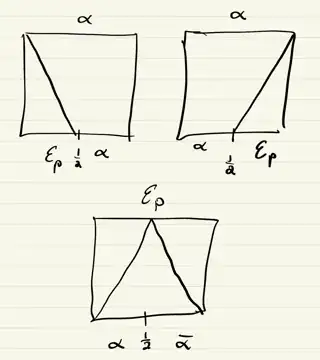
Lastly, you can use similar pictures in order to explain the other homotopies on your list. First, it might be worth trying to draw these pictures yourself, but if you get stuck I'll include them under the cut. It makes a nice exercise to use these in order to derive your other homotopies from scratch!
I hope this helps ^_^


