I am looking for an (if possible constructive) classification of those finite, simple graphs (no loops, no multi-edges), where the open neighbourhood of each vertex (excluding that vertex aka open neighbourhood) is isomorphic to $C_7$; equivalently, where the closed neighbourhood of each vertex including that 'central' vertex is isomorphic to the wheel graph $W_8$ with 7 spokes

Alternatively, theses graphs are called 'locally $C_7$ (open)'.
Is there a classification of the finite, simple graphs that are locally $C_7$ (open neighbourhood definition)?
I understand that there is some relationship to triangulations or 'polyhedral realizations' of Hurwitz surfaces (https://en.wikipedia.org/wiki/Hurwitz_surface) that exist only for certain values of the genus (https://oeis.org/A179982); which would suggest a respective infinite set of locally $C_7$ graphs.
References
- https://en.wikipedia.org/wiki/Neighbourhood_(graph_theory)
- https://mathworld.wolfram.com/LocalGraph.html
- Modern reference for 'local graphs' aka 'neighborhood regular graphs' aka 'graphs with isomorphic neighbourhood subgraph' aka 'link graphs'
- https://en.wikipedia.org/wiki/Klein_graphs#The_7-regular_Klein_graph
- https://en.wikipedia.org/wiki/Graph_automorphism
- https://arxiv.org/abs/2111.05566 for the 'combinatorial schemes' of the 2 $C_7$ graphs
- https://en.wikipedia.org/wiki/Order-7_triangular_tiling
- https://mathoverflow.net/questions/393300/algorithm-for-regular-graphs-of-tessellation-p-q
- https://en.wikipedia.org/wiki/Macbeath_surface
- https://houseofgraphs.org/graphs/52273
Examples
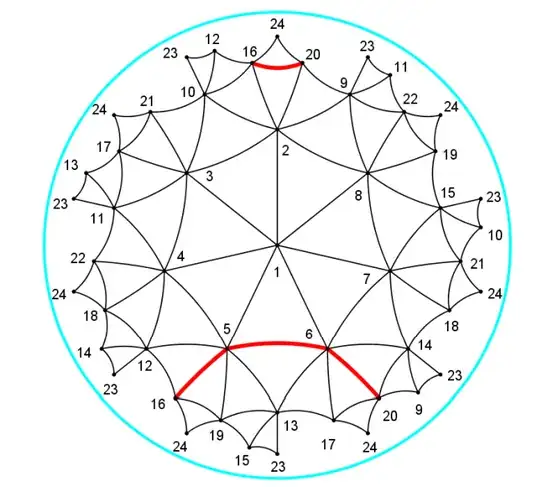
- The 7-regular Klein graph has 24 vertices and 84 edges - also see https://houseofgraphs.org/graphs/1198. The graph automorphism group has order 336 and can be embedded in the genus-3 orientable surface. One of the 'best ways looking' at the graph is embedded in an order-7 triangular tiling identifying certain vertices on the border of the disk
- The self-intersection-free, polyhedral realization of the Hurwitz surface of genus 7 aka Macbeath surface or Fricke-Macbeath surface with 72 vertices, 252, edges, 168 triangles and automorphism group of order 1008 (including orientation-reversing automorphisms) - see https://houseofgraphs.org/graphs/52273
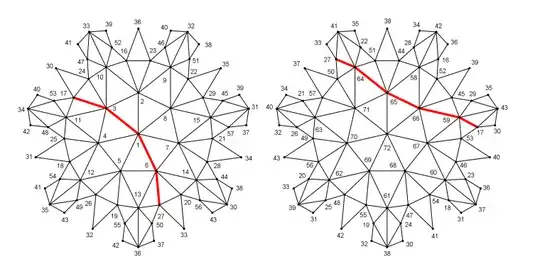


Additional example
- The paper in the reference provides a $C_7$ graph with 36 vertices, 126 edges, 84 triangles and graph automorphism group of order 7. The genus is unknown.
Here the 'high dimensional embedding'
Graph[ImportString[">>graph6<<cvjCSLgUI@G`GG?Ie?@?DCC?O?gO_??_SI?A@OP?GGO?_Cb?BCO?AO_?@@HW?EH_?_c???AA`WA@aC?E@?GS?CKgO?OOsO_CG`CP???@lg\n", "Graph6"], GraphLayout->"HighDimensionalEmbedding"]
This example suggests that there are many more locally $C_7$ graphs - just not maximizing the automorphism group order for a given genus (the ones maximizing are the Hurwitz surfaces - examples 1 and 2 above).
References
- Chi-Feng Chan. Hung-Lin Fu. Chao-Fang Li. "Graphs with Isomorphic Neighbor-subgraphs." Taiwanese J. Math. 15 (3) 1171 - 1182, 2011. https://doi.org/10.11650/twjm/1500406293
- https://houseofgraphs.org/graphs/53180


