1

A line through one of the vertices of a triangle is "special" if it cuts this triangle into equal perimeters. Prove that the special lines of triangle $\triangle ABC$ meet at one point.

This is true if they also cut the area in half. This is because all of the lines would intersect the incenter and so would all meet at the incenter. Is there a way to modify this proof for any area?

Blue
  • 83,939
  • 2
    Have you heard of https://en.wikipedia.org/wiki/Ceva%27s_theorem? – Joshua Wang Mar 29 '25 at 06:56
  • 1
    If you have a wire frame triangle, does it have a center of mass? – RobinSparrow Mar 29 '25 at 06:58
  • @Joshua Wang you could elaborate to an answer. This question is already answered by Ceva's Theorem's converse. – theREALyumdub Mar 29 '25 at 07:00
  • 3
    Thinking about where the incircle meets the sides of the triangle helps. – Blue Mar 29 '25 at 07:04
  • @Blue Actually the three excircles meet the sides of the triangle at the feet of these “special lines”. – YNK Mar 30 '25 at 16:51
  • @RobinSparrow The center of the wire frame triangle, which is known as the $X_{10} : Spieker\space Center$, has nothing to do with the meeting point of these three “special lines”. This particular point is called $X_8 : Nagel\space Point$. – YNK Mar 30 '25 at 17:01
  • @YNK: "Actually the three excircles meet the sides of the triangle at the feet of these “special lines”" Indeed! (In this old answer, I note that the points of tangency with the excircles are perimeter-bisecting points.) It just seemed like thinking in terms of the incircle might be slightly more accessible. – Blue Mar 30 '25 at 17:02
  • @Blue I agree with you – YNK Mar 30 '25 at 17:05
  • @YNK: nothing to do might be a bit strong, the Spieker center is where such lines meet when they issue from the midpoints of the sides, the Nagel point when issuing from the vertices... I misremembered in making the comment. – RobinSparrow Mar 30 '25 at 20:53
  • @RobinSparrow I am sorry if my comment hurts your feelings. Thanks for explaining what led you to mention Spieker Center in your previous comment. – YNK Mar 31 '25 at 15:57
  • @YNK: thanks but no harm done! These "special lines" have names, btw, splitters (from vertices) and cleavers (from midpoints). – RobinSparrow Mar 31 '25 at 16:01

2 Answers2

1

enter image description here

Let $BC = a$, $AC = b$, $AB=c$.

The special line through $A$ meets $BC$ at $D$.
Perimeter of $\triangle ABD = AB + BD + DA = c + BD + AD$.
Perimeter of $\triangle ADC = AD + DC + CA = AD + DC + b$

Since the lines bisect the perimeter, we have,
$c+BD = BC + b$

Also, $BC=a=BD + DC$. So, let $BD=x$
We can write $DC = a-x$
$c+x=(a-x)+b$
$x=\dfrac{a+b-c}{2}$

We can also write $BD = \dfrac{a+b-c}{2}$ and $DC = \dfrac{a-b+c}{2}$.

Special line through $B$ touches $AC$ at $E$.
Perimeter of $\triangle ABE = AB + BE + EA = c + BE + EA$
Perimeter of $\triangle BCE = BC + CE + EB = a + CE + BE$

$c + AE = a + CE$.

Let $AE=y$, so, $CE=b-y$.
$c+y=a+b-y$
$y = \dfrac{a+b-c}{2}$.

So, $AE = \dfrac{a+b-c}{2}$, $CE = \dfrac{b+c-a}{2}$

Following this procedure, we have,
$AF = \dfrac{a+c-b}{2}$, $FB = \dfrac{c+b-a}{2}$

From Ceva's theorem we can prove that these lines are concurrent if, $\dfrac{BD}{Dc}. \dfrac{CE}{EA}. \dfrac{AF}{FB} = 1$.

The LHS is $$ \dfrac{a+b-c}{a-b+c}.\dfrac{b+c-a}{a+b-c}.\dfrac{a+c-b}{c+b-a} $$ You should be able to notice that every term has it's pair and indeed the left-hand side evaluates out to $1$.

Thus, it is evident that these "special lines" are concurrent

However, your proof is not clear to me. It doesn't seem the area also has to be bisected by these special lines. A median bisects the area into two and they meet at the centroid. However, it is true that the lines meet at the incentre.

1

Let the incircle of $\triangle ABC$ meet the sides at points $A'$, $B'$, $C'$ (with $A$ opposite $A'$, etc). Tangent segments being congruent, we can define lengths $a$, $b$, $c$ where $$a := |AB'|=|AC'| \qquad b := |BC'| = |BA'| \qquad c := |CA'| = |CB'|$$
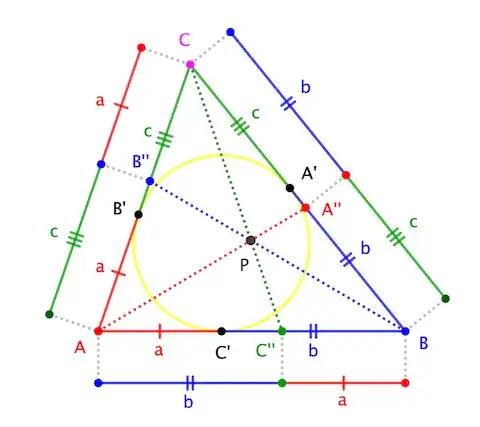
Triangle ABC with incircle meeting the sides at A', B', C'

Swapping the sub-segments on each side determines points $A''$, $B''$, $C''$ such that paths along the boundary from $A$ to $A''$, from $B$ to $B''$, and from $C$ to $C''$ each has length $a+b+c$: the new points are the desired perimeter-bisecting points.

Invoking Ceva's Theorem, we find

$$\frac{|A''C|}{|BA''|} \cdot \frac{|B''A|}{|CB''|} \cdot \frac{|C''B|}{|AC''|} = \frac{c}{b} \cdot \frac{a}{c} \cdot \frac{b}{a} = 1$$

guaranteeing that cevians $AA''$, $BB''$, $CC''$ meet at a point. $\square$


Note. The argument is effectively the same as that of @RandomMathEnthusiast. RME's values $\frac12(-a+b+c)$, $\frac12(a-b+c)$, $\frac12(a+b-c)$ are precisely the lengths of the incircle-tangent segments when the sides of the triangle are $a$, $b$, $c$, but obtained algebraically.

Note 2. YNK notes in a comment to the question that $A''$, $B''$, $C''$ are points of tangency with the triangle's excircles. This old answer of mine provides a justification of this fact.

Note 3. YNK indicates in a comment this answer that the point of concurrence is the Nagel point, indexed as $X_8$ in the Encyclopedia of Triangle Centers.

As it happens, cevians $AA'$, $BB'$, $CC'$ also concur, at the Gergonne point, aka $X_7$ in the ETC.

The fact that $A'$ and $A''$ (likewise, $B'$ and $B''$, and $C'$ and $C''$) are mutual reflections in the midpoint of the side of the triangle makes $X_7$ and $X_8$ "isotomic conjugates".

Blue
  • 83,939
  • These three cevians meet at the triangle center called $X_8 : Nagel\space Point$. – YNK Mar 30 '25 at 16:52
  • @YNK: Ah, yes. Thanks! I'd considered adding a bit of triangle-center lore to the answer, but "Nagel point" wasn't on the tip of my brain and I didn't want to look it up. :) I've added a couple more Notes to my answer, incorporating info from your comments. Thanks, again! – Blue Mar 30 '25 at 17:36