Given $n=3$ points with coordinates $(x_i,y_i)$ you can find the parameters $(a,b,r)$ of the circle such that $$ (x-a)^2 +(y-b)^2 = r^2 $$ is the equation of the circle.
use https://math.stackexchange.com/a/213670/3301 for one of the ways to get the center and radius of a circle from 3 points.
There are $10$ combinations to consider given that the order isn't important of which three points are to be included at a time
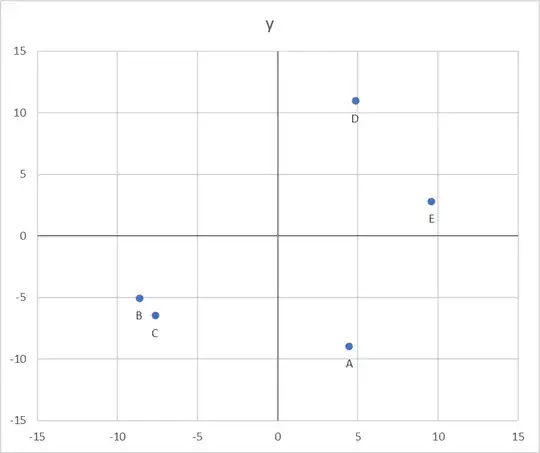
In the example below I have labeled the 5 points as $A,B,C,D,E$ and made $D$ the bad one
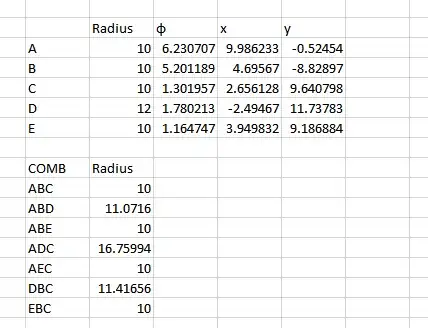
As pointed out in the comments, I only tested for 7 combinations instead of the full 10, missing the ADE, BDE, and CDE rows. The process is the same though.
As you can see, the three results that give the same result for radius do not contain the bad point. So the other three $ABD$, $ADC$ and $DBC$ above have point D in common and hence it is the bad one.
Here is the VBA function that calculates the radius of a circle from three points
Public Function CalcRadiusFromThreePoints(ByRef rng_A As Range, ByRef rng_B As Range, ByRef rng_C As Range) As Variant
    Dim A() As Variant, B() As Variant, C() As Variant, R As Variant
    Dim D As Variant, KX As Variant, KY As Variant, cx As Variant, cy As Variant
    A = rng_A.Value
    B = rng_B.Value
    C = rng_C.Value
D = A(1, 1) * (B(1, 2) - C(1, 2)) + B(1, 1) * (C(1, 2) - A(1, 2)) + C(1, 1) * (A(1, 2) - B(1, 2))


KX = (-(A(1, 1) ^ 2) + (B(1, 1) ^ 2) - (A(1, 2) ^ 2) + (B(1, 2) ^ 2)) / 2#
KY = (-(B(1, 1) ^ 2) + (C(1, 1) ^ 2) - (B(1, 2) ^ 2) + (C(1, 2) ^ 2)) / 2#


cx = -(KX * (B(1, 2) - C(1, 2)) + KY * (B(1, 2) - A(1, 2))) / D
cy = -(KX * (B(1, 1) - C(1, 1)) + KY * (B(1, 1) - A(1, 1))) / D


R = Sqr((A(1, 1) - cx) ^ 2 + (A(1, 2) - cy) ^ 2)


CalcRadiusFromThreePoints = R


End Function
and it is used with three arguments, each being a range of 1×2 cells for the (x,y) coordinates of a point.
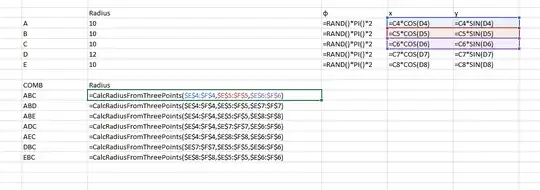
and here is an example of 5 points, of which point D has a radius of $12$, and all the other ones have a radius of $10$, and are randomly placed somewhere around the circle.