If you ask Wolfram to convert your target rate of: $$0.2312076819339227309219662514224185$$ to continued fractions it returns a series of partial quotients $a_i$: $$[0, 4, 3, 13, 5, 3, 9, 2, 1, 2, 1, 5, 1, 1, 10, 1, 5, 1, 1, 1, 2, 1, 5, 1, 1, 11, 3, 10, 4, 3...]$$ and if you then ask for the convergents $\frac{p_i}{q_i}$ derived from this series we obtain a series of fractions $$[\frac{0}{1}, \frac{1}{4},\frac{3}{13},\frac{40}{173}...]$$ and assuming you require $p+q<4200000000$ you could take later terms like the $21$st: $$\frac{715427443}{3094306543}$$ which will deviate from your desired value by less than $$\frac{1}{3094306543^2}$$ which I believe should already be sufficient as it is near $10^{-20}$.
Edit 1: to show commands and the list of fractions:
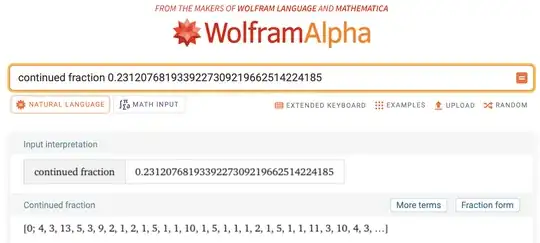
And in the list below, the one I reference is the 21st, neglecting the leading term of zero.
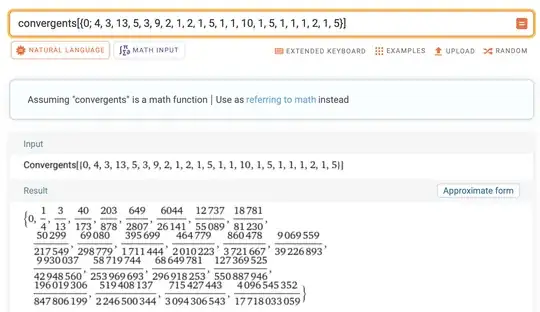
Edit 2: to describe CF algorithm for convergents for OP.
Given a sequence of partial quotients $a_i$ we obtain convergents with numerators $p_i$ and denominators $q_i$ via the recurrence relation $p_i=a_ip_{i-1}+p_{i-2}$ and similarly for $q_i$ with initiating terms $p_{-1}=0, p_0=1,q_{-1}=1,q_o=0$.
$p_1=a_1p_0+p_{-1}=a_1\times1+0=a_1$
$p_2=a_2p_1+p_0=a_2a_1+1$, etc.
Concretely, with $a_i:[0,4,3,13,5,...]:\\
p_1=0 \times 1 + 0 = 0\\
p_2=4 \times 0 + 1 = 1\\
p_3=3 \times 1 + 0 = 3\\
p_4=13 \times 3 + 1 = 40\\
p_5=5 \times 40 + 3 = 203$
And you should see how this matches the first several numerators output by WA in the screenshot above. The theory of how this works is not hard, the gentlest introduction I know of is Continued Fractions by CD Olds, targeting a high school audience.
Edit 3:
I see from further comments some confusion remained. And that I neglected to mention in my answer the key point I made in the comments. The key to immediately choosing the right fraction to represent your target with desired precision is that fractions produced by continued fractions (i.e., convergents) come with a guarantee that the error of a convergent $\frac{p_i}{q_i}$ is bounded above by $\frac{1}{q_i^2}$.
The initial rate and target rate are represented as decimals then continued fractions below:
$
0.23120\ 76819\ 33922\ 75902\ 33670\ 63832\ 52993\ 86033\ 24579\ 86759 \\
0.23120\ 76819\ 33922\ 73092\ 19662\ 51422\ 4185 \\
[0; 4, 3, 13, 5, 3, 9, 2, 1, 2, 1, 5, 1, 1, 10, 1, 9] \\
[0; 4, 3, 13, 5, 3, 9, 2, 1, 2, 1, 5, 1, 1, 10, 1, 5, 1, 1, 1, 2, 1, 5, 1, 1, 11, 3, 10, 4, 3,...]
$
These begin diverging at the 17th decimal place, and (coincidentally) the 17th partial quotient in continued fraction form.
Taking the continued fraction form, if we adjust the original 9 to a target 5 we obtain $\frac{p_{17}}{q_{17}}=\frac{58719744}{253969693}$ as the "best" adjustment of the original fraction. However, this only agrees to the 16th decimal place, not the requested 18th:
$
0.23120\ 76819\ 33922\ 73092\ 19662\ 51422\ 4185 \\
0.23120\ 76819\ 33922\ 72203\ 12464\ 60577
$
Which is sensible since the error is bounded by $\frac{1}{253969693^2} \approx 10^{-17}$. We must take the convergents further to obtain the needed precision, sequentially the next several yield the following decimals (target at top)
$
0.23120\ 76819\ 33922\ 73092\ 19662\ 51422\ 4185 \\
0.23120\ 76819\ 33922\ 73529\ 23971\ 29927 \\
0.23120\ 76819\ 33922\ 72917\ 87575\ 25401 \\
0.23120\ 76819\ 33922\ 73131\ 98732\ 57968 \\
0.23120\ 76819\ 33922\ 73079\ 48277\ 79470 \\
0.23120\ 76819\ 33922\ 73093\ 86845\ 06411 \\
$
These last two, accurate to the 18th place, correspond to $\frac{519408137}{2246500344},\frac{715427443}{3094306543}$, the latter being the one I mentioned initially in my answer. Both have terms summing to less than the needed size, and bounds on error of $\frac{1}{q_i^2} < 2*10^{-19}$, whereas all prior terms have bounds $>10^{-18}$, which is why none of them were satisfactory. The key is $\frac{1}{q_i^2}$.


