1

I am in the process of finding a general solution for this integral:

$$ \int_0^\infty \!\! \frac{1}{x^n+1} \, dx $$ with $n\in \Bbb R$ such that $n>1$ using contour integration over the slice contour with angle $\tfrac{2\pi}{n}$.

For $n>1.5$, there is no problem, as there is only one pole at $$ e^{\frac{\pi i}{n}}, $$ but if $n \leq 1.5$, then suddenly there is also a pole at its conjugate with the same residue as the previous.

This leads me to the integral being $$ \frac{2\pi i (-1)^\frac{1}{n}}{n(e^\frac{2\pi i}{n}-1)} $$ for $n>1.5$, which is correct, but for $n \leq 1.5$, it gives two times the desired result. Why does this happen?

R. Reed
  • 355
  • 1
    @RDK Question is clearly different. – R. Reed Dec 05 '24 at 00:04
  • Is $n$ a real number? – Turquoise Tilt Dec 05 '24 at 00:23
  • @TurquoiseTilt Yep – R. Reed Dec 05 '24 at 00:23
  • You can try checking here – Turquoise Tilt Dec 05 '24 at 00:24
  • @TurquoiseTilt I do know that there are other ways to evaluate this, but I'm wondering why this specifically doesn't work. – R. Reed Dec 05 '24 at 00:27
  • 1
    If $n$ is not a real number then please use a different letter like $r$ or $b.$ You don't have to, but $n$ is normally used for integers, so the question will unnecessarily confuse some readers. – Adam Rubinson Dec 05 '24 at 00:42
  • 1
    How many singularities you have inside your "pizza slice" for each $n\in \Bbb R$ only one should fall inside the slice from $0 \to 2\pi/n$ – Turquoise Tilt Dec 05 '24 at 00:45
  • @TurquoiseTilt Consider n=1.3. There is a singularity at $e^\frac{-i\pi}{1.3}$, which is inside the contour, no? – R. Reed Dec 05 '24 at 00:48
  • $e^\frac{-i\pi}{1.3}$ is below the real axis. Proper contour for this integration is the pizza slice starting from the real axis up to an angle equal to $2\pi/n$ so $e^\frac{i\pi}{1.3}$ is inside, $e^\frac{-i\pi}{1.3}$ is outside. Is this the doubt you're having? – Turquoise Tilt Dec 05 '24 at 00:54
  • @TurquoiseTilt I know it's below the real axis, but the pizza slice has angle $2\pi/n$ - surely for n<2 this includes a section from below the real axis. And when n<1.5, we have the pole inside it, no? – R. Reed Dec 05 '24 at 00:57
  • 2
    I suggest changing the title of the post to reflect the actual question, which is about resolving an apparent contradiction with the Residue Theorem and not just about computing the integral in question, the latter of which has been asked many times on this site, to help avoid closure as a duplicate. – Travis Willse Dec 05 '24 at 02:49

2 Answers2

4

When the exponent $\alpha$ is not an integer, defining $z^\alpha$ requires a choice: Explicitly, we pick a branch $\log$ of the logarithm and define $z^\alpha := \exp (\alpha \log z)$. For some choices the contour intersects the branch cut, in which case the Residue Theorem does not apply.

The integrand $\frac{1}{z^\alpha + 1}$ has a branch cut $\mathcal B$ where our choice of logarithm does, and its poles will be at the solutions of $\exp (\alpha \log z) = -1$, i.e., where $\alpha \log z = \pi i \ell$ for some odd integer $\ell$ (except of course for those solutions that lie on the branch cut itself).

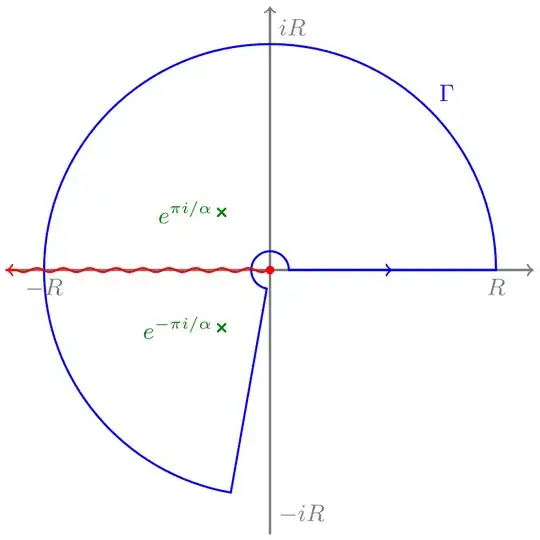
If we take the most common choice of $\log$, whose imaginary part takes values in, say, $(-\pi, \pi)$, then the integrand $\frac{1}{z^\alpha + 1}$ has a branch cut $\mathcal B$ along the negative real axis and has poles at $z = \exp \frac{\pi i \ell}\alpha$, where $\ell$ is an odd integer in $(-\alpha, \alpha)$. If $\alpha > 2$, then the slice contour $\Gamma$ (with its clockwisemost side along the positive real axis) is contained entirely inside the open, simply connected set $\Bbb C \setminus \mathcal B$ on which the integrand is meromorphic, and the Residue Theorem applies. If $\alpha \in (1, 2]$, however, then $\Gamma$ intersects $\mathcal B$ and the Residue Theorem does not apply.

Illustration: The case $\alpha \in \left(1, \frac32\right)$, wherein the contour encloses $2$ poles, with the most common choice of $\log$ A slice contour not qualifying for the Residue Theorem
To resolve this issue, we simply choose $\log$ so that its branch cut doesn't intersect $\Gamma$, e.g., the one whose imaginary part takes values in $(-\epsilon, 2 \pi - \epsilon)$, where $\epsilon > 0$ is chosen small enough to avoid intersection, so that the Residue Theorem applies.

Illustration: A choice of branch cut for which the Residue Theorem can be applied enter image description here
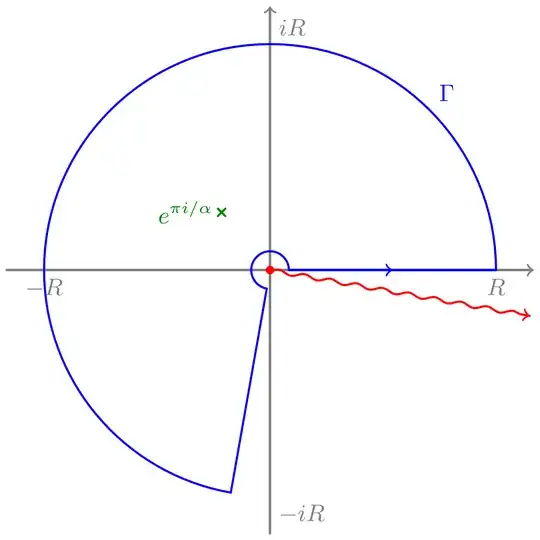
For such a choice of $\log$, $\Gamma$ encloses only a single pole, at $\exp \frac{\pi i}\alpha$, hence the Residue Theorem gives for all $\alpha > 1$ that $$\oint_\Gamma \frac{dz}{z^\alpha + 1} = 2 \pi i \operatorname{Res}\left(\frac{1}{z^\alpha + 1}; \exp \frac{\pi i}\alpha\right) = -\frac{2 \pi i}\alpha \exp \frac{\pi i}{\alpha} ,$$ which leads to the usual formula, $$\int_0^\infty \frac{dx}{x^\alpha + 1} = \frac\pi \alpha \csc \frac\pi\alpha .$$

Travis Willse
  • 108,056
  • Thank you! So essentially to avoid the branch cut I can only consider values between $0$ and $e^{2\pi i}$, unless I'm misinterpreting? – R. Reed Dec 05 '24 at 08:11
  • 1
    The idea is that you can choose both the contour and the branch cut, but you'll want to make sure they don't intersect, so that you can apply the Residue Theorem. Often when you're evaluating an integral on $[0, \infty)$ with a single branch point at $0$, it's convenient to pick a branch along or just below the positive real axis, which amounts to choosing the logarithm to have imaginary part in $(-\epsilon, 2 \pi - \epsilon)$. – Travis Willse Dec 05 '24 at 19:52
1

Your proposed complex conjugate pole does not exist, so the sum of residues actually never changes (except for the variation from the $\exp(i\pi/n)$ pole).

For all nonintegral $n$ the function $f(z)=1/(z^n+1)$ has a branch cut going from $0$ to $\infty$. For the integration with the Residue Theorem to be valid we must have the branch cut outside the contour.

For all $n>1$ this may be accomplished by running the branch cut infinitesimally below the positive real axis. But then we do not have conjugate symmetry; that is we do not have $f(\overline{z})=\overline{f(z)}$. We would have this equality if instead the branch cut were along the negative real axis, but that invalidates the integration for $n<2$ and the complex conjugate does not enter the contour interior for $n\ge2$.

Lacking conjugate symmetry with the proper branch cut means $z^n=-1$ when $z=\exp(i\pi/n)$, but $z^n\not=-1$ when $z=\overline{\exp(i\pi/n)}$. So $f(z)=1/(z^n+1)$ is not singular at the latter point; the proposed complex conjugate pole is not really there.

As an aside, you write $(-1)^{1/n}$ in the numerator. You should use $\exp(i\pi/n)$ instead; it's more precise.

Oscar Lanzi
  • 48,208