Yes, it's true!
Let $x = \frac{1}{1+e^u}$ so that $dx = -\frac{1}{2\cosh u+2}\,du$. Then
$$
\begin{align}
\mathcal{I} &:= \int_{0}^{1}x^{2}\sin\left(\pi x\right)x^{x}\left(1-x\right)^{1-x}\,dx \\
&= \int_{\mathbb{R}}\left(\frac{1}{e^{u}+1}\right)^{2}\sin\left(\frac{\pi}{e^{u}+1}\right)\left(\frac{1}{e^{u}+1}\right)^{\frac{1}{e^{u}+1}}\left(1-\frac{1}{e^{u}+1}\right)^{1-\frac{1}{e^{u}+1}}\frac{1}{2\cosh u+2}\,du \\
&= \int_{\mathbb{R}}\frac{e^{2u}}{\left(1+e^{u}\right)^{5}}\sin\left(\frac{\pi}{e^{u}+1}\right)\exp\left(-\frac{u}{e^{u}+1}\right)\,du \\
&= \Im\int_{\mathbb{R}}\frac{e^{2u}}{\left(1+e^{u}\right)^{5}}\exp\left(\frac{i\pi-u}{e^{u}+1}\right)\,du\,.
\end{align}
$$
Define a holomorphic function $f: \mathbb{C}\,\setminus \left\{(2k+1)\pi i:k\in\mathbb{Z}\right\} \longrightarrow \mathbb{C}$ where $z \mapsto \frac{e^{2z}}{\left(1+e^{z}\right)^{5}}\exp\left(\frac{i\pi-z}{1+e^{z}}\right)$. We also construct a counterclockwise contour in the shape of a rectangle $C = [-R,R]\cup\Lambda_1\cup\Lambda_2\cup\Lambda_3$, where
$$
\begin{align}
\Lambda_1 &= \left\{R+it\in\mathbb{C}:t\in[0,2\pi]\right\} \\
\Lambda_2 &= \left\{2\pi i-t\in\mathbb{C}:t\in[-R,R]\right\} \\
\Lambda_3 &= \left\{-R-it\in\mathbb{C}:t\in[-2\pi,0]\right\}\,. \\
\end{align}
$$
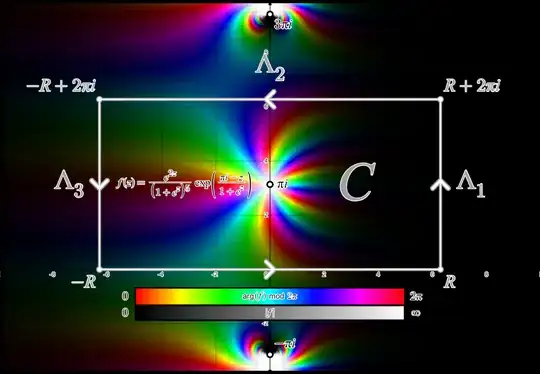
Feel free to click this link for an animation of what traveling around the contour looks like, using Desmos's new October 2024 update featuring complex numbers. Below is a visual of the contour with RGB domain coloring and shading.
$$\text{Figure 1: Rectangular Contour $C$ Traveling Positively}$$
We write the contour integral over $C$ as the sum of integrals
$$
\oint_{C}f = \int_{-R}^R f + \int_{\Lambda_1}f + \int_{\Lambda_2}f + \int_{\Lambda_3}f\,.
$$
We equate the imaginary part on both sides and apply $R \to \infty$ as
$$
\lim_{R\to\infty}\Im\oint_{C}f = \mathcal{I} +\lim_{R\to\infty}\Im\int_{\Lambda_1}f + \lim_{R\to\infty}\Im\int_{\Lambda_2}f + \lim_{R\to\infty}\Im\int_{\Lambda_3}f\,.
$$
First, we will evaluate the integral over $\Lambda_1$ as $R \to \infty$. Bounding the modulus of the integral, we use the Triangle Inequalities and the equation $\left|e^w\right| = e^{\Re w}$ for all $w \in \mathbb{C}$ to get
$$
\begin{align}
\left|\Im\int_{\Lambda_1}f(z)\,dz\right| &\leq \left|\int_{\Lambda_1}f(z)\,dz\right| \\
&\overset{t\in\Lambda_1}=\left|\int_{0}^{2\pi}f(R+it)i\,dt\right| \\
&=\left|\int_{0}^{2\pi}\frac{e^{2\left(R+it\right)}}{\left(1+e^{R+it}\right)^{5}}\exp\left(\frac{i\pi-\left(R+it\right)}{1+e^{R+it}}\right)\,dt\right| \\
&\leq \int_{0}^{2\pi}\left|\frac{e^{2\left(R+it\right)}}{\left(1+e^{R+it}\right)^{5}}\exp\left(\frac{i\pi-\left(R+it\right)}{1+e^{R+it}}\right)\right|\,dt \\
&\leq \int_{0}^{2\pi}\frac{e^{2R}}{\left(e^{R}-1\right)^{5}}\exp\left(\Re\left(\frac{i\pi-R-it}{1+e^{R}e^{it}}\right)\right)\,dt \\
&= \int_{0}^{2\pi}\frac{e^{2R}}{\left(e^{R}-1\right)^{5}}\exp\left(\frac{e^{R}t\sin t+\pi e^{R}\sin t-Re^{R}\cos t-R}{e^{2R}+2e^{R}\cos t+1}\right)\,dt\,.
\end{align}
$$
We have the inequality
$$
0\leq\left|\Im\int_{\Lambda_1}f(z)\,dz\right|\leq\int_{0}^{2\pi}\frac{e^{2R}}{\left(e^{R}-1\right)^{5}}\exp\left(\frac{e^{R}t\sin t+\pi e^{R}\sin t-Re^{R}\cos t-R}{e^{2R}+2e^{R}\cos t+1}\right)\,dt\,.
$$
Notice that
$$
\lim_{R\to\infty}\int_{0}^{2\pi}\frac{e^{2R}}{\left(e^{R}-1\right)^{5}}\exp\left(\frac{e^{R}t\sin t+\pi e^{R}\sin t-Re^{R}\cos t-R}{e^{2R}+2e^{R}\cos t+1}\right)\,dt\, = \int_{0}^{2\pi}0\cdot\exp\left(0\right)\,dt = 0\,.
$$
Using the Squeeze Theorem, we get
$$
\lim_{R\to\infty}\left|\Im\int_{\Lambda_1}f(z)\,dz\right| = 0
$$
which implies
$$
\lim_{R\to\infty}\Im\int_{\Lambda_1}f(z)\,dz = 0\,.
$$
The integral over $\Lambda_3$ follows a similar but more tedious procedure. I'll leave it up to you to evaluate it.
Next, we recover the desired integral $\mathcal{I}$ by manipulating the integral over $\Lambda_2$ like
$$
\begin{align}
\int_{\Lambda_2}f(z)\,dz &\overset{t\in\Lambda_2}=\int_{-R}^Rf(-t+2\pi i)(-1)\,dt \\
&\overset{-t=x}= \int_{R}^{-R}f(x+2\pi i)\,dx \\
&= -\int_{-R}^{R}\frac{e^{2\left(x+2\pi i\right)}}{\left(1+e^{x+2\pi i}\right)^{5}}\exp\left(\frac{i\pi-\left(x+2\pi i\right)}{e^{x+2\pi i}+1}\right)\,dx \\
&= -\int_{-R}^{R}\frac{e^{2x}}{\left(1+e^{x}\right)^{5}}\exp\left(-\frac{x}{e^{x}+1}\right)\exp\left(-\frac{\pi i}{e^{x}+1}\right)\,dx\,. \\
\end{align}
$$
Equating the imaginary part and applying $R \to \infty$ on both sides, we get
$$
\lim_{R\to\infty}\Im\int_{\Lambda_2}f(z)\,dz = -\lim_{R\to\infty}\int_{-R}^{R}\frac{e^{2x}}{\left(1+e^{x}\right)^{5}}\exp\left(-\frac{x}{e^{x}+1}\right)\sin\left(-\frac{\pi}{e^{x}+1}\right)\,dx = \mathcal{I}\,.
$$
Next, we evaluate the integral over the entire contour using the Residue Theorem. First, there is a fifth-order pole at $z=\pi i$ (the rainbow hue in the screenshot "goes around" five times for lack of a better term) and essential singularities at $z = (2k+1)\pi i$ for all integers $k$ besides $k=0$. Regarding the fifth-order pole, we can redefine $\frac{i\pi-z}{1+e^z}$ as its power series representation
$$
\frac{i\pi-z}{1+e^z} = \sum_{n=0}^{\infty}\frac{B_n}{n!}(z-i\pi)^n = 1-\frac{1}{2}\left(z-i\pi\right)+\frac{1}{12}\left(z-i\pi\right)^{2}-\frac{1}{720}\left(z-i\pi\right)^{4}+\mathcal{O}\left(\left(z-i\pi\right)^{6}\right)\,,
$$
where $B_n$ is the $n$th Bernoulli number. Using this, we see that plugging in $i\pi$ into $\frac{1}{f}$ yields
$$
\frac{1}{f(i\pi)} = \frac{\left(1+e^{i\pi}\right)^{5}}{e^{2\left(i\pi\right)}\exp\left(1-\frac{1}{2}\left(i\pi-i\pi\right)+\frac{1}{12}\left(i\pi-i\pi\right)^{2}-\frac{1}{720}\left(i\pi-i\pi\right)^{4}+\mathcal{O}\left(\left(i\pi-i\pi\right)^{6}\right)\right)} = 0\,,
$$
which makes $z=i\pi$ a fifth-order pole of $f$. Though it's technically possible to use the Residue at Multiple Pole Theorem to evaluate the residue at $z = i\pi$, it would be so much differentiating and calculating. Instead, I decided to go with WolframAlpha's Laurent asymptotic series representation of $f$ and find the coefficient of $\frac{1}{z-i\pi}$ from the series:
$$
f(z) = -\frac{e}{\left(z-i\pi\right)^{5}}+\frac{e}{\left(z-i\pi\right)^{4}}-\frac{3e}{8\left(z-i\pi\right)^{3}}+\frac{e}{24\left(z-i\pi\right)^{2}}+\frac{73e}{5760\left(z-i\pi\right)}-\frac{5e}{1152}+\frac{299e\left(z-i\pi\right)}{2903040}+\frac{89e\left(z-i\pi\right)^{2}}{580608}-\frac{9949e\left(z-i\pi\right)^{3}}{464486400}+\mathcal{O}\left(\left(z-i\pi\right)^{4}\right)\,.
$$
By Cauchy's Residue Theorem, we get
$$
\oint_{C}f(z)\,dz = 2\pi i\mathop{\mathrm{Res}}_{z=i\pi}f(z) = \frac{146\pi ei}{5760}\,.
$$
Gathering all of the results together, we have
$$
\require{cancel}{\lim_{R\to\infty}\Im \frac{146\pi ei}{5760} = \mathcal{I} + \cancelto{0}{\lim_{R\to\infty}\Im\int_{\Lambda_1}f} + \mathcal{I} + \cancelto{0}{\lim_{R\to\infty}\Im\int_{\Lambda_3}f}}\,.
$$
We end with
$$
\bbox[13px,#f1ffff ,border:5px double #a300ab ]{\int_{0}^{1}x^{2}\sin\left(\pi x\right)x^{x}\left(1-x\right)^{1-x}dx=\frac{73\pi e}{5760}}
$$
and we're done! :)


$I(f)=\int_{0}^{1} f(x) F(x)dx$
$I(1)=\frac{\pi e}{24}$
$F$ is invariant under the King property, but $f$ need not be, giving $I(f(x))=I(f(1-x))$. Using this
$I(x)=\frac{1}{2}I(1)$
$I(x^{3})=\frac{3}{2}I(x^{2})-\frac{1}{4}I(1)$
That didn't work. $I(x^{4})$ just tells us what we know, and $I(x^{a\geq5})$ introduces new integrals to deal with. I can't see a way to manipulate it to get $I(x^{2})=\frac{73}{240}I(1)$
– Darmani V Oct 09 '24 at 18:24