11

Is there a closed form expression to represent the function obtained by taking nested repeating sums of alternating sin and cos functions?

Something looking like this:

$$\sin(x +\cos(x + \sin(x + \cos(x + \cdots))))$$

I guess it could be defined this way:

$$L(x)=\sin(x+\cos(x+L(x)))$$

I have plotted several iterations of the function here: enter image description here https://www.desmos.com/calculator/h2aj27gveg

Although you can't algebraically solve for it using that definition, maybe there's some other clever way to get to a closed form expression I'm overlooking.

If there's not a closed form solution, is there a name for the numerical approximation of this function? It looks like it converges based on the graphs.

HackR
  • 3,940

2 Answers2

5

If the iterations $$y_{n+1}=\sin(x+\cos(x+y_{n}))$$

converge, they converge to some $y$ that satisfies

$$y=\sin(x+\cos(x+y)).$$

This is the implicit equation of the curve.

enter image description here

There is no analytical expression of $y(x)$ nor $x(y)$ as the equation is highly transcendental.

For rigor, analysis of pointwise convergence using the fixed-point theorem should be carried out. It seems that given the contracting nature of the sine and cosine, convergence is granted everywhere.


You can get faster convergence by using Newton's iterations instead of simple fixed-point. You obtain the value of the derivative of $y$ by implicit derivation.

  • 1
    I don't think this question is about function iteration, even though the OP uses that word. – Ethan Bolker Sep 25 '24 at 19:44
  • 1
    @EthanBolker: on second thoughts, this process is the iteration of a parametric function $f(y;x)$, $y_{n+1}=\sin(x+\cos(x+y_{n})$, so that $y$ is implicitly defined by $y=\sin(x+\cos(x+y))$. Thus my first answer was wrong. –  Sep 25 '24 at 19:56
  • @YvesDoust How fast would Newton’s method convergence be? – Тyma Gaidash Nov 18 '24 at 19:53
1

There is almost likely no closed form. However, to find the Fourier series for $y=L(x)$ in $y=\sin(x+\cos(x+y))$, substitute $y=\frac\pi2-w-x$, set $x=a$, and subtract $\sin(a)$ so the curve passes through $(\pm\pi,\pm\pi)$:

$$f(w)=\sin(\sin(w)+a)+w-\sin(a)=\frac\pi2-x-\sin(a)$$

Setting up the Fourier series for $g(x)=f^{-1}(x)$, substituting $g(t)\to t$, and integrating by parts gives:

$$g(x)=\sum_{n\in\Bbb Z}a_n e^{i nx},a_n=\frac1{2\pi}\int_{-\pi}^\pi g(t)e^{-i nt}dt=\frac in\cos(\pi n)-\frac in\int_{-\pi}^\pi e^{-inf(t)}dt$$

One extracts $a_0=\frac1{2\pi}\int_{-\pi}^\pi t df(t)=\lim\limits_{n\to0}a_n $ becoming $\sin(a)-\frac1{2\pi}\int_{-\pi}^\pi\sin(\sin(t)+a)dt=\sin(a)(1-J_0(1))$, evaluates $\sum\limits_{n\in\Bbb Z/0}\frac ine^{inx}\cos(\pi n)=x$, and takes the real part. Thereafter, a Jacobi Anger expansion is applied with the Bessel function of the first kind $J_n(x)$:

$$g(x)=\sin(a)(1-J_0(1))+x-\operatorname{Re}\sum_{n\in\Bbb Z/0}\sum_{k\in\Bbb Z}\frac{iJ_k(-n)}{2\pi n}e^{in(\sin(a)+x)} \int_{-\pi}^\pi e^{i(k(\sin(t)+a)-n t)}dt$$

The inner integral gives $J_n(x)$:

$$\boxed{f(x)=\sin(\sin(x)+a)+x-\sin(a)\implies f^{-1}(x)=\sin(a)(1-J_0(1))+x+\sum_{n\in\Bbb Z/0}\sum_{m\in\Bbb Z}\frac{(-1)^k}nJ_k(n)J_n(k)\sin(nx+n\sin(a)+ak)}$$

Since $L(x)=\frac\pi2-x-g\left(\frac\pi2-x-\sin(a)\right)$, the Fourier series is therefore:

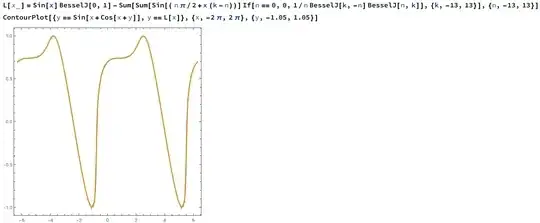
$$\bbox[2px, border: 3px blue groove]{y=\sin(x+\cos(x+y))\implies y=L(x)=\sin(x)J_0(1)-\sum_{n\in\Bbb Z/0}\sum_{m\in\Bbb Z}\frac{(-1)^k}nJ_k(n)J_n(k)\sin\left(x(k-n)+\frac{\pi n}2\right)}$$

shown here by plotting $y=L(x)$ and the truncated series: enter image description here
Тyma Gaidash
  • 13,576