3

As titled, I want to find the inverse function of $f(x) \triangleq \ln x - x + \dfrac{1}{x}$, where $x \in (0,1]$. Note that $f(0)$ is hard to define, because $\displaystyle\lim_{x \to 0^+} f(x)\to-\infty$. We also know $f(1)=0$.

Such $f^{-1}$ exists. Because $f'(x)=\dfrac{1}{x}-1-\dfrac{1}{x^2} < 0$ when $x\in (0,1]$, thus $f$ is decreasing. However, it seems hard to find it out more explicitly.

  • Why is the limit $\infty$ and not undefined. – Theincredibleidiot Sep 23 '24 at 05:50
  • 5
    $f$ is well defined in $(0, 1]$ so it does not matter what $f(0)$ means, if anything. There is no simple inverse formula in terms of elementary functions (though it may be expressed in terms of the Lambert W function) – Paul Sep 23 '24 at 07:40
  • 1
    I have the impression you are mixing between "Such a function exists." and "Such a function can relatively easy be written.". – Dominique Sep 23 '24 at 08:52
  • This is a transcendental equation. With a very few exceptions, this kind of equations can't be solved in term of known functions, and that is probably the case for this one. In this cases the best one can do is to prove the existence of the inverse (as you did) and use numerical methods to calculate it for specific values. By the way, the inequality for $f'$ is valid for all $x>0$ which means that the inverse exists for the whole interval $(0,\infty)$. – jjagmath Sep 23 '24 at 09:20
  • You have to solve $\log(x)-x+\dfrac1x=y$ for $x$, or equivalently $t-2\sinh(t)=y$ for $t$. there is no analytical solution, even using Lambert's $W$. –  Sep 23 '24 at 09:47
  • What form should it be in? A modification of this integral should work. – Тyma Gaidash Sep 23 '24 at 14:56
  • It may be possible to leverage the fact that $$f(\frac 1x)=-f(x) $$ – WW1 Sep 23 '24 at 16:36

3 Answers3

2

As said in comments, you cannot solve for $x$ the equation $$y=\log(x) -x + \dfrac{1}{x}$$ but you can have the result in terms of an infinite series since $$y=-(x-1)+\sum_{n=2}^\infty (-1)^n\, \frac {n-1} n (x-1)^n$$

Using power series reversion $$x=\sum_{n=0}^\infty (-1)^n\, \frac{a_n}{n!}\,y^n$$where the first $a_n$ $$\{1,1,1,-1,-7,19,229,-1009,-17263,105211,2332141\}$$ correspond to sequence $A331404$ in $OEIS$.

According to $OEIS$ documentation, with $a_0=1$

$$a_n=\sum _{k=1}^n (-1)^{n-k}\,\binom{n}{k}\, a_{k-1} \, a_{n-k}$$

Truncating the series at $O(y^{51})$, for $y=\frac 12$ this gives $$x=\color{red}{0.6275585295}93$$

Doubling the number of terms $$x=\color{red}{0.62755852958180167}15$$

  • 2
    This is an enlightening answer but it does not seem to be complete for me. First, the OEIS page does not claim that the e.g.f. of A331404 is the inverse of $y=\log x - x + \dfrac{1}{x}$ (up to a sign change), so you cannot use the formula that defines A331404 to get the series of inverse function untill you prove it. What's more, we need to determine the radius of convergence of the series (conjecturally to be the e.g.f. of A331404) to have the right to plug in $y=\dfrac{1}{2}$. – Jianing Song Sep 30 '24 at 08:18
0

One can find a series for $g(x)=f^{-1}(x)$, with this method, but the coefficients would be recursive, not explicit. Another way is to apply the inverse Laplace transform; $g(x)’s,x>0$ Laplace transform is:

$$L_x(g(x))=\int_0^\infty e^{-st}g(t)dt=-\int_0^1 te^{-sf(t)}f’(t)dt=\frac1s-\frac1s\int_0^1 e^{-sf(t)}dt$$

after integrating by parts. Next, substitute $t\to e^t$ and apply the DLMF’s Associated Anger Weber function $A_v(z)=\frac1\pi\int_0^\infty e^{-vt-z\sinh(t)dt}$:

$$L_x(g(x))=\frac1s-\frac1s\int_0^\infty e^{(s-1)t-2s\sinh(t)}dt=\frac1s-\frac\pi sA_{s-1}(2s)$$

Taking the inverse Laplace transform gives:

$$\boxed{f(x)=\ln(x)-x+\frac1x\implies f^{-1}(x)=1-\frac1{2i}\int_{c-i\infty}^{c+i\infty}\frac{e^{sx}}sA_{1-s}(2s)ds}$$

shown here via a resource function:

enter image description here

Тyma Gaidash
  • 13,576
0

First we note that the equation

\begin{equation} \log\left(x\right)-x+1/x=y \end{equation}

it comes from the equation

\begin{equation} (*)\,x-2\sinh\left(x\right)=y \end{equation}

taking the change of variable $x\rightarrow e^{x}$. We will work with this last one.

Transforming the equation with the change of variable $x\rightarrow\textrm{arccsch}\left(iz\right)$, we obtain the equation

\begin{equation} \textrm{arccsc}\left(z\right)-\frac{2}{z}-iy=0 \end{equation}

Defining the function $f(z)=\textrm{arccsch}\left(z\right)-\frac{2}{z}-iy$ and applying the Burniston-Siewert method to solve transcendental equations to this equation we obtain

\begin{equation} z=-i\left(\frac{1}{t}+m\right) \end{equation}

where

\begin{equation} m=\frac{1}{2\pi}{\displaystyle \int\limits_{0}^{1}\log\left(\frac{\left(\pi t-4\right)^{2}+4t^{2}\left(\textrm{arcsech}\left(t\right)+y\right)^{2}}{\left(\pi t-4\right)^{2}+4t^{2}\left(\textrm{arcsech}\left(t\right)-y\right)^{2}}\right)}\,dt \end{equation}

Therefore the solution to equation (*) is

\begin{equation} x=y-\frac{2}{\frac{1}{y}+m} \end{equation}

Retaking the change of variable for the original equation and placing everything in a single expression the inverse function of $L(x)=\log\left(x\right)-x+1/x$ is

\begin{equation} L^{-1}\left(x\right)=\exp\left[x-2\left[\frac{1}{x}+\frac{1}{2\pi}{\displaystyle \int\limits_{0}^{1}\log\left(\frac{\left(\pi t-4\right)^{2}+4t^{2}\left(\textrm{arcsech}\left(t\right)+x\right)^{2}}{\left(\pi t-4\right)^{2}+4t^{2}\left(\textrm{arcsech}\left(t\right)-x\right)^{2}}\right)}\,dt\right]^{-1}\right] \end{equation}
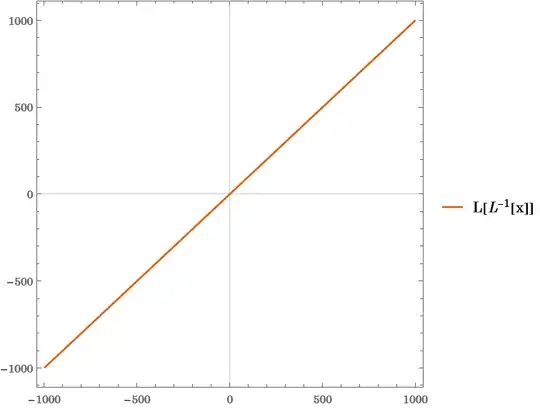
enter image description here

Ref:

-E. E. Burniston, C.E. Siewert. The use of Riemann problems in solving a class of transcendental equations. Mathematical Proceedings of the Cambridge Philosophical Society. 73. 111 - 118. (1973).

*-Henrici P., Applied and computational complex analysis, Volume III. Wiley, New York. 183-191 (1986).