Referring to the comments on the main question above, I am posting my "too long for comments" answer.
I did not thoroughly read through the material in the link provided by the OP in detail to understand the whole background. As such, I am wring my detailed comments with just the OP provided in the text of their question.
A smooth roll-off function is achieved with a transition function. You can make your $\Psi(y)$ with a Bump Function constructed out of a transition function. See Here. Note that bump functions are only smooth - they are not analytic. So my initial comment of contour closing is meaningless with any bump function. My initial suggestion of raised-cosine is not even smooth (but only continuous). So that is to be disregarded.
Since your question is only dealing with Big-O representation of the integral, we can quickly evaluate the integral with a piecewise function WITHOUT a smooth roll-off. Though the actual integral will not be the same, the order of the terms should not change much. In that spirit, we can approximate $\Psi(y)$ as a piece-wise function as shown below (using $a$ instead of $\epsilon$):
$$
\Psi(y) =
\begin{cases}
\frac{2}{a} (y+a), & -a \le y \lt -\frac{a}{2} \\
1, & -\frac{a}{2} \le y \le \frac{a}{2} \\
-\frac{2}{a} (y-a), & \frac{a}{2} \lt y \le a \\
0, & \text{otherwise}
\end{cases}
$$
- As noted in #1 above, contour integration doesn't apply. So we will simply solve this integral in straightforward way.
$$F(t) = \frac{1}{2 \pi i} \int\limits_{(1)} \frac{e^{(1-t)s}}{s} \Psi\left(\frac{\mathfrak{I}(s)}{\log(x)}\right) ds$$
Let's set $s = 1+i p$.
$$F(t) = \frac{1}{2 \pi} \int\limits_{p=-\infty}^{\infty} \frac{e^{(1-t)(1+i p)}}{1 + i p} \Psi\left(\frac{p}{\log(x)}\right) dp$$
Let's set $y = \frac{p}{\log(x)}$.
$$F(t) = \frac{\log(x)}{2 \pi} \int\limits_{p=-\infty}^{\infty} \frac{e^{(1-t)(1+i \log(x) y)}}{1 + i \log(x) y} \Psi\left(y\right) dy$$.
let's now plugin the piecewise formula for $\Psi(y)$ as defined in #2. This integral can be calculated manually, but I used Mathematica. The result is this huge expression (I am pasting an image since this is not intended to be a proper answer)
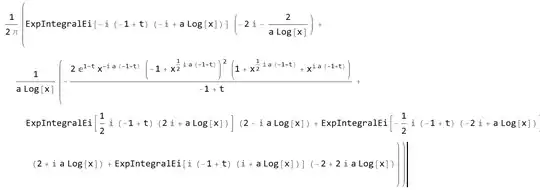
- If you expand Exponential Integral, you will NOT get terms that are only $O((1+|(1-t)|\log(x))^{-10})$, but you will get much higher order terms, possibly $O(\log(x))+...$. I didn't proceed towards further simplification since your goal is to get that much tighter bound with Littlewood Paley theory. I took a look at it in Wikipedia, but I honestly think that the theory is beyond my current math knowledge.

