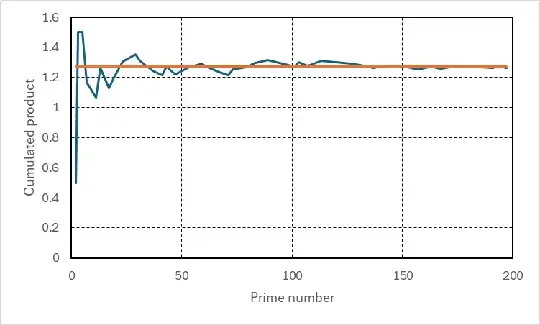
As something of a ground rule, we might require the factors to be listed in order of increasing value of the prime, so that the different residues $\bmod 5$ are mixed together and thus cancel out, by "interference", the divergent tendencies.
Given a list of consecutive primes starting with $2$, the denominator associated with a prime numerator $p$ is determined by the formula
$2p-5\lfloor(\frac{p}5+\frac{1}{2})\rfloor$
where the second term rounds the prime to the nearest multiple of $5$.
Thus
$2\to(2×2-5×0)=4,3\to(2×3-5×5)=1,$
etc and we get the fractions
$\frac24,\frac31,\frac55,\frac79,...$
whose cumulated products then seem to be approaching the target value $4/\pi$ indicated by the heavy orange horizontal line:
A better established product involving $\bmod 5$ residues of primes is as follows:
$\frac{\pi}{\sqrt5}=+\frac11+\frac13+\frac17+\frac19-\frac1{11}-\frac1{13}-\frac1{17}-\frac1{19}...$
$=(\frac32)(\frac76)(\frac{11}{12})(\frac{13}{14})...$
$=\prod\limits_{p\in\mathbb{P}-\{2,5\}}\dfrac{p}{p+(-1)^{(p+1)/2}(p|5)}$
The infinite series comes from Dirichlet $L$-functions (it may also be derived using a properly constructed Fourier series evaluation). The denominators end with $1,3,7,9$ in base ten and the signs repeat the eight-cycle shown. Converting this to the Euler product form gives the result with the general term indicated in the last line and $(p|5)$ being the Legendre symbol.


