Is it still possible that mathematicians contribute to the theory of music? Is the mathematical foundation of music still an area of research? If yes, what new researches have been done regarding that?
Asked
Active
Viewed 376 times
9

-
2http://math.stackexchange.com/questions/79885/mathematics-and-music?rq=1 possibly related. – Dan Rust Sep 16 '13 at 13:43
-
@DanielRust: No, I had read that but that topic is mostly about book suggestions and reference request. On the other hand, this one is about the recent research done in this area, if there's any. – user66733 Sep 16 '13 at 13:46
-
1@some1.new4u How does that contradict that that link is related to this question? – Git Gud Sep 16 '13 at 13:49
-
When you ask "new researches", what do you mean by "new"? New since when? – MJD Sep 16 '13 at 13:49
-
It seems that IRCAM researches on this. – Red Banana Sep 16 '13 at 14:13
-
@some1.new4u Also, in the page mentioned by Daniel Rust, you can find some answers. For example Guerino Mazzola's Topos of Music. – Red Banana Sep 16 '13 at 14:39
-
@GitGud: It depends on what you mean by related. If you want to use it loosely then anything that has the 'music-theory' tag on here could be 'related' to my question in some way ;) MJD: I mean 'the research done in the last two decades' by 'new'. – user66733 Sep 16 '13 at 15:00
4 Answers
2
I know that a member of Mathoverflow Tobias Schlemmer works in this topic, you can consult with him.

Boris Novikov
- 17,754
1
Key reference:
That set theory is useful with digital music, especially MIDI, seems not to be widely known.Consider a sequence consisting of the following chords: $F^1 , C^2 , G7^4$ .
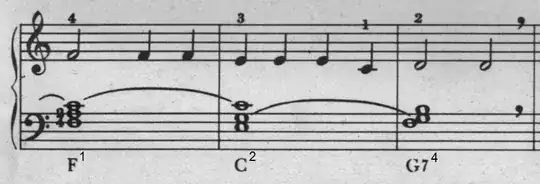
Changing the chords means that
the set of notes $F^1 = \{F,A,C\}$ is replaced by the set of notes
$C^2 = \{E,G,C\}$ is replaced by the set of notes $G7^4 = \{F,G,B\}$ .
Mind the notes in common; these are joined by bows in the score.
In MIDI, first the notes in $F^1$ are set On (Note On).
After a duration of four beats, the notes in $C^2$ should sound.
In order to accomplish smooth transition of the chords,
this should be done by first hitting the chord $C^2$ before (immediately)
releasing the chord $F^1$. More in detail, apply a Note On event to the
elements in $\{E,G,C\}$ minus $\{F,A,C\} = \{E,G\}$ immediately followed
(timestep $0$) by a Note Off event applied to the elements in $\{F,A,C\}$
minus $\{E,G,C\} = \{F,A\}$ . Note that nothing happens with the note $C$ .
After a duration of four beats again, the notes in $G7^4$ should sound.
This should be done by first hitting the chord $G7^4$ before (immediately)
releasing the chord $C^2$. More in detail, apply a Note On event to the
members of the set $G7^4 \setminus C^2$ immediately followed
by a Note Off event applied to the members of the set $C^2 \setminus G7^4$ .
This is in a nutshell how chord transition works - or rather should work
- in MIDI. It's implemented in my personal mathematical contribution to music : MidiDoos .

Han de Bruijn
- 17,475
0
Aside from the mentioned set theory, many 20th century composers used various atonal techniques called 12-tone composition where each of the 12 notes between an octave were used sequentially before the sequence could be repeated. They would then apply various aspects of set theory to this which included transposition of the sequence, retrogrades of the sequence, and combinations thereof. Further 20th century techniques explored the overtone series and actually orchestrated overtone series which had some very interesting sonic effects. This could be equated to a sonic exploration of a Fourier series. I experimented with that myself back at university in a symphony that I never completed writing. The university orchestra did a reading of the incomplete work and it was quite a stunning sound. I had very strong bass C notes and basically orchestrated the instruments up the overtone series in decreasing dynamic intensity along with upper wind instruments basically scaling up and down the series. Despite having what should have been dissonant notes within the soundscape, they all served to reinforce the fundamental C pitch and gave it a rather striking and unique timbre!
As someone studying engineering mathematics and holding a music composition degree, I'm extremely curious about applying mathematical concepts to future compositions once I complete my engineering degree! (no time for that really at the moment unfortunately whilst I study).

C. Wolfe
- 184
0
Yes, specifically in the area of musical tuning theory: the xenharmonic wiki is a good place to read about this. Harmonic entropy and xenharmonic temperament theory are two relatively new topics with a lot of current (albeit somewhat obscure) research going on in them.

Nathan BeDell
- 3,407