37

Show that $$\{z \in \mathbb{C}: |z^2+1|\le 2 \} \subseteq \{z \in \mathbb{C} : |z^3+3z+2|\le 6 \} \tag{*}$$ (In other words: Let $z\in \mathbb{C}$ satisfy $|z^2+1|\le 2$. Prove that $|z^3+3z+2|\le 6.$)

This problem was asked by mengdie1982 roughly a day ago(relative to posting this question), but was closed due to lack of work. This has been bothering me because of how simply it has been stated, however even after hours of work I am not close to proving this mathematically. Geometrically the statement (*) is true, as seen below.

$\hspace{4cm}$ enter image description here

Here are some estimates:

  1. From reverse triangle inequality, $|z^2+1| \le 2$ implies $|z| \le \sqrt{3}$ with equality at $z=i\sqrt{3}$. From triangle inequality, $|z^3+3z+2| \le |z|^3+3|z|+2 \le 6\sqrt{3}+2 \approx 12.4$. A better bound can also be achieved by factorization, $$|z^3+3z+2| = |z(z^2+1)+2(z+1)| \le |z||z^2+1|+2(|z|+1) \le 4\sqrt{3}+2 \approx 8.93. $$
  2. Another approach I took was to show that for any $r<6$, $$\{z \in \mathbb{C}: |z^2+1|\le 2 \} \nsubseteq \{z \in \mathbb{C} : |z^3+3z+2|\le r \} $$ which explains the pinching behavior between the sets near the point $(1,0)$. Define $$L=\left(\frac{2}{2-r+\sqrt{8-4r+r^{2}}}\right)^{\left(\frac{1}{3}\right)},\quad z_0 = \frac{1}{2}\left(1+L-\frac{1}{L}\right), $$ then with much effort, it can be shown that $z_0$ satisfies $|z^2+1|\le 2$, but it is not present in the other set. This implies that (*) can be reworded as finding the largest $r>0$ such that $$\{z \in \mathbb{C}: |z^2+1|\le r \} \subseteq \{z \in \mathbb{C} : |z^3+3z+2|\le 6 \}$$

or it is possible that there is an easier solution which I am missing.

Ak3.14
  • 347
Sam
  • 3,763
  • 2
    Someone posted a proof here:https://www.zhihu.com/question/655655805/answer/3496062494. But I wonder whether it's correct or not. – WuKong May 13 '24 at 03:27
  • The proof seems incorrect, they are basically using $|z|\le 1$ in the second last step. @mengdie1982 – Sam May 13 '24 at 04:21
  • But $|z|\leq1$ does not contradict the case shown by the OP $z=i\sqrt{3}$? – Vincenzo Tibullo May 13 '24 at 07:09
  • @VincenzoTibullo what if $z=\frac{1+\sqrt 3}{2}i$. This satisfies $|z|≤3$ but contradicts $|z|≤1$ – Gwen May 13 '24 at 08:02

4 Answers4

28

Proof.

Let $z = a + \mathrm{i} b$. It suffices to prove that $$(a^3-3ab^2+3a+2)^2 + (3a^2b-b^3+3b)^2 \le 36$$ for all real numbers $a, b$ with $(a^2-b^2+1)^2 + 4a^2b^2 \le 4$.

We have the following identity \begin{align*} &36-(a^3-3ab^2+3a+2)^2-(3a^2b-b^3+3b)^2\\ ={}& (8a^2+b^2+1)\Big(4-(a^2-b^2+1)^2-4a^2b^2\Big)\\ &\qquad + \frac17(7a^3 + 7ab^2 - 13a + 6)^2 + \frac15(7a^2 + 5b^2 - 7)^2\\ &\qquad + \frac{8}{85}(17a + 12)^2(a - 1)^2 + \frac{60}{119}(a - 1)^2. \end{align*}

We are done.

River Li
  • 49,125
  • 2
    Could you explain how you derived/guessed the identity? – Amir May 16 '24 at 05:22
  • 4
    How did you find that the expression can be rearranged like this @River ? – Sam May 16 '24 at 05:23
  • 3
    @Sam From the theory of SOS (Sum of Squares), if $f \ge 0 \implies g \ge 0$, sometimes we can write $g - h f = SOS$ for some $h\ge 0$. Some special cases are: https://math.stackexchange.com/questions/449755/prove-that-a-d2b-c2-geq-1-6-if-a24b2-4-and-cd-4/4539078#4539078, https://math.stackexchange.com/questions/4678243/find-the-minimum-of-x2y2z2-under-several-constraints/4678679#4678679, https://math.stackexchange.com/questions/4887718/find-minimum-of-a2-cdotse2-under-2-quadratic-constraints?noredirect=1&lq=1. – River Li May 16 '24 at 05:37
  • How were you sure that this could be written as SOS ? @RiverLi Is there a theorem which confirms this ? – Sam May 16 '24 at 06:44
  • @Sam We need to prove that $36-(a^3-3ab^2+3a+2)^2-(3a^2b-b^3+3b)^2
    • (8a^2+b^2+1)\Big(4-(a^2-b^2+1)^2-4a^2b^2\Big) \ge 0$ for all real numbers $a, b$. You can use other approach to prove it, rather than SOS.
    – River Li May 16 '24 at 07:06
  • 2
    @Sam If you want SOS, see some material about SOS: e.g., https://math.stackexchange.com/questions/2619131/how-can-one-prove-that-this-polynomial-is-non-negative/2621147#2621147 – River Li May 16 '24 at 07:11
  • 1
    @Sam Here is one more material for SOS: https://math.stackexchange.com/questions/2410994/write-x2-y2-z22-3-x3-y-y3-z-z3-x-as-a-sum-of-three-squ/2414847#2414847 – River Li May 16 '24 at 08:07
  • How did you guess $h$ and $SOS$ in $g-hf=SOS$? Did you use any special techniques that you may let us know? Or reaching these expressions is completely intuitive and cannot be explained to others. – Amir May 16 '24 at 08:17
  • 1
    @Amir Because $g$ is degree 6 and $f$ is degree four, we want $h$ to be degree two. We guess the form $h = p_1a^2 + p_2b^2 + p_3$. We want to find $$F(a, b; p_1, p_2, p_3) := 36-(a^3-3ab^2+3a+2)^2-(3a^2b-b^3+3b)^2
    • (p_1a^2+p_2b^2+p_3)\Big(4-(a^2-b^2+1)^2-4a^2b^2\Big) \ge 0$$ for all real numbers $a, b$. Since $F(a, b; p_1, p_2, p_3)$ has a minimum at $a=1, b = 0$, we obtain $p_3 = 9 - p_1$ by taking derivative to be zero. We can try some $p_1, p_2$. We can use Mathematica to verify whether or not $F\ge 0$ for these $p_1, p_2$.
    – River Li May 16 '24 at 08:20
  • Thanks! Any guidance on how the SOS can be obtained then? – Amir May 16 '24 at 08:31
  • 1
    @Amir It is a big issue. You should look at many material about SOS such as: https://math.stackexchange.com/questions/2410994/write-x2-y2-z22-3-x3-y-y3-z-z3-x-as-a-sum-of-three-squ/2414847#2414847. You can learn many SOS solver. For example, here is an online example (by KaiRain): https://sagecell.sagemath.org/?q=pnnxok – River Li May 16 '24 at 08:39
  • @RiverLi I'm sorry, but I believe you might have some ideas to help me solve this problem (https://mathoverflow.net/q/483373/478965). I hope it’s intriguing enough for you. – Dang Dang Nov 30 '24 at 04:21
  • 1
    @kangwon_1502 I have no idea how to solve that problem. – River Li Nov 30 '24 at 05:50
  • 1
    Thank you so much! – Dang Dang Nov 30 '24 at 12:48
6

As River also showed, the implication is equivalent to the following implication involving only real numbers by considering $z = x + iy$:

$$(x^2-y^2+1)^2 + 4x^2y^2 \le 4 \Rightarrow (x^3-3xy^2+3x+2)^2 + (3x^2y-y^3+3y)^2 \le 36. $$

To show the above implication, River nicely used a method based on SOSs, but it requires guessing several functions, which can probably only be done using solvers specifically developed for SOSs and knowing the optimal solution. Here, I prove the above implication using elementary analysis tools.

The above implication can be proven if we show the optimal value $p^*$ of the following optimization problem is less than or equal to 36:

$$\max z(x,y)=A(x,y)^2 + B(x,y)^2 $$ subject to $$(x^2-y^2+1)^2 + 4x^2y^2 \le 4 \tag{1}$$

where

$$A(x,y)=x^3-3xy^2+3x+2, B(x,y)=3x^2y-y^3+3y.$$

Here, we prove $p^*=36$ using the following steps:

1) It can be shown that $ x^2\le 1$. Indeed, from

$$(x^2-y^2+1)^2 + 4x^2y^2 \le 4 \Leftrightarrow (x^2+y^2+1)^2 \le 4(1+y^2), \tag{2}$$

we have $x^2 \le 2\sqrt{1+y^2}-(1+y^2) \le \max_{a}(2a-a^2)= 1.$

2) The equation $\nabla Z(x,y)=0$ is equivalent to

$$(x^2-y^2+1)A(x,y)+2xyB(x,y)=0$$ $$-2xyA(x,y)+(x^2-y^2+1)B(x,y)=0.$$

These together give $$((x^2-y^2+1)^2+4x^2y^2)B(x,y)=0,$$ which has a solution only if $B(x,y)=0 \Leftrightarrow y^2=3(1+x^2) \vee y=0$. The first $y^2=3(1+x^2)$ results in no feasible solution (just plug it into (1)), but $y=0$ yields the feasible solution $(0,0)$ that cannot be optimal (compare it with some trivial feasible solution such as $(1,0)$ or eliminate it at the end of step 3).

3) From step 2, we can see that the optimal value $p^*$ must be attained at some point on the curve $(x^2-y^2+1)^2 + 4x^2y^2 = 4,$ which using (2) can be written as

$$\big (x^2+t(x) \big )^2 = 4t(x), t(x)=y^2+1. $$

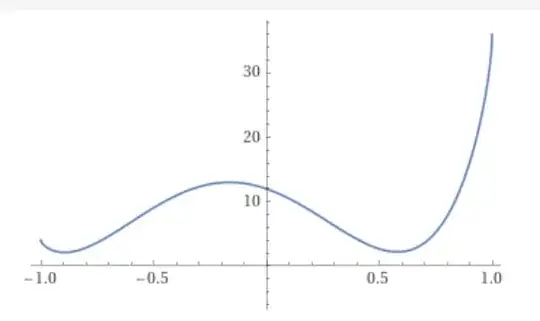
Then, $$t(x)=2-x^2+\sqrt{1-x^2}$$ can be explicitly obtained as a function of $x$ by solving the above quadratic equation (it has real roots if and only if $ x^2\le 1$) and noting that $t(x)\ge 1$. As the objective function $z(x,y)$ depends on $y$ through $y^2$, we obtain:

$$ f(x)=\big (x^3-3x(t(x)-1)+3x+2\big)^2+(t(x)-1)\big (3x^2-(t(x)-1)+3 \big)^2\\=\left (4x^3-3x\sqrt{1-x^2}+2 \right)^2 +\left (1-x^2+\sqrt{1-x^2}\right)\left (4x^2-1-\sqrt{1-x^2} \right)^2, |x|\le 1.$$

$f(x)$ [1] is a univariate function of $x$ depicted below [2]:

$\hspace{3cm}$

The maximum is attained at $x=1$, which can be shown by finding the solutions of $f'(x)=0$ [3], which are $r_1=-0.894803$, $r_2=-0.163729$, and $r_3=0.580693$, and then selecting the best among $-1,r_1,r_2,r_3,1$. Therefore, from $t(1)=y^2+1, t(1)=1$, we obtain $y=0$. Hence point $(1,0)$ with $z(1,0)=36$, which also dominates $(0,0)$ obtained in step 2,, is the optimal solution, and thus $p^*=36$. QED


Following River's comment, we may be able to prove that the maximum occurs at the boundary without calculus or maximum modulus principle, and the iss to use the transformation $x=\frac{2t}{1+t^2}$ to get rid of $\sqrt{1-x^2}$. The result is given here, which seems complex. I also tried transformation $x=\sin t$, but the result given here is still complex. Any comments are welcome!

Amir
  • 11,124
  • 1
    Nice. We can eliminate the sqrt by $x = \frac{2t}{1 + t^2}$. It is actually an easy way. Perhaps, we can prove without calculus or Maximum Modulus Principle that the maximum occurs at the boundary. – River Li May 16 '24 at 23:26
  • 1
    @RiverLi, thanks for your kind support! I just applied the suggested transformation and this transformation $x=\sin t$. You may see the results in the links provided in the answer. – Amir May 17 '24 at 00:26
  • 1
    The curve $(x^2-y^2+1)^2+4x^2y^2=4$ could also be parametrized as four branches $x=\pm\sqrt{u+3/4-u^2}, y=\pm\sqrt{u-3/4+u^2}$, for $u\in[1/2,3/2]$. – Vincenzo Tibullo May 17 '24 at 07:40
  • @VincenzoTibullo Nice observation! This can be used to convert the objective function $z(x,y)$ to a number of univariate functions when $z(x,y)$ is very complex. How did you get this? – Amir May 17 '24 at 07:57
  • @Amir, the equation $(x^2-y^2+1)^2+4x^2y^2$, only contains the squares of $x$ and $y$. I did a simple substitution $x^2\to X$ and $y^2\to Y$. It was then evident that it is a rotated parabola, and the substitution $X=u+v, Y=u-v$ make it a vertical one. – Vincenzo Tibullo May 17 '24 at 08:11
5

Another way.

Let $z = a + \mathrm{i} b$. It suffices to prove that $$(a^3-3ab^2+3a+2)^2 + (3a^2b-b^3+3b)^2 \le 36 \tag{1}$$ for all real numbers $a, b$ with $$(a^2-b^2+1)^2 + 4a^2b^2 \le 4. \tag{2}$$

From (2), we have $4 \ge (a^2 - b^2 + 1)^2 + 4a^2b^2 = (a^2 + b^2 + 1)^2 - 4b^2$ which results in $$a^2 \le 2\sqrt{1 + b^2}- (1 + b^2). \tag{3}$$ Also, by AM-GM, we have $a^2 \le 1 + (1 + b^2) - (1 + b^2) = 1$.(This has been pointed out by @Amir's nice answer.) Also, since $2\sqrt{1+b^2}-(1+b^2)\ge 0$, we have $b^2 \le 3$.

(1) is written as $$(a^3-3ab^2+3a)^2 + 4a(a^2-3b^2+3) + (3a^2b-b^3+3b)^2 \le 32. \tag{4}$$

We split into two cases.

Case 1. $a^2-3b^2+3 > 0$

Using $a^2 \le 1$ and $b^2 \le 3$, we have \begin{align*} &32 - (a^3-3ab^2+3a)^2 - 4a(a^2-3b^2+3) - (3a^2b-b^3+3b)^2\\ \ge{}& 32 - (a^3-3ab^2+3a)^2 - 4(a^2-3b^2+3) - (3a^2b-b^3+3b)^2\\ ={}& -a^6+(-3b^2-6)a^4+(-3b^4-13)a^2-b^6+6b^4+3b^2+20\\ \ge{}& -1+(-3b^2-6)+(-3b^4-13)-b^6+6b^4+3b^2+20\\ ={}& -b^6 + 3b^4\\ \ge{}& 0. \end{align*}

Case 2. $a^2 - 3b^2 + 3 \le 0$

Using $a^2 \le 1$ and $b^2 \le 3$ and (3), we have \begin{align*} &32 - (a^3-3ab^2+3a)^2 - 4a(a^2-3b^2+3) - (3a^2b-b^3+3b)^2\\ \ge{}& 32 - (a^3-3ab^2+3a)^2 + 4(a^2-3b^2+3) - (3a^2b-b^3+3b)^2\\ ={}& -a^6+(-3b^2-6)a^4+(-3b^4-5)a^2-b^6+6b^4-21b^2+44\\ \ge{}& -a^2+(-3b^2-6)a^2+(-3b^4-5)a^2-b^6+6b^4-21b^2+44\\ ={}& -(3b^4+3b^2+12)a^2-b^6+6b^4-21b^2+44\\ \ge{}& -(3b^4+3b^2+12)(2\sqrt{1 + b^2}- (1 + b^2))-b^6+6b^4-21b^2+44\\ \ge{}& -(3b^4+3b^2+12)\left(\frac{2b^2}{1 + b^2/3 + 1} + 2- (1 + b^2)\right)-b^6+6b^4-21b^2+44\\ ={}& \frac{2b^8 + 6b^4 - 112b^2 + 192}{6 + b^2}\\ \ge{}& 0 \end{align*} where we use $\sqrt{1 + b^2} - 1 = \frac{b^2}{\sqrt{1 + b^2} + 1} \le \frac{b^2}{1 + b^2/3 + 1}$ which follows from $$(1 + b^2) - (1 + b^2/3)^2 = \frac19b^2(3-b^2)\ge 0.$$

We are done.

Riemann
  • 11,801
River Li
  • 49,125
4

Following some ideas already presented by Amir's answer, assuming wlog $y\ge 0$, we have that

$$|z^2+1|= 2 \implies y=\sqrt{1 - x^2 + 2 \sqrt{1 - x^2}} \tag 1$$

with $|x|\le 1$, then we need to prove that $|z^3+3z+2|^2-36\le 0 $ that is

$$ F(x,y)=((2 + 3 x + x^3 - 3 x y^2)^2 + (3 y + 3 x^2 y - y^3)^2)-36\le 0 \tag 2$$

and by substituting $(1)$ in $(2)$ we obtain

$$f(x)=4 (-1 + 6 x^2 + 4 x^3 + 2 \sqrt{1 - x^2} (1 - 3 x + 2 x^2))-36\le 0$$

and by $x=\sin u$ with $u\in\left[-\frac \pi 2, \frac \pi 2\right]$ we obtain

$$f(u)=8 (-1 + \sin u) (6 - \cos u - \cos(2 u) + 5 \sin u + \sin(2 u)) \le 0$$

which reduces the given problem $(2)$ to prove that

$$g(u)=6 + 5 \sin u + \sin(2 u)- \cos u - \cos(2 u) \ge 0 \tag 3$$

enter image description here

which is indeed true and can be proved as indicated here below.


Proof of $(3)$

(deleted, refer to the following alternative proof)


Alternative and clever proof of $(3)$

As shown by River Li's answer here, we simply have

$$g(u)=6 + 5 \sin u + \sin(2 u)- \cos u - \cos(2 u) \ge $$

$$\ge 6 + 5 \sin u -1- 1 - (1-2\sin^2 u)=$$

$$=3+ 5 \sin u+2\sin^2 u= (2\sin u + 3)(\sin u + 1)\ge 0$$

user
  • 162,563
  • I look forward to seeing the analytical proof of (3). – Amir May 17 '24 at 13:42
  • @Amir Yes I'm completing it in a few! Thanks – user May 17 '24 at 13:42
  • @Amir I've added the proof. For the case $u\in \left[-\frac \pi 3,0\right]$ I've used a numerical verification mixed with derivative, very effective I think in this case. Do you have some other methid? – user May 17 '24 at 14:30
  • +1: Could you check the alternative forms of $l(x)$ provided in the link I just added to your answer? One of them may work. – Amir May 17 '24 at 14:42
  • @Amir Why do you say alternative, isn't it the same? – user May 17 '24 at 14:53
  • @Amir I let the given link here if you don't mind https://www.wolframalpha.com/input?i2d=true&i=6%2B5sinx%2Bsin2x – user May 17 '24 at 15:14
  • 1
    Finally $x=\sin t$ worked, and everthing has been solved nicly. One unsolved question to me: How did the designer find the implication? (@RiverLi). – Amir May 17 '24 at 20:49
  • @Amir Geometrically, I suppose. – user May 17 '24 at 20:51
  • I guess $|z^3+3z+2|\le 6$ was drawn first and then $|z^2+1|\le \alpha$ was drawn for different values ​​of $\alpha$ until the two graphs got tangent to each other at $\alpha=2.$ – Amir May 17 '24 at 22:58