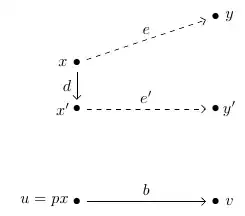
I am trying to understand a statement in Brown's Topology and Groupoids, 7.2.5 (Corollary 1), page 270.
Let's first have some preliminary remarks
Let $X,Y$ be topological spaces. The track groupoid $\pi Y^X$ is defined as the groupoid whose objects are the maps $f:X\to Y$ and morphism in $\pi Y^X(f,g)$ are the homotopies $f\simeq g,$ where two homotopies $F,G$ are identified if they can be continuously deformed into each other while fixing the end maps. For $X=\{*\}$ we obtain the fundamental groupoid $\pi Y.$ A map $i:A\to X$ induces a morphism $i^*:\pi Y^X\to\pi Y^A$ by $i^*([F])=[F(i\times 1)].$
Let $i:A\to X,\ u:A\to Y.$ By $[(X,i),(Y,u)]$ we mean the set of homotopy classes of maps $f:X\to Y,fi=u,$ where a homotopy $F:f\simeq g$ is required to satisfy $F(ia,t)=ua.$ (We say $f$ and $g$ are homotopic under $i.$)
(You might want to skip this shaded part as it's probably not relevant for the particular question.):
Let $p : E → B$ be a morphism of groupoids. We say $p$ is a fibration if the following condition holds: for all objects $x$ of $E$ and elements $b$ in $B$ with initial point $px,$ there is an element $e$ of $E$ with initial point $x$ and such that $pe = b.$
If $p : E → B$ is a morphism of groupoids and $u$ is an object of $B,$ we write $p^{-1}[u]$ for the subgroupoid of $E$ with objects those $x$ in Ob$(E)$ such that $px = u,$ and with elements those $e$ in $E$ such that $pe = 1_u.$
Let $\pi_0G$ denote the set of components of $G.$ then we have:
Lemma 1: If $p:E\to B$ is a fibration of groupoids, then for each $b\in B(u,v)$ there is a bijection $$b_\#:\pi_0 p^{-1}[u]\to\pi_0 p^{-1}[v]$$ which respects identities and composition. Namely, if $x$ is an object with $px=u$, we assign to the component of $x$ the component of the object $y$ which is the codomain of the element $e$ such that $pe=b.$Lemma 2: A cofibration $i:A\hookrightarrow X$ induces a fibration $i^*:\pi Y^X\to\pi Y^A.$
Lemma 3: Let $i:A\hookrightarrow X$ be a cofibration. Let $u:A\to Y$ be a map. Let $p=i^∗:πY^X\to πY^A.$ Then there is a canonical bijection $$π_0 p^{−1}[u]\cong[(X, i), (Y, u)].$$
In the proof of the Lemma 3 we use the following fact. Maybe it turns out to be useful in solving my question:
Lemma 4: Let $i:A→X$ be a cofibration. Let $H:X\times\Bbb I→Y$ be a homotopy $f≃g,$ and let $G=H(i\times1)$ be homotopic rel end maps to $G′:u≃v.$ Then $H$ is homotopic rel end maps to some $H′:f≃g$ such that $H'(i\times 1)=G'.$
Now we can combine the three lemmas to derive the following
Corollary: Let $i:A\hookrightarrow X$ be a cofibration and $α\in πY^A(u,v).$ Then there is a bijection $$α_\#:[(X, i), (Y, u)] → [(X, i), (Y, v)] $$
I have figured out that this bijection works as follows:
Choose a representative $F$ of $\alpha.$ For a homotopy class $[f]$ take a representative $f:X\to Y,\ fi=u.$ The homotopy $F:u\simeq v$ on $A$ can be extended to a homotopy $G:f\simeq g'.$ Then we have $[g']=\alpha_\#([f]).$
Now, Brown writes
Also, if $α_\#([f]) = [g],$ then any representative of $α$ extends to a homotopy $f\simeq g.$
I don't see why this should be obvious. I know that if $F:u\simeq v,\ F\in\alpha,$ then there is an extension of $f\cup F$ to a homotopy $G:f\simeq g'$ for some $g:X\to Y,\ g'i=v.$ And this $g'$ is homotopic under $i$ to $g.$ But I don't see how these homotopies can be combined to a homotopy $f\simeq g$ which extends $F.$