N.B. - I'm looking for the simplest way to ascertain the number of templates $T$ (see below) comprising the structure from just one angle alone; that is, I'm sitting down looking up at this thing, and I want a way to compute its cardinality based on the simplest methods, but perhaps relying on some underlying abstract concept, in particular, graph theory, geodesics, topology, algebra, or something totally new.
My working theory is that we need only the equation
$$V-E+F=2,$$
and the Inclusion-Exclusion Principle. In fact, we might also need the fact that the star is a fraction of the whole, and some other symmetry to rely on to create a system of equations. That is
$$\frac{V}{n}-\frac{E}{n}+\frac{F}{n}=2$$
and
$$\frac{V}{m}-\frac{E}{m}+\frac{F}{m}=2,$$
where we know the relationship between $m$ and $n$. Actually, that makes no sense... Hmm...
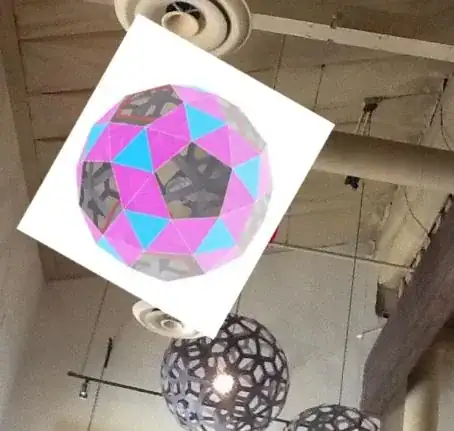
UPDATE: I have verified, with sufficient effort, Mr. Narain's proposal that the structure is a snub dodecahedron:
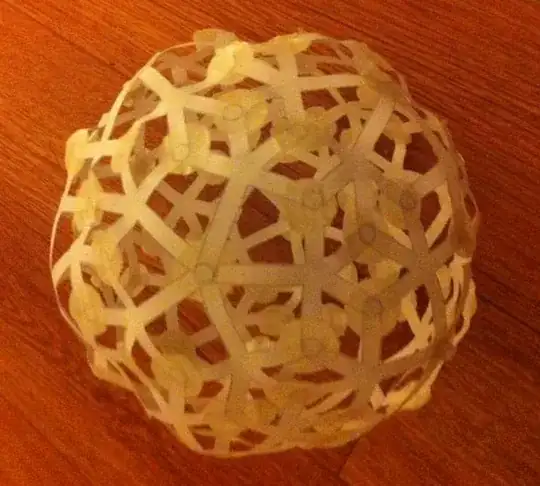
There are indeed 60 pieces, however, I'd still like a lazy method using the ideas I've alluded to all throughout this post...
I'm at a fancy restaurant, and I saw these template ball lights:
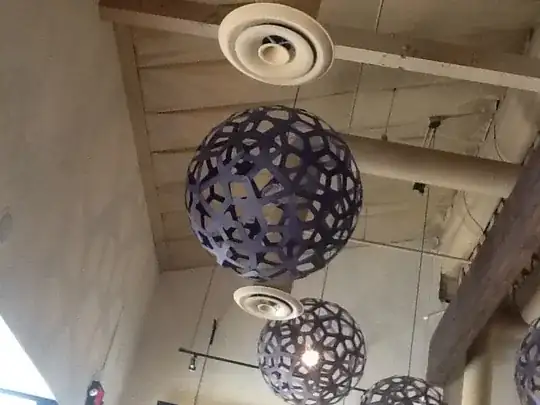 http://tinypic.com/r/2co6b9w/5
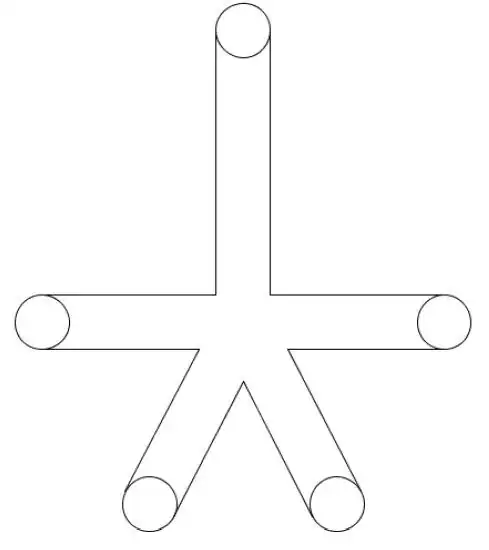
I'm trying to figure out the number of template pieces, call them $T$; they look like this:
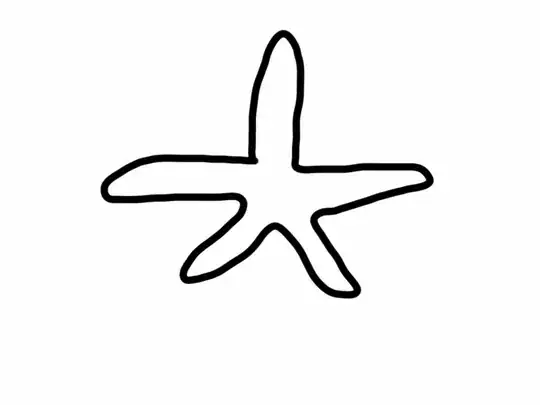 http://tinypic.com/r/29cs8cw/5
Here is my approach: Count the number of things that look like this:
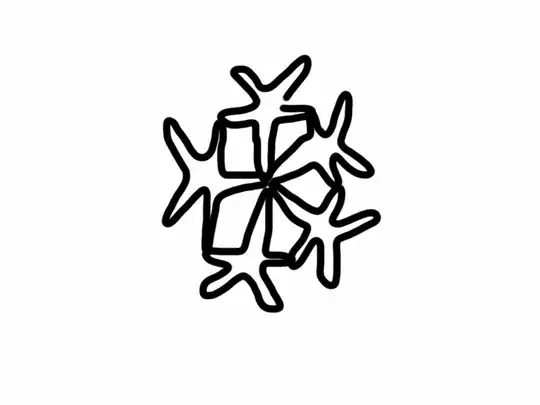
Now notice that for each $T$ coming out from the center there are four legs which the rest are connected to, two of which are connected to adjacent $T$'s which are coming out from the same center mentioned before. I feel this problem is one of algebra. My friend here thinks that if you measured the shape of $T$, then you could find it easily with the surface area of a sphere, but she can't seem to work out how to get the number of $T$'s. If you need more photos, let me know.
Just in case you don't see it:
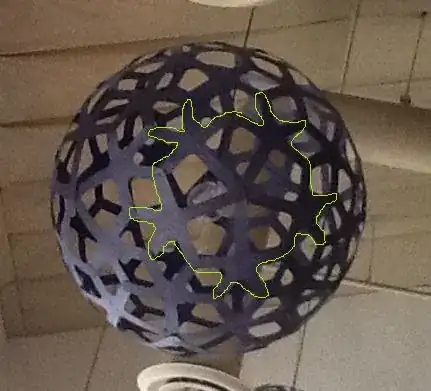
This appears to be a snub dodecahedron--as was pointed out by one of the commenters--and can be seen in an overlay here:
Look at this:
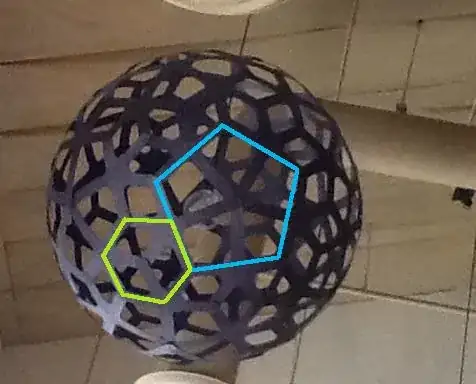
I believe these two can be related in a system of equations via the Euler Characteristic--perhaps I'd need a third distinct shape...
Here are some statistics:

Based on these statistics, here is the template--just in case you want to make one for yourself:
If you pay me $50 I'll make a larger one for you out of balsa wood. ^_^
THE BIG IDEA:
Assume I am a tree--maybe I'm an African Baobab, and my Baobab friend next to me has this thing dangling motionlessly from her branches. Me being an Baobab, I don't know about snub dodecahedrons, but--for some genetically mutative reason--I know a bit of mathematics. So, now, I'm looking at this thing wondering if I can count how many $T$'s there are (see above) just by noting how the arms of the $T$'s are connected. What is the least amount of data that I need from my single, grounded point of view to ascertain the number of the $T$'s comprising this object?


