0

If the equation $\frac{x^3+4}{{(x+1)}^3}=c,\forall x \in \Bbb R\setminus{\{-1\}}$ possess two roots, then what are the values of $c$ ?

Attempt: $c=1$ may be a solution if the quadratic equation thus formed has distinct real roots, i.e. $x^3+4={(x+1)}^3$, which gives $ x^2+x-1=0$ which has $2$ different solutions $(\neq -1)$. How to get other solutions?

amWhy
  • 210,739
Aniii
  • 155
  • 9
  • Can we use the cubic discriminant? https://math.stackexchange.com/questions/3418726/how-to-find-discriminant-of-a-cubic-equation – Red Five Mar 28 '24 at 08:49
  • Are there any other methods to proceed? As it is actually a question from an exercise on calculus. Also I have no idea about what the cubic discriminant is. – Aniii Mar 28 '24 at 08:53
  • Ah. I see... OK, I'll keep thinking. Maybe mention this in the question and add Calculus as a tag? (Just noticed that the calculus tag is there... sorry) – Red Five Mar 28 '24 at 08:54
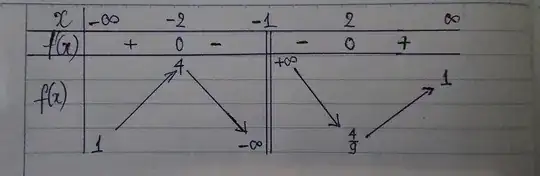
  • You can draw $f(x)=\frac{x^3+4}{(x+1)^3}$ and change the line $y=c$ in order to see when only two points meet. – Joshua Woo Mar 28 '24 at 08:54
  • Yes, I actually did add Calculus as a tag – Aniii Mar 28 '24 at 08:55
  • If you need to use calculus, can we assume that since it is a cubic there is always one root and therefore it is a matter of finding values of c such that there is a turning point on the x-axis? – Red Five Mar 28 '24 at 08:56
  • @JoshuaWoo but I think drawing is not feasible as I have to 'solve' it. Plus I think all the solutions may not be integers. – Aniii Mar 28 '24 at 08:59
  • @RedFive I tried that as it is seemingly a good approach but the equations in $c$ seem to go nowhere – Aniii Mar 28 '24 at 09:01
  • It is better to use derivative and variation table since the derivative of $f(x)=\frac{x^3+4}{(x+1)^3}$ has 2 nice roots, then you can see when the line $y=c$ intersect at 2 points. – OnTheWay Mar 28 '24 at 09:01
  • @OnTheWay Explain a bit please. – Aniii Mar 28 '24 at 09:04

2 Answers2

3

$$f(x)=\frac{x^3+4}{(x+1)^3}$$ $$f'(x)=\frac{3(x^2-4)}{(x+1)^4}$$

  • There is a vertical asymptote at $x=-1$.
  • $\lim_{x\to -\infty}f(x)=\lim_{x\to \infty}f(x)=1$
  • There are two inflection points, at $x=-2,2$. At these points, $f(-2)=4$, $f(2)=\frac{4}{9}$.
  • For $x\in(-\infty,-2)$, $f(x)$ is increasing.
  • For $x\in(-2,-1)$, $f(x)$ is decreasing.
  • For $x\in (-1,2)$, $f(x)$ is decreasing.
  • For $x\in (2,\infty)$, $f(x)$ is increasing.

To help us visualize, using these facts you can draw the graph of $f(x)$: enter image description here

Using the intermediate value theorem, you can show the following using the above facts:

  • $f(x)=c$ has exactly one solution for $c>4$ and $c<\frac{4}{9}$.
  • $f(x)=c$ has exactly two solutions for $c=\frac{4}{9},1,4$
  • $f(x)=c$ has exactly three solutions otherwise.
Shean
  • 1,022
2

$$\begin{gathered} \frac{{{x^3} + 4}}{{{{\left( {x + 1} \right)}^3}}} = c \hfill \\ * {\text{Let}}:f\left( x \right) = \frac{{{x^3} + 4}}{{{{\left( {x + 1} \right)}^3}}}{\text{ so the domain is }}\mathbb{R}\backslash\left\{ { - 1} \right\} \hfill \\ f'\left( x \right) = \frac{{3\left( {{x^2} - 4} \right)}}{{{{\left( {x + 1} \right)}^4}}} \Rightarrow f'\left( x \right) = 0 \Leftrightarrow x = \pm 2 \Rightarrow f\left( 2 \right) = \frac{4}{9},f\left( { - 2} \right) = 4 \hfill \\ f'\left( x \right) \geqslant 0 \Leftrightarrow \left[ \begin{gathered} x \geqslant 2 \hfill \\ x \leqslant - 2 \hfill \\ \end{gathered} \right.,f'\left( x \right) < 0 \Leftrightarrow x \in \left( { - 2, - 1} \right) \cup \left( { - 1,2} \right) \hfill \\ {\text{Also}}:\mathop {\lim }\limits_{x \to - {1^ - }} f\left( x \right) = - \infty ,\mathop {\lim }\limits_{x \to - {1^ + }} f\left( x \right) = \infty ,\mathop {\lim }\limits_{x \to \infty } = 1,\mathop {\lim }\limits_{x \to - \infty } = 1 \hfill \\ {\text{See the variation table, then the line }}y = c{\text{ intersect at 2 points where }}c = \frac{4}{9},1,4 \hfill \\ \end{gathered}$$ Variation table
OnTheWay
  • 3,523
  • 1
    These answers (whilst very good in their own right) seem a bit more complicated that what I suspect the (original) author of the question was after. These textbook questions often want a less-than-rigorous solution (so I don't think limits would be included as part of the intended solution, even though they work in the two answers here). – Red Five Mar 28 '24 at 10:38
  • Yes but I assume limits don't hurt me as long as they're intuitive. But if you think there is a simpler solution to the problem(other than sketching the graph or making a variation table) I'd love to see it. Please be sure to frame the answer as for a high school student, if you ever wish to. – Aniii Mar 28 '24 at 14:05
  • 1
    @Aniii This is the method for high school students in my country deal with this kind of question. It is very useful, not only for equation but also for inequation, and problem with parameters (by isolating the parameters). – OnTheWay Mar 28 '24 at 14:37
  • @OnTheWay Certainly seems like a good way to solve such problems, being somewhat similar to graphing. Feels more powerful though as you write all the details about the function and its derivative in a tabular form. – Aniii Mar 28 '24 at 15:15