We will prove
$$
\int_{0}^{\pi}\cos\left(x\right)\operatorname{sech}\left(\frac{\pi}{2}\tan\frac{x}{2}\right)\,dx=\frac{\pi^{2}}{12}\,.
$$
PROOF
Let $\mathcal{I}$ be the integral in question. We use the mapping $x \mapsto 2\arctan x$ to get
$$
\begin{align}
\mathcal{I} &\stackrel{\Delta}{=} \int_{0}^{\pi}\cos\left(x\right)\operatorname{sech}\left(\frac{\pi}{2}\tan\frac{x}{2}\right)\,dx \\
&=2\int_{0}^{\infty}\operatorname{sech}\left(\frac{\pi x}{2}\right)\frac{1-x^{2}}{\left(1+x^{2}\right)^{2}}\,dx \\
&= \int_{\mathbb{R}}\operatorname{sech}\left(\frac{\pi x}{2}\right)\frac{1-x^{2}}{\left(1+x^{2}\right)^{2}}\,dx \\
&= 2\Re\int_{\mathbb{R}}\frac{e^{\pi x /2}}{\left(e^{\pi x}+1\right)\left(1+ix\right)^{2}}\,dx\,.
\end{align}
$$
Next, we define a holomorphic function $f: \mathbb{C}\setminus\left\{(2k+1)i \in \mathbb{C} : k \in \mathbb{Z}\right\} \longrightarrow \mathbb{C}$ where $z \mapsto \frac{e^{\pi z/2}}{\left(e^{\pi z}+1\right)\left(1+iz\right)^{2}}$. Every element of the set $\left\{(2k+1)i \in \mathbb{C} : k \in \mathbb{Z}\right\}$ are simple poles, except the third order pole $i$ when $k=0$. Also, we construct a simple, counterclockwise, and closed contour in the shape of an isosceles triangle $\mathcal{T}$ with vertices at $(-2N,0)$, $(2N,0)$, and $(0,2N)$. We express this triangle as $[-2N,2N] \cup T_1 \cup T_2$ where
$$
\begin{align}
T_1 &\stackrel{\Delta}{=} \left\{2Ni+it-t \in \mathbb{C}: t \in [-2N,0]\right\} \\
T_2 &\stackrel{\Delta}{=} \left\{2Ni-it-t \in \mathbb{C}: t \in [0,2N]\right\}\,. \\
\end{align}
$$
The set of poles that $\mathcal{T}$ encloses is
$$
P_n \stackrel{\Delta}{=} \left\{(2n+1)i \in \mathbb{C} : 0 \leq n \leq N-1\right\}\,,
$$
where $n$ and $N$ are non-negative integers such that $n < N$.
Here is a visual of the contour with the domain coloring and shading of $f$.
$$
\text{Counterclockwise Triangle Contour $\mathcal{T}$ With Domain Coloring}
$$
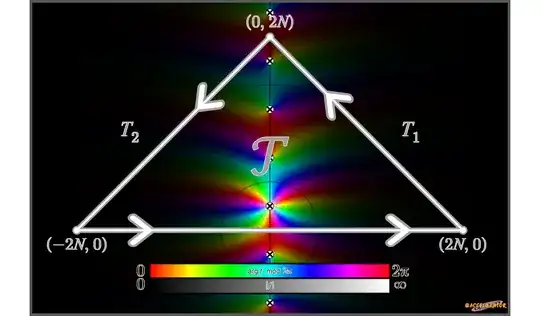
See this Desmos link for an automatic animation of the contour I made. As $N$ grows, none of the odd integer poles touch it because we judiciously constructed $\mathcal{T}$ where its top vertex lies between two poles.
With this contour, we construct a sequence of contour integrals $\oint_{\mathcal{T}}f$ such that $\oint_{\mathcal{T}}f$ converges as $N \to \infty$. We express the contour integral as
$$
\oint_{\mathcal{T}}f = \int_{-2N}^{2N}f+\int_{T_{1}}^{ }f+\int_{T_{2}}^{ }f\,.
$$
Taking $N \to \infty$ on both sides, we get
$$
\lim_{N \to \infty}\oint_{\mathcal{T}}f = \int_{\mathbb{R}}f+\lim_{N \to \infty}\int_{T_{1}}^{ }f+\lim_{N \to \infty}\int_{T_{2}}^{ }f\,.
$$
We will prove that the integral over $T_1$ vanishes as $N$ goes to $\infty$ using the Estimation Lemma and the Squeeze Theorem for sequences.
We obtain the length of $T_1$ from the Distance Formula:
$$
\sqrt{\left(2N-0\right)^{2}+\left(0-2N\right)^{2}}=2\sqrt{2}N\,.
$$
In addition, we obtain the upper bound of $|f|$:
$$
\begin{align}
|f| &= \left|\frac{e^{\frac{\pi z}{2}}}{\left(e^{\pi z}+1\right)\left(1+iz\right)^{2}}\right| \\
&\leq \frac{\left|e^{\frac{\pi z}{2}}\right|}{\left|1-\left|e^{\pi z}\right|\right|\cdot\left|1-\left|z\right|\right|^{2}} \\
&\overset{z \in T_1}{=} \frac{\left|e^{\frac{\pi}{2}\left(2Ni+it-t\right)}\right|}{\left|1-\left|e^{\pi\left(2Ni+it-t\right)}\right|\right|\cdot\left|1-\left|2Ni+it-t\right|\right|^{2}} \\
&= \frac{1}{e^{\frac{\pi t}{2}}\left(e^{-\pi t}-1\right)\left(\sqrt{\left(2N+t\right)^{2}+t^{2}}-2\right)^{2}}\,. \\
\end{align}
$$
We employ the Estimation Lemma and obtain the inequality
$$
\left|\int_{T_{1}}^{ }f\right|\le\frac{2\sqrt{2}N}{e^{\frac{\pi t}{2}}\left(e^{-\pi t}-1\right)\left(\sqrt{\left(2N+t\right)^{2}+t^{2}}-2\right)^{2}}\,.
$$
Taking the limit as $N \to \infty$ of the upper bound, we get
$$
\lim_{N \to \infty}\frac{2\sqrt{2}N}{e^{\frac{\pi t}{2}}\left(e^{-\pi t}-1\right)\left(\sqrt{\left(2N+t\right)^{2}+t^{2}}-2\right)^{2}} = 0
$$
because the numerator grows asymptotically slower than the denominator.
The Squeeze Theorem concludes that
$$
\lim_{N \to \infty} \left|\int_{T_{1}}^{ }f\right| = 0
$$
which means
$$
\lim_{N \to \infty} \int_{T_{1}}^{ }f = 0\,.
$$
By a similar process, we could also evaluate the contour integral over $T_2$, which is
$$\lim_{N \to \infty}\int_{T_{2}}^{ }f = 0\,.$$
Going back to $\oint_{\mathcal{T}}f$, we use the famous Cauchy's Residue Theorem and apply $N \to \infty$ to get
$$
\begin{align}
\oint_{\mathcal{T}}f &= 2\pi i\sum_{n \in P_n}\mathop{\mathrm{Res}}_{z=(2n+1)i} f \\
\implies \lim_{N \to \infty}\oint_{\mathcal{T}}f &= 2\pi i\sum_{n=0}^{\infty}\mathop{\mathrm{Res}}_{z=(2n+1)i} f \\
&= \underbrace{2\pi i\mathop{\mathrm{Res}}_{z=i} f}_{\text{third-order pole}} + \underbrace{2\pi i\sum_{n=1}^{\infty}\mathop{\mathrm{Res}}_{z=(2n+1)i} f}_{\text{simple poles}}\,. \\
\end{align}
$$
First, we calculate the residue of $f(z)dz$ at the third-order pole. Note that $f(z) = -\frac{1}{2\left(z-i\right)^{2}}\operatorname{sech}\left(\frac{\pi z}{2}\right)$. With some algebra, we expand $\operatorname{sech}\left(\frac{\pi z}{2}\right)$ as the asymptotic
$$
-\frac{2i}{\pi\left(z-i\right)}+\frac{i\pi}{12}\left(z-i\right)-\frac{7\pi^{3}i}{2880}\left(z-i\right)^{3}+\mathcal{O}\left(\left(z-i\right)^{5}\right)
$$
which is the Laurent series centered at $z=i$. Multiplying $-\frac{1}{2\left(z-i\right)^{2}}$ by each term of the series yields the coefficient of $\frac{1}{z-i}$ as
$$
\mathop{\mathrm{Res}}_{z=i} f = -\frac{i\pi}{24}\,.
$$
Second, we solve for the infinite sum of residues at the simple poles. Using the piecewise equality
$$
e^{k\pi i} =
\begin{cases}
1 & k \equiv 0 \pmod{2} \\
-1 & k \equiv 1 \pmod{2}\,, \tag{1}\\
\end{cases}
$$
we do the following tedious calculations:
$$
\begin{align}
\mathop{\mathrm{Res}}_{z=(2n+1)i} f &= \lim_{z \to (2n+1)i}\frac{e^{\frac{\pi z}{2}}}{\frac{d}{dz}\left(\left(e^{\pi z}+1\right)\left(1+iz\right)^{2}\right)} \\
&= \lim_{z \to (2n+1)i}\frac{e^{\frac{\pi z}{2}}}{\left(1+iz\right)\left(2i+e^{\pi z}\left(\pi+2i+\pi iz\right)\right)} \\
&= \frac{e^{\frac{\pi}{2}\left(2n+1\right)i}}{\left(1+i\left(2n+1\right)i\right)\left(2i+e^{\pi\left(2n+1\right)i}\left(\pi+2i+\pi i\left(2n+1\right)i\right)\right)} \\
&\overset{(1)}{=} -\frac{i\left(-1\right)^{n}}{4\pi n^{2}}\,. \\
\end{align}
$$
Putting all the residues together, we have
$$
\begin{align}
\lim_{N \to \infty}\oint_{\mathcal{T}}f &= 2\pi i\left(-\frac{i\pi}{24}\right)-2\pi i\sum_{n=1}^{\infty}\frac{i\left(-1\right)^{n}}{4\pi n^{2}} \\
&= \frac{\pi^{2}}{12}+\frac{1}{2}\sum_{n=1}^{\infty}\frac{\left(-1\right)^{n}}{n^{2}} \\
&= \frac{\pi^{2}}{12}+\frac{1}{2}\left(-\frac{1}{1^{2}}+\frac{1}{2^{2}}-\frac{1}{3^{2}}+...\right) \\
&= \frac{\pi^{2}}{12}+\frac{1}{2}\left(-\frac{1}{1^{2}}-\frac{1}{2^{2}}-\frac{1}{3^{2}}-...+2\left(\frac{1}{2^{2}}+\frac{1}{4^{2}}+\frac{1}{6^{2}}+...\right)\right) \\
&= \frac{\pi^{2}}{12}+\frac{1}{2}\left(-\sum_{m=1}^{\infty}\frac{1}{m^{2}}+2\cdot\frac{1}{2^{2}}\sum_{l=1}^{\infty}\frac{1}{l^{2}}\right) \\
&= \frac{\pi^{2}}{12}+\frac{1}{2}\left(-\frac{\pi^{2}}{6}+\frac{1}{2}\cdot\frac{\pi^{2}}{6}\right) \\
&= \frac{\pi^{2}}{24}\,. \\
\end{align}
$$
Gathering all our results together, we finally recover the integral we want:
$$
\begin{align}
&\require{cancel}{\frac{\pi^{2}}{24} = \int_{\mathbb{R}}\frac{e^{\pi x /2}}{\left(e^{\pi x}+1\right)\left(1+ix\right)^{2}}\,dx + \cancelto{0}{\lim_{N \to \infty}\int_{T_{1}}f}+\cancelto{0}{\lim_{N \to \infty}\int_{T_{2}}f}} \\
\implies 2\Re&\frac{\pi^{2}}{24} = 2\Re\int_{\mathbb{R}}\frac{e^{\pi x /2}}{\left(e^{\pi x}+1\right)\left(1+ix\right)^{2}}\,dx\,.
\end{align}
$$
We finally conclude with
$$
\bbox[15px,#eefef8,border:5px outset #4f9a8f]{\int_{0}^{\pi}\cos\left(x\right)\operatorname{sech}\left(\frac{\pi}{2}\tan\frac{x}{2}\right)\,dx=\frac{\pi^{2}}{12}}
$$
and the proof is done! $\blacksquare$
I might upload my second solution depending on how I feel.


