1

This is part of the proof of finding the closed from solution of third order recurrence relation

enter image description here

I know that the closed form will look like the following

enter image description here

And this is the part of the proof I can get up to
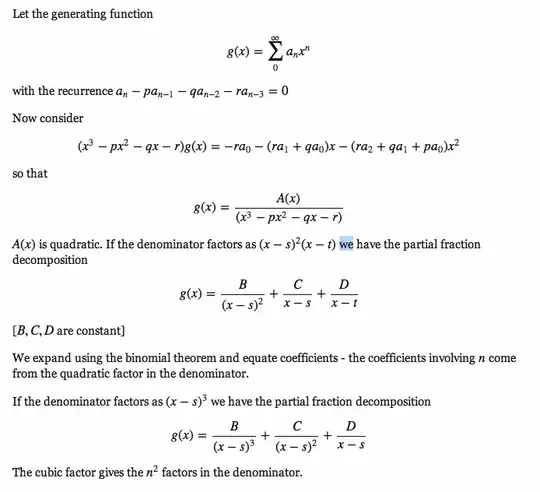
enter image description here

But what do I need to do after this procedure to get the shape of the closed form mentioned above?

Please can you walk me through the steps?

Brian
  • 43

1 Answers1

1

After you get $B,C,D$, of course, and $g(x)$, then just expand $g(x)$ as a Taylor series. The term $a_n$ is the closed form of recurrence relation you want.

Shuchang
  • 9,988
  • well thats the part I don't know how to do,,, sorry but could you please show me how to do it step by step? – Brian Aug 31 '13 at 04:07
  • @Brian, what is your actual background? – Will Jagy Aug 31 '13 at 04:56
  • What do you mean by background? – Brian Aug 31 '13 at 05:02
  • Taylor expansion is used here. Do you know $\frac{1}{1-x}=1+x+x^2+...$? Use this to reduce further your result. – Shuchang Aug 31 '13 at 05:05
  • sorry my depth of knowledge in this area is very shallow. I know that a taylor expansion looks like shown however I just don't know how to manipulated everything.

    a step by step explanation would really help

    thanks

    – Brian Aug 31 '13 at 05:17
  • If you know $\frac{1}{1-x}$, then $\frac{1}{(1-x)^2}=(1+x+...)(1+x+...)=1+2x+...$ follows. Can you go further now? – Shuchang Aug 31 '13 at 05:19
  • Thanks for clarifying but you know that B/(x-s)^3 and B/(x-s)^2 are not in the form of 1/(x-1)^n. I guess is pretty obvious that you can take out the B and multiply it later however what change would (x-s) bring to the equation rather than it being (x-1)? – Brian Aug 31 '13 at 05:28
  • Try to let $y=sx$ – Shuchang Aug 31 '13 at 05:33
  • I dont see the point in letting y=sx.. if y=x-s+1 the I could say 1/(y-1) but what would the equation become if y=sx? – Brian Aug 31 '13 at 05:41
  • $\frac{C}{(x-s)^n}=\frac{C}{(-s)^n}\frac{1}{(1-(\frac{x}{s}))^n}=\frac{C}{(-s)^n}(1+\frac{x}{s}+(\frac{x}{s})^2+...)$ – Shuchang Aug 31 '13 at 05:55
  • Would the (1-x/s)^n part expand as 1+x/s+x^2/s^2+... and so on? so later on I would have to find the coefficient of x^n and that would give me the closed form solution right? – Brian Aug 31 '13 at 06:01
  • Sorry, it shall be $\frac{1}{(1-(\frac{x}{s}))^n}=(1+\frac{x}{s}+...)^n$. Then, as you know, find the coefficient of the term $x^n$ – Shuchang Aug 31 '13 at 06:06
  • sorry but in this proof there was an error. I multiplied g(x) by the characteristic equation which then lead me to the partial fraction however that was wrong because then the terms after x^2 do not cancel out. In fact it should have been (1-Px-Qx^2-Rx^3) that was supposed to be multiplied. Then the method of dividing into partial factions cannot apply. What am I supposed to do? – Brian Sep 01 '13 at 08:00
  • Sorry, I didn't see the problem.Everything goes right – Shuchang Sep 01 '13 at 10:13
  • Well if you look at the part saying "now consider" I found that the algebra was wrong. You see the (x^3-Px^2-Qx-R)g(x) does not equal the right hand side. The proof thought that the coefficients of x^3 and onwards would cancel out however if you actually calculate the values you get (a1-Pa2-Qa3-Ra4)x^3 which is defiantly not zero

    Sorry for not making myself more clearer but its hard trying to communicate through comments. I'll clarify the parts you do not understand. Please let me know

    – Brian Sep 01 '13 at 10:49
  • Reverse the polynomial you times on g(x) and try $1-Px-Qx^2-Rx^3$ – Shuchang Sep 02 '13 at 01:29