I come up with this strange curve. I don't know if it's a fractal or not.
First, take a unit length line, parametrize it from $t = 0$ to $1$, and bend two corners with angle $\pi-\frac 1 3$ at $t=\frac 1 3, \frac 2 3$. Then bend 4 corners with angle $\pi-\frac 1 {3^2}$ at $t=\frac19, \frac29, \frac49, \frac89$. Bend 5 corners with angle $\pi-\frac 1 {3^3}$ at $t=\frac1{27}, \frac2{27}, \frac4{27}, \frac8{27}, \frac{16}{27}$ . Keep on bending more corners with angle $\pi-\frac1{3^n}$ at $t=\frac{2^m}{3^n}<1$ with $n$ approaching $\infty$.
This curve is interesting because it has infinitely many corners, but its length is finite unlike other fractal curves I know. And I don't know if this curve is self-similar or not.
This curve wouldn't be self-similar like the other common fractals, which a smaller part of the shape looks exactly like the whole fractal, since the angles are different. But I think it is possible that a small part of the curve can look like the whole curve after rescaling.
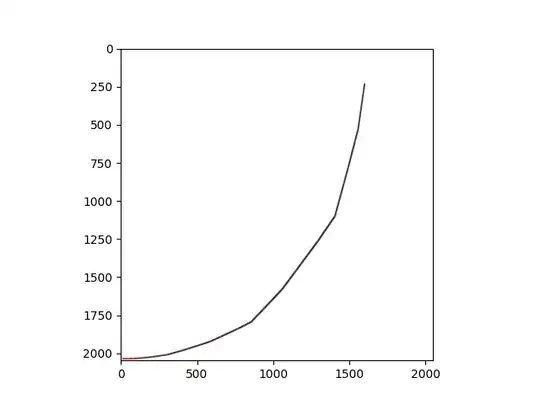
edit:
I come up with this strange curve because I originaly want to create a convext 2d fractal, but according this post convex fractals don't exist: " Are convex fractals possible? "
I think what I was really trying to create is a 2d convex shape with fractal boundary. The 2d shape is created by joining two copies of this curve to form a ellipse-like or leaf-like shape with corners.
My understanding of fractals are shapes with self-similar property and inifintely many details. I don't know if there is a formal definitinon of fractals since there is no formal definition of fractals on wikipedia. If this is not a fractal then I am also curious to know wether there is a name for such shapes with infinitely many details(corners, straight lines, segment of curves) but do not as a fractal?
When I make this curve, I want to keep all the angles bending toward the same side, and make the sum of external angles ($\text{external angle}=\pi-\text{internal angle}$) finite.
Sum of external angles: $$\sum_{n=1}^\infty\frac1{3^n}\times \left(\text{Number of }2^m\text{ s.t. } 1\le2^m\le 3^n\right)$$ $$\le\sum_{n=1}^\infty\frac1{3^n}\left(1+\log_23\right)$$ which is a finite number.

