Here's another idea that may be easier to deal with (although the reasoning is a bit long for a standardized test question):
We start by noting that the polynomial $ \ f(x) \ = \ x^4 - 4x^2 + x + k \ $ has no symmetry about the $ \ y-$ axis. Since the leading coefficient is positive, the curve "opens upward". Some values of the polynomial function are
$$ f(-2) = k - 2 \ , \ f(-1) = k - 4 \ , \ f(0) = k \ , \ f(1) = k - 2 \ , \ f(2) = k + 2 \ , \ f(3) = k + 48 \ . \ $$
From this and the behavior of the "tails" of the curve, we can surmise that there are three "turning points" [I will avoid the language of calculus and not say "local extrema"].
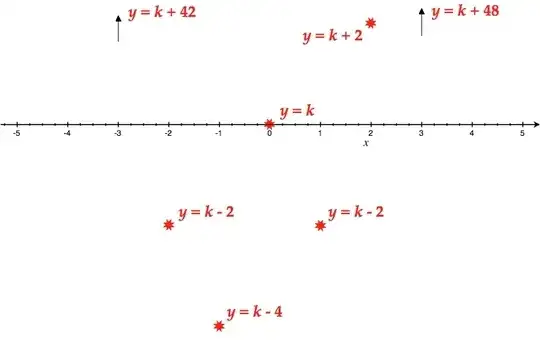
The relative positions of these points suggests the presence of "turning points" in the vicinity of $ \ x = -1 \ , \ x = 0 \ , \ \ \text{and} \ \ \ x = 1 \ . $
Taking $ \ k = 0 \ $ , the polynomial can be factored as $ \ x \ \cdot \ (x^3 - 4x + 1) \ $ . Descartes' "Law of Signs" tells us that the cubic polynomial has two or no positive real zeroes and one negative real zero. Together with the number of turning points and the lack of symmetry, we can conclude that there are four distinct real zeroes (one being $ \ x = 0 \ $). By the Intermediate Value Theorem (which is often mentioned, at least briefly in pre-calculus), the sign changes of the function indicate that the negative zero lies in $ \ x < -2 \ $ and the two positive zeroes are in the intervals $ \ 0 < x < 1 \ $ and $ \ 1 < x < 2 \ $ (the first of these really requires a little extra work, either by showing that there are positive values of the function in that interval, or by considering the form of the curve).
For $ \ k = -2 \ $ , all of the aforementioned function values are negative until we reach $ \ f(2) \ $ [in fact, $ \ x = 2 \ $ is a zero], so we are left with only two real zeroes in $ \ x < -2 \ $ and $ \ x > 2 \ $ .
For $ \ k = 3 \ $ , $ \ f(-2) = -1 \ $ and all the rest of the aforementioned function values are positive until we reach $ \ f(2) \ $ , so we lose the two positive real zeroes (the two real zeroes are in $ \ -2 < x < -1 \ $ and $ \ -1 < x < 0 \ $ ) .
[Upon consulting the graph, we find that the number of real zeroes will drop from four to two if the $ \ x-$axis lies "above" the turning point near $ \ x = 0 \ $ or "below" the one near $ \ x = 1 \ $ . This indicates that we must have $ \ \sim 0 \ < \ k \ < \ \sim 2 \ . $ ]
This leaves $ \ k = 1 \ $ -- upon checking the function values, we find the real roots are in the intervals $ \ x < -2 \ , \ -1 < x < -0 \ , \ 0 < x > 1 \ \ \text{and} \ \ 1 < x < 2 \ . $
This may still seem a little glib and call for a bit more calculating of function values, but does not actually require plotting a whole graph.
EDIT: added graph and elaborated on argument concerning permissible values of $ \ k \ $ .


