Use the Gudermannian Function by
$$
x = 2\arctan\left(e^u\right) - \frac{\pi}{2} = \operatorname{gd}(u).
$$
Then
$$
\begin{align}
I &:= \int_{0}^{\frac{\pi}{2}}\ln\left(\sec x+\tan x\right)\csc xdx \\
&= \int_{0}^{\infty}\ln\left(\sec\left(\operatorname{gd}(u)\right)+\tan\left(\operatorname{gd}(u)\right)\right)\csc\left(\operatorname{gd}(u)\right)\cdot\frac{d}{du}\left(\operatorname{gd}(u)\right)du \\
&= 2\int_{0}^{\infty}\frac{ue^{-u}}{1-e^{-2u}}du \\
&= 2\sum_{n=0}^{\infty}\int_{0}^{\infty}ue^{\left(1-2n\right)u}du \\
&= \sum_{n=0}^{\infty}\frac{2}{\left(2n+1\right)^{2}} \\
&= \frac{\pi^{2}}{4}. \\
\end{align}
$$
Here is an alternate (and non-integration-bee-friendly) solution. Map $x \mapsto 2\arctan x$. Then
$$
I := \int_{0}^{1}\ln\left(\sec\left(2\arctan x\right)+\tan\left(2\arctan x\right)\right)\csc\left(2\arctan x\right)\left(\frac{d}{dx}2\arctan x\right)dx \\
$$
which simplifies down to
$$
\begin{align}
I &= \int_{0}^{1}\frac{1}{x}\ln\left(\frac{1+x}{1-x}\right)dx \\
&= \int_{0}^{1}\frac{\ln\left(1+x\right)}{x}dx-\int_{0}^{1}\frac{\ln\left(1-x\right)}{x}dx \\
&= \int_{0}^{-1}\frac{\ln\left(1-x\right)}{x}dx-\int_{0}^{1}\frac{\ln\left(1-x\right)}{x}dx \\
&= -\int_{-1}^{1}\frac{\ln\left(1-x\right)}{x}dx. \\
\end{align}
$$
Let $f(z) = \displaystyle \frac{\log (1-z)}{z}$ where $\arg(1-z) \in (-\pi,\pi]$ so that the branch cut is on $[1,\infty)$. The function has a removable singularity at $z=0$ because $\displaystyle f(z) = -1-\frac{z}{2}-\frac{z^{2}}{3}-\frac{z^{3}}{4}+O\left(z^{6}\right)$, and so $f(z)$ doesn't blow up as $z \to 0$. Choose any small radius $r \ll 1$. We travel counterclockwise around $C$, which we define as the union of the three sets $C_1 = [-1,1-r]$, $\displaystyle C_{2}=\left[1-r,1-\frac{r^{2}}{2}+\frac{ir}{2}\sqrt{4-r^{2}}\right]$, and $\displaystyle C_{3}=\left[1-\frac{r^{2}}{2}+\frac{ir}{2}\sqrt{4-r^{2}},-1\right]$. Here, $C_2$ is the small arc and $C_3$ is the big arc illustrated below.
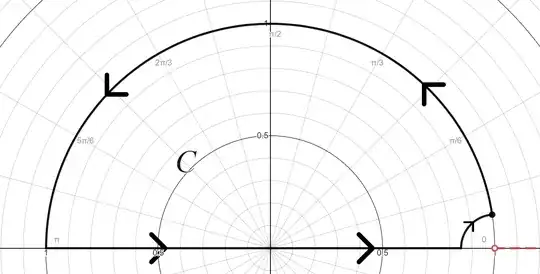
Cauchy's Integral Theorem allows us to write $\displaystyle \oint_{C} f(z)dz$ as
$$
0 = \int_{C_1}f(z)dz + \int_{C_2}f(z)dz + \int_{C_3}f(z)dz.
$$
By equating $\Re$ and making $r \to 0^+$ on both sides, we get
$$
I = \Re \lim_{r \to 0^+} \int_{C_2}f(z)dz + \Re \lim_{r \to 0^+} \int_{C_3}f(z)dz.
$$
For the small arc, parameterize $z = 1-re^{-i\theta}$ where $\displaystyle \theta \in \left[0, \arcsin{\left(\frac{1}{2}\sqrt{4-r^2}\right)}\right]$. Then we use the ML-inequality
$$
\left|\int_{C_2}f(z)dz\right| \leq ML.
$$
We find $L$ by the arc length formula for a circle like
$$
L = r \arcsin{\left(\frac{1}{2}\sqrt{4-r^2}\right)}.
$$
We find $M$ by bounding $|f(z)|$ like
$$
\left|\frac{\log\left(1-z\right)}{z}\right|\le\frac{\left|\ln\left|1-z\right|\right|+\left|i\arg\left(1-z\right)\right|}{\left|z\right|}\le\frac{\left|\ln\left|1-\left(1-re^{-i\theta}\right)\right|\right|+\pi}{\left|1-re^{-i\theta}\right|}\le\frac{\pi-\ln r}{1-r}.
$$
The Squeeze Theorem should make things easier from here. The integral over $C_2$ goes to $0$ as $r \to 0^+$.
For the other integral, parameterize $z = e^{it}$ where $\displaystyle t \in \left[\arccos{\left(1-\frac{r^2}{2}\right)}, \pi\right]$. Then
$$
\begin{align}
\Re \lim_{r \to 0^+} \int_{C_2}f(z)dz &= \Re \lim_{r \to 0^+}\int_{\arccos\left(1-\frac{r^{2}}{2}\right)}^{\pi}\frac{\log\left(1-e^{it}\right)}{e^{it}}\cdot ie^{it}dt \\
&= \Re\int_{0}^{\pi}\left(i\ln\left|1-e^{it}\right|-\arg\left(1-e^{it}\right)\right)dt \\
&= \Re i\int_{0}^{\pi}\ln\left|1-e^{it}\right|-\Re\int_{0}^{\pi}\arctan\left(\frac{-\sin t}{1-\cos t}\right)dt \\
&= 0+\int_{0}^{\pi}\arctan\left(\tan\left(\frac{\pi}{2}-\frac{t}{2}\right)\right)dt \\
&= \frac{\pi^{2}}{4}. \\
\end{align}
$$
Therefore,
$$
I = 0 + \frac{\pi^2}{4} = \frac{\pi^2}{4}
$$
and we're done!


