3

Let $n>-1$ be an integer and $f(n)$ be the integer part of $n^{\frac{5}{4}}$.

And to avoid confusion define $f(0)=0,f(1)=1$ and all $f(n)$ as the integer part of the positive real values for $n^{\frac{5}{4}}$. ( no complex or negative branches for the power )

Conjecture :

Every positive integer can be expressed as

$$ A = f(B) + f(C)$$

For any given positive integer $A$, and some positive integers $B,C$.

How to prove this ?


Some details or background ...

I have no formal method for the value $\frac{5}{4}$.

A generalization is ofcourse $f(q,n)$ be the integer part of $n^{q}$ for $1<q<2$. This is similar to Waring problem and Eulers son noticed the connection to

$$v(k) = 2^k + **(3/2)^k** - 2.$$

where the ** ** means integer part.

which you can see explained on wiki.

See : https://en.wikipedia.org/wiki/Waring%27s_problem

the similar function

$$ w(k) = 2^k + (3/2)^k - 2 $$

has as solution

$$ w(k) = 2 $$

$$k = 1.2333...$$

what is close to $1.25 = \frac{5}{4}$.

How large $a$ can be so that we can represent

$$ A = f(q,B) + f(q,C)$$

is a natural question.

I am not conjecturing q can be at most $1.25$ although it might be so. ( I think $q = \frac{4}{3}= 1.333...$ fails and $q = 1/2$ fails so it seems reasonable )


mick
  • 17,886
  • 3
    Out of curiosity, have you computed $a(q)$ for a sample of $q>5/4$? It would be cool to see it jump around but approach infinity as $q$ approaches $5/4$, as one would expect if the conjecture is true. And maybe the trend would help to suggest a proof strategy? – Chris Culter May 17 '23 at 21:46
  • @ChrisCulter i assume you mean the number of representations for a given $A$ with respect to $q$ ? Erdős–Turán conjecture on additive bases is what you assume here I think but that is not proven. The set by 5/4 is very dense and looks pretty linear ( only the triangular numbers never look linear and all slower must look so somewhere ) locally or for small values. The number of representations probably goes beyond 7 because of that. Wirsing proved that there exists subset of squares S such that very positive integer smaller than or equal n can be written as a sum of at most 4 elements of S. – mick May 17 '23 at 21:56
  • @CalvinLin 2^x + (3/2)^x - 2 = 2 gives $x=1.23336...$ you can check with calculator, software or say W alpha. ( not 1.35 ?? ) – mick May 17 '23 at 22:07
  • 1
    Can you check your $w(k$)? 1/ Shouldn't you want $ \lfloor ( 3/2) ^k \rfloor$? 2/ If so, isn't the solution at $ k \approx 1.585$? $\quad$ I agree that without the floor function, the solution is $ \approx 1.233$ – Calvin Lin May 17 '23 at 22:07
  • @CalvinLin 1.585 is too high ( by testing ). so that is out. – mick May 17 '23 at 22:09
  • By $a(q)$ I was referring to this part of the question: "How large $a$ can be so that we can represent $A = f(q,B) + f(q,C)$ is a natural question." I assumed this meant the largest possible $a$ such that all $A\leq a$ is representable. – Chris Culter May 17 '23 at 22:09
  • @ChrisCulter ah like that – mick May 17 '23 at 22:10
  • 2
    Relevant: https://math.stackexchange.com/questions/2838191/additive-basis-of-order-2-i?rq=1 and https://math.stackexchange.com/questions/2846506/additive-basis-of-order-2-ii?noredirect=1&lq=1 . The results mentioned there are to do with asymptotic bases though. In general, I doubt there is a straightforward approach to how you would prove a specific subset of $\mathbb{N}$ is an additive basis of $\mathbb{N}.$ – Adam Rubinson May 17 '23 at 23:12
  • @CalvinLin whoops that was a mistake! Ofcourse $ 1 < q < 2$. Thanks for pointing out. – mick May 18 '23 at 18:10

1 Answers1

2

I don't usually post empirical results as an answer, but I find it difficult to see how to make analytical progress.

Claim. (Additive basis of order 2) Every positive integer can be written in the form $\lfloor m^q\rfloor+\lfloor n^q\rfloor$ for some positive integers $m\le n$.

The difficulty lies in the difference that you request "every positive integer" instead of "every sufficiently large positive integer". The latter phrase is easier as we can make (sometimes quite crude) number-theoretic bounds to arrive at the result. As noted in the comments, several publications have resolved the claim for various ranges of $q$.

In the "sufficiently large" case, these include:

  • $q\in(1,3/2)$: Konyagin, S.V., 2002. An additive problem with fractional powers.

  • $q\in(1,11/10)$ when one of $m,n$ is prime: Yu, G., 2020. On a binary additive problem involving fractional powers. Journal of Number Theory, 208, pp.101-119.

Your post has two questions:

  1. Does the claim hold when $q=5/4$?
  2. What is $\sup q$ such that the claim holds?

For empirical results, I will look at the smallest positive integer that cannot be written in said form with $n$ given.

  1. The R code to compute the smallest positive integer is as follows.
floorfunc <- function(q,a){
  p <- array(NA,c(a,a))
  for(m in 1:a){for(n in 1:a){p[m,n] <- floor(m^q)+floor(n^q)}}
  return(sort(setdiff(2:p[a,a],unique(as.vector(p))))[1])}

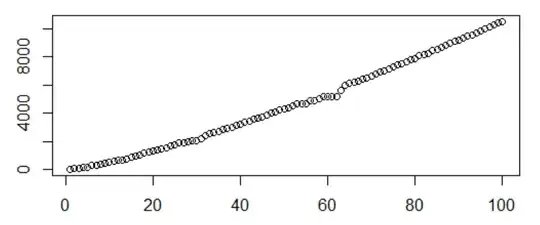
The horizontal axis in the plot is $n/10$ and the vertical axis is the smallest positive integer. enter image description here The growth rate is slowly exponential, and with Konyagin's result, it makes sense to believe the claim holds.
  1. I believe $$\sup q=1.26966\cdots$$ (note this does not appear in OEIS). The following function calculates the smallest non-representable positive integer as $q$ increments from $a+b/100$ to $a+b$ in increments of $1/100$, when $n=200$.
floorarray <- function(a,b){
  r <- array(NA,100)
  for(k in 1:s){r[k] <- floorfunc(a+b*k/100,200)}
  return(r)}

When $a=b=1$, we observe a very apparent drop in the $27$th element; that is, $q=1.27$. This means that $31$ cannot be written as $\lfloor m^{1.27}\rfloor+\lfloor n^{1.27}\rfloor$.

 [1]   NA   NA   NA  493   NA   NA   NA  609  639  675  661  705  743  757
[15]  790  835  874  876  967 1032 1055 1115 1097 1254 1330 1387   31 1544
[29]   30   17   15   13   13   11   11   11    9    9    9    9    7    7
[43]    7    7    7    7    5    5    5    5    5    5    5    5    5    5
[57]    5    5    3    3    3    3    3    3    3    3    3    3    3    3
[71]    3    3    3    3    3    3    3    3    3    3    3    3    3    3
[85]    3    3    3    3    3    3    3    3    3    3    3    3    3    3
[99]    3    3

With this knowledge, narrowing the interval $(a+b/100,a+b)$ repeatedly leads to the interval $(1.26966+0.00004/100,1.26967)$, in which we obtain

 [1] 1375 1375 1375 1375 1375 1375 1375 1375 1375 1375 1375   31   31   31
[15]   31   31   31   31   31   31   31   31   31   31   31   31   31   31
[29]   31   31   31   31   31   31   31   31   31   31   31   31   31   31
[43]   31   31   31   31   31   31   31   31   31   31   31   31   31   31
[57]   31   31   31   31   31   31   31   31   31   31   31   31   31   31
[71]   31   31   31   31   31   31   31   31   31   31   31   31   31   31
[85]   31   31   31   31   31   31   31   31   31   31   31   31   31   31
[99]   31   31
TheSimpliFire
  • 28,020