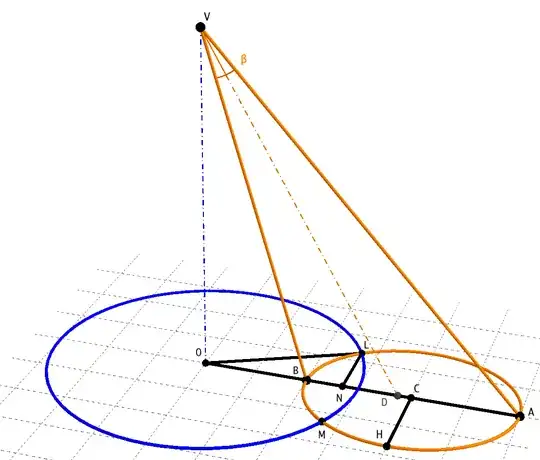
Consider the plane of the axes $VO$, $VD$ of the cones, and another plane perpendicular to $VO$ at $O$, intersecting the first cone on a circle of center $O$ (blue in figure below) and the second cone on an ellipse (orange).
Line $OD$ cuts the ellipse at the endpoints of major axis $AB$: knowing the apertures of the cones and the angle formed by their axes it is not difficult to find the positions of $A$, $B$ and of their midpoint $C$, which is the center of the ellipse.
The semi-major axis of the ellipse $a=AC=BC$ can then be computed, while the minor axis $b=CH$ is given by
$$
b^2=VA\cdot VB\,\sin^2\beta,
$$
where $\beta$ is the semi-aperture of the second cone (see here for a proof).
Let then $L$ and $M$ be the intersections of circle and ellipse, and $N$ their midpoint.
If we set: $ON=x$, $LN=y$, $OC=d$, $OL=r$ we have:
$$
y^2=r^2-x^2,\quad{(d-x)^2\over a^2}+{y^2\over b^2}=1.
$$
Substituting $y^2$ from the first equation into the second one, we can find a quadratic equation for $x$ which can be solved.