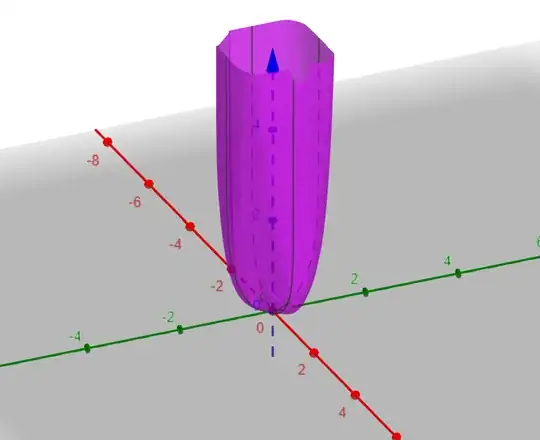
I ask for a proof of :
Let $x,y\in(-0.9,0.9)$ then it seems we have :
I have conjecture for and $x,y\in(-1,1)$ :
$$f(x,y)=\ln\left(\frac{(1+xy)^{2}(1+x^{2})}{(1-xy)^{2}(1-x^{2})}\right)-\left(x\operatorname{arctanh}(x)-y\operatorname{arctanh}(y)+6\left(xy\right)-6\left(xy\right)^{2}\right)\geq 0$$
It's an attempt to solve the problem here Prove that $\prod_{1\leq i,j\leq n}\frac{1+a_ia_j}{1-a_ia_j}\geq1$ for $n$ real numbers $a_i\in(-1,1)$ .
The only thing I know is the function for $|y|<1/2$ fixed is convex on the domain above .
Then the equality case is a limit at $x=y=0$ which is equal to zero .
If true it remains to summing the inequalities and then it's not hard to show the remainders is positive .
My strategy :
First step :
Show for $x\in(-0.9,0.9)$ and $0.8>a>0$ a fixed unknow then :
$$h(x)=f(x,a),h''(x)>0$$
Second steps :
As the function $h(x)$ is convex on that domain above we use tangent line method we have :
$$h'\left(a\left(1-a\right)\right)\left(x-a\left(1-a\right)\right)+h\left(a\left(1-a\right)\right)\leq f(x,a)$$
So it remains to show :
$$h'\left(a\left(1-a\right)\right)>0,h\left(a\left(1-a\right)\right)>0$$
A similar strategy works for $-0.8<a<0$
We have also the stronger statement $x,y\in(-0.9,0.9)$:
$$g\left(x,y\right)=\ln\left(\frac{(1+xy)^{2}(1+x^{2})}{(1-xy)^{2}(1-x^{2})}\right)-\left(x\operatorname{arctanh}(x)-y\operatorname{arctanh}(y)+6xy\right)\geq 0$$
Complement to the strategy :
We have :
Let $0<x<1$ then we have :
$$\operatorname{arctanh}\left(x\right)>2\arcsin\left(x\right)-x$$
Using the inequality above we introduce :
$$m\left(x,y\right)=\ln\left(\frac{(1+xy)^{2}(1+x^{2})}{(1-xy)^{2}(1-x^{2})}\right)-\left(x\left(2\arcsin\left(x\right)-x\right)-y\left(2\arcsin\left(y\right)-y\right)+6xy\right)$$
Then we differentiate and using $\arcsin\left(x\right)>x$ on the same domain squaring both side then the derivative is :
$$j\left(x,y\right)=-\left((2x)/\sqrt{1-x^{2}}\right)^{2}+\left((4(x^{4}(-y)-x^{3}y^{2}+x+y))/((x^{4}-1)(x^{2}y^{2}-1))-6y\right)^{2}$$
Then we use a form of Buffalo's way we have :
$$j\left(\frac{1}{2}+\frac{\frac{1}{2}x}{x+y},\frac{1}{2}+\frac{\frac{1}{2}y}{x+y}\right)\geq 0$$
Where in this example all the coefficients are positives.
How to (dis)prove it ?
Any progress is very welcome !