6

Let $n$ be a positive integer

Now define the collatz variant

  1. if $n=2m$ divide by $2$ as often as possible.
  2. if $n=3m$ divide by $3$ as often as possible.
  3. if $n=5m$ divide by $5$ as often as possible.
  4. else take $7n + 1$

Notice the order of steps 1,2,3 does not matter.

Now statistically we divide on average by $4\cdot 3^{\frac{3}{4}} \cdot 5^{\frac{5}{16}} = 15.077...$ wich is larger than $7$ , so we should not go to infinity ?

( Notice that the analogue case with 11x + 1 does not work out since there are sequences that are never divisible by $5$ ! Also 11 is slightly larger than $4\cdot 3^{\frac{3}{4}} = 9.118...$ so disaster strikes hard. Also I want to keep it simple )

Correct me if I said wrong things.

What is known about this ? How many cycles ?

By the way this is not the 7x+1 collatz I found online at arxiv or here, this one is different.

edit

I changed the statistical estimate because it was wrong.

Allow me to explain.

Take division by $3$ and powers of $3$. On average we can divide by $3$ with probability $1/3$.

And on average we can divide by $9$ with probability $1/9$. And by $27$ with probability $1/27$. This means that on average we divide by

$$ 3^{1/3} \cdot 9^{1/9} \cdot 27^{1/27}...$$

Or equivalent

$$ 3^{1/3} \cdot 3^{2/9} \cdot 3^{3/27}...$$

The same applies for every prime $p$.

So for a prime $p$ we divide on average by

$$ p^{1/p} \cdot p^{2/p^2} \cdot p^{3/p^3}...$$

What equals ( by the taylor series $x + 2x^2 + 3x^3 + ... = \frac{x}{(x-1)^2}$ )

$$p^{\frac{p}{(p-1)^2}}$$

Therefore the acurate estimate is

$4\cdot 3^{\frac{3}{4}} \cdot 5^{\frac{5}{16}}$

Sorry for the mistake.


mick
  • 17,886
  • 3
    How do you arrive at those "statistics"? – Dan Asimov Mar 25 '23 at 01:56
  • Basic statistics @DanAsimov It is well known that on average you can divide a number by 2 , 2 times so that gives 4. This is how it is done $1/2$ probability for $/2^2 $, $1/4$ probability for $/2^3$ , $1/8$ probability for $/2^3$ , So on average we divide by $2^{1+1/2+1/4+1/8+...} = 2^2 = 4$. Now we do the same with $3 ; 3^{1/3 + 1/9 + 1/27 + ... }$ so we get \sqrt 3 etc. The geometric series is key and some assumptions on independance. Notice 3x + 1 can always divided by 2. so that gives the extra 2. kinda – mick Mar 25 '23 at 11:40
  • 1
    Recently a question occured, where this is a subproblem. See https://math.stackexchange.com/a/4653993 (an answer of mine for the first Q)
    https://math.stackexchange.com/a/4658056 (an answer of mine for the 2nd Q)

    https://math.meta.stackexchange.com/a/4726 (beginning of working out formulae for the general case) and I have a vague idea I have seen the (fully generalized) thing once on mathoverflow, but a short search didn't find anything...

    – Gottfried Helms Mar 25 '23 at 15:03
  • 1
    (...cntd) An initial list for cycles (heuristical) for the generalized question (not only $7x+1$) see https://go.helms-net.de/math/expdioph/primefactor1.htm (but didn't do your requested statistics) – Gottfried Helms Mar 25 '23 at 15:17
  • for your last link , we (me and tommy) noticed a pattern/conjecture : if a positive cycle exists for prime p then a positive cycle exists for 2^p - 1 if that is a prime. Secondly sufficiently large prime twins $p,p+2$ always have a positive cycle for either $p$ or $p+2$ ( tommy's conjecture ). You might be interested in that I assume @GottfriedHelms – mick Mar 25 '23 at 23:16
  • 1
    @GottfriedHelms the statistics of the generalization relates to the prime case of this question ( which was what tommy and I were talking about recently and it is a "run " towards number theory ideas such as PNT , twins and collatz etc) : https://math.stackexchange.com/questions/4665519/asymptotics-for-fn-prod-k-2n-sqrtk-1k But alot of work needs to be done. – mick Mar 25 '23 at 23:25
  • @GottfriedHelms see this question here : https://math.stackexchange.com/questions/4666737/asymptotics-for-gn-sum-k-1n-1-frac-log-1-p-kp-k – mick Mar 26 '23 at 13:36
  • 1
    Hmm, using my heuristical tables and counting the occurences of primefactors 2,3,5 (respecting their multiplicities as well) I get the quotient as $\hat q_\text{go} = 2^2 \cdot 3^{3/4} \cdot 5^{5/16}$ where you have $\hat q_\text{mick} = 2^2 \cdot 3^{2/4} \cdot 5^{4/16}$. I'm not completely sure of my result because of finitety of the frequencies tables (and maybe overlooking something). But I did two rechecks so far... – Gottfried Helms Mar 26 '23 at 15:47
  • 1
    Thanks, mick, for notification on the other Q&A. I'll look at it when I've a bit more time. (But cannot promise to be able to step in deeper on this evening) – Gottfried Helms Mar 26 '23 at 16:10
  • @GottfriedHelms $(2 \cdot 3 \cdot 5)^4 = 810 000 > 800 000$ so in that sense the data is small. You may be right or not, I dont know. But thanks for the info. – mick Mar 26 '23 at 17:40
  • 1
    @mick: Take a look at this problem. – DaBler Mar 27 '23 at 10:19
  • @DaBler I was already aware of that paper. It is a bit different. Not sure if it helps. But thanks anyway. – mick Mar 27 '23 at 11:07
  • mick: "'By the way this is not the 7x+1 collatz I found online at arxiv or here, this one is different." Since you don't provide references, nobody knows what this "collatz" is different from. – Dan Asimov Mar 27 '23 at 16:50
  • According to my calculation, the expected exponent of the prime p ∊ {2,3,5} that one divides by is 1/(p-1)^2. Since the occurrence of different primes' powers are (in the limit) independent, this implies that the expected divisor is 2^1 × 3^(1/4) × 5^(1/16), which is about 2.91. – Dan Asimov Mar 27 '23 at 18:12
  • 1
    ok everyone, check out the improved estimate. – mick Mar 27 '23 at 20:07
  • 1
    Very nice your edit! – Gottfried Helms Mar 27 '23 at 20:23
  • In a parallel universe , I posted the estimate correctly and left out rule 3. (divisions by 5) because $9.118$ is also larger than $7$. In other words this might be worth investigating as well. I conjectured that the ratios determine the speed of convergeance towards a cycle , so that behaviour will probably be different. Just a comment for now until I have done more research. – mick Mar 27 '23 at 20:39
  • How do we get the average division by 3 coming out to 3^(3/4)? Can that be explained quickly, or should I just ask a separate question? – G Tony Jacobs Sep 25 '24 at 03:02
  • @GTonyJacobs it follows from the explaination in the " edit " of the OP ? – mick Sep 27 '24 at 11:21
  • @GTonyJacobs i doublt it can be explained more quickly while remaining formal – mick Sep 27 '24 at 11:22
  • 1
    @mick Ok, I'm pretty sure those exponents are wrong, because there's a factor that explanation doesn't take into account. I see how one would get 3/4 for the exponent, but it's not that simple. The number n, after just one iteration, can't be treated as random, because the process biases its residue class, mod 30. For some residue classes, applying 7n+1 makes division by 3 and/or 5 impossible. It's more than I can easily fit into a comment. – G Tony Jacobs Oct 03 '24 at 15:51

3 Answers3

5

history:

  • 1st version
  • update : frequency tables (on $N=800\,000$)
  • update2: reliability of estimate of $\hat q_\text{go}$ for $N \to \infty$
  • update3: estimates for $\hat q_{\text{go},p}$ for general $p$ instead of $7$

A heuristic frequencies list using only $a_{r}$ from the first $800\,000$ numbers $a_{r} \in \mathbb N^+ \mathbb{/2/3/5}$ beginning with $[1, 7, 11, 13, 17, 19, 23, 29, 31, 37]$.

Using $p=7$ I compute $w_{r} = p \cdot a_{r}+1$ then $b_{r}= \{w_{r}\}_{2,3,5} $ and $q_{r}=w_{r}/b_{r}$ . Here the notation $ \{n\}_s$ means complete extraction of all primefactors given in the list $s$ from natural number $n$.
In the following the absolute and the relative frequencies of $q_{r}$ (partially reordered hoping this gives a better sense for the patterns):

       q_r  frq(q_r)    relfrq(q_r) %    N=800 000 
  -------------------------------------------------
         2  150000      18.7500000000
         4   75000      9.37500000000
         8   37500      4.68750000000
        16   18750      2.34375000000
        32    9375      1.17187500000
        64    4687     0.585875000000
       128    2343     0.292875000000
       ...
         6  100000      12.5000000000
        12   50001      6.25012500000
        24   25000      3.12500000000
        48   12500      1.56250000000
        96    6249     0.781125000000
       ...
        18   33332      4.16650000000
        36   16666      2.08325000000
        72    8334      1.04175000000
       144    4166     0.520750000000
       ...
        10   40000      5.00000000000
        20   20000      2.50000000000
        40   10000      1.25000000000
        80    5000     0.625000000000
       ...
        50    8000      1.00000000000
       100    4000     0.500000000000
       200    2000     0.250000000000
       400    1000     0.125000000000
       ...
        54   11112      1.38900000000
       108    5556     0.694500000000
       ...
        30   26667      3.33337500000
        60   13333      1.66662500000
       120    6667     0.833375000000
       ...
        90    8889      1.11112500000
       150    5334     0.666750000000
       160    2500     0.312500000000
       162    3704     0.463000000000
       180    4445     0.555625000000
       192    3125     0.390625000000
       ...
       216    2777     0.347125000000
       ...
       ...

In the "relfrq%" columns in relative fractional expression:

       q_r  frq(q_r) relfrq(q_r)     N=800 000 
  -------------------------------------------------
         2  150000   3/16
         4   75000   3/32
         8   37500   3/64
        16   18750  3/128
       ...
         6  100000    1/8
        12   50001   1/16
        24   25000   1/32
        48   12500   1/64
        96    6249  1/128
       ...
        10   40000   1/20
        20   20000   1/40
        40   10000   1/80
        80    5000  1/160
       ...
        18   33332   1/24
        36   16666   1/48
        72    8334   1/96
       144    4166  1/192
       ...
        30   26667   1/30
        60   13333   1/60
       120    6667  1/120
       ...
        50    8000  1/100
       100    4000  1/200
       ...
        54   11112   1/72
       108    5556  1/144
       ...
        90    8889   1/90
       150    5334  1/150
       180    4445  1/180
       ...

Update


Here are my frequencies-tables. Each table is understood as increasing exponents at $3$ along rows(downwards) and increasing exponents at $5$ along columns (rightwards), each beginning with exponents $0$.
The separate tables are according to increasing exponents of $2$. The first table is empty because they are no cases, where the exponents at $2$ are zero. The last row,column,table are accumulated frequencies for exponents larger or equal than $6$:

       0      0     0     0    0   0   0  |
       0      0     0     0    0   0   0  |
       0      0     0     0    0   0   0  |
       0      0     0     0    0   0   0  |       for exponent 2^0
       0      0     0     0    0   0   0  |
       0      0     0     0    0   0   0  |
       0      0     0     0    0   0   0  |
       -      -     -     -    -   -   -  +
  150000  40000  8000  1600  320  64  16  | Example 320 cases with 2^1*3^0*5^4
  100000  26667  5334  1067  213  42  11  |         213 cases with 2^1*3^1*5^4
   33332   8889  1777   356   71  15   3  |
   11112   2962   593   118   24   5   1  |       for exponent 2^1
    3704    988   197    39    8   1   1  |
    1234    330    66    13    2   1   0  |
     618    164    33     7    2   0   0  |
       -      -     -     -    -   -   -  +
   75000  20000  4000   800  160  32   8  |
   50001  13333  2666   533  107  22   5  |
   16666   4445   889   178   35   7   2  |
    5556   1482   296    59   12   2   1  |       for exponent 2^2
    1851    494   100    20    3   1   0  |
     617    164    33     7    2   0   0  |
     309     82    16     3    1   0   0  |
       -      -     -     -    -   -   -  +
   37500  10000  2000   400   80  16   4  |
   25000   6667  1333   266   53  11   3  |
    8334   2222   445    89   18   3   1  |
    2777    740   149    30    6   1   0  |       for exponent 2^3
     925    247    49    10    3   0   0  |
     309     82    16     3    0   1   0  |
     155     42     8     2    0   0   0  |
       -      -     -     -    -   -   -  +
   18750   5000  1000   200   40   8   2  |
   12500   3333   667   134   27   5   1  |
    4166   1111   222    45    9   2   0  |
    1390    370    74    14    3   1   0  |       for exponent 2^4
     463    124    24     4    1   0   1  |
     155     42     8     2    0   0   0  |
      76     20     5     1    0   0   0  |
       -      -     -     -    -   -   -  +
    9375   2500   500   100   20   4   1  |
    6249   1666   333    67   14   3   0  |
    2085    556   111    21    4   1   1  |
     694    186    37     8    1   0   0  |       for exponent 2^5
     231     62    13     3    0   0   0  |
      77     20     5     1    0   0   0  |
      39     10     1     0    1   0   0  |
       -      -     -     -    -   -   -  +
    9375   2500   500   100   20   4   1  |
    6250   1668   333    67   12   3   1  |
    2083    554   112    22    6   0   0  |       accumulated
     694    186    36     8    1   1   0  |       for exponents 2^(6..oo)
     233     60    13     2    1   0   0  |
      76     22     3     1    0   0   0  |
      39     10     3     0    0   0   0  |
       -      -     -     -    -   -   -  +

The counting the occurences of primefactors 2,3,5 (respecting their multiplicities as well) I get the average quotient as $\hat q_\text{go} = 2^2 \cdot 3^{3/4} \cdot 5^{5/16} \approx 15.077$ This is little but systematically different from yours where you have $\hat q_\text{mick} = 2^2 \cdot 3^{2/4} \cdot 5^{4/16} \approx 10.36$.

I'm not completely sure of my result because of finitety of the frequencies tables (and maybe overlooking something). The extrapolation of the heuristical tables using the rules of geometric series (to fill up the missing frequencies for higher exponents) give a change only less than $0.01 \text{%} $ and so I'm now somehow confident of my estimate.


Update 2 Improving reliability of estimate for $\hat q_\text{go}$ .


To see, how increase of $N$ (number of used initial numbers $a_r$) increases accuracy of estimate of $\hat q_\text{go}$ I've now made a small but efficient program which shows, that my given estimates for the quotient $q$ are very likely correct.

Pari/GP-program:

p=7;
N=30000000;
{s2=s3=s5=0;n7=0;
  forstep(a1=1,N ,[6,4,2,4,2,4,6,2],n7++; \\ a1<--[1,7,11,13,17,...]
     w1=p*a1+1;
     e2=valuation(w1,2);s2+=e2;
     e3=valuation(w1,3);s3+=e3;
     e5=valuation(w1,5);s5+=e5;
 );
print(n7,"   ",[s2,s3,s5]/n7*1.0);}

This gives for increasing $N$:

 n7        expon at 2       expon at 3         expon at 5       
-------------------------------------------------------------
8000    [2.00025000000, 0.750625000000, 0.312500000000]
80000   [2.00007500000, 0.750037500000, 0.312525000000]
800000  [2.00000500000, 0.750001250000, 0.312501250000]
8000000 [2.00000087500, 0.750000000000, 0.312500000000]

This is obvious convergence to $\hat q_{go}=2^2 \cdot 3^{3/4} \cdot 5^{5/16}$


Update 3: Generalizing to $px+1$ with $p<>7$ .


If we insert any $p>2$ into the basic formula $px+1$ and define the divisor by the sequence of all smaller primes then we find heuristically $$ \begin{array} {} \hat q_{\text{go},3} & = 2^ 2 \\ \hat q_{\text{go},5} & = 2^ 2 \cdot 3^{3/4} \\ \hat q_{\text{go},7} & = 2^ 2 \cdot 3^{3/4} \cdot 5^{5/16}\\ \hat q_{\text{go},11} & = 2^ 2 \cdot 3^{3/4} \cdot 5^{5/16}\cdot 7^{7/36}\\ \end{array} \tag {3.1} $$ from where I guess, we can continue this in the obvious way.

This gives as decreasion-ratio per step for $p=3$ : $ r_p = p/ \hat q_{\text{go},3} = 0.75 $, for $p=5$ : $ r_p = p/ \hat q_{\text{go},5} = 0.548364172064 $ and so on, which for higher $p$ seems to converge to some value near $0.5221...$ (but convergence is extremely slow and possibly no convergence occurs at all)
Here are some few first decrease-ratios:

p    r_p
--------------------------
   3 0.750000000000
   5 0.548364172064
   7 0.464268246566
  11 0.499734125829
  13 0.453666258060
  17 0.470627952355
  19 0.435785623530
  23 0.443872763259
  29 0.482190280028
  31 0.455080623128
  37 0.482568810773
  41 0.482358783004
  43 0.459967559885
  47 0.458710305317
  53 0.474871755038
  59 0.489052691745
  61 0.470733529185
...
9941 0.514336091023
9949 0.514273517069
9967 0.514727391276
9973 0.514561607904
...
99961 0.520162302125
99971 0.520154427675
99989 0.520188173244
99991 0.520138684311
...
999931  0.521839942933
999953  0.521844214134
999959  0.521840135480
999961  0.521833969462
999979  0.521836153082
999983  0.521831030904
...
9999929  0.522079299112
9999931  0.522078562031
9999937  0.522078033784
9999943  0.522077505537
9999971  0.522078125867
9999973  0.522077388790
9999991  0.522077487040
...
99999773  0.522130942161
99999787  0.522130919079
99999821  0.522131000424
99999827  0.522130935571
99999839  0.522130902047
99999847  0.522130847637
99999931  0.522131190048
99999941  0.522131146080
99999959  0.522131143884
99999971  0.522131110360
99999989  0.522131108163
...
905041847  0.522168528916
905055527  0.522168532733
905055559  0.522168539297
905055623  0.522168540525
905055691  0.522168544062
...

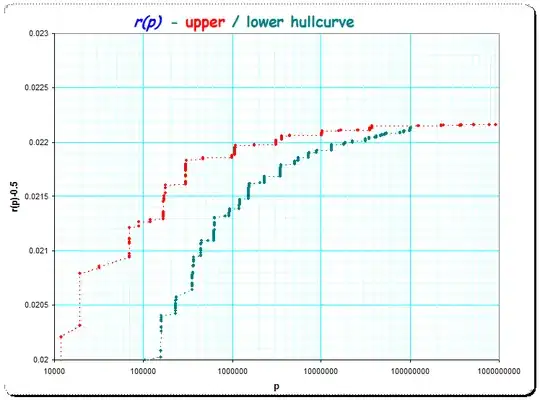
I took this up to $N =100\,000\,000$ , $p_N=2\,038\,074\,743 $ giving the following picture for $r_p-0.5$ depending on $p$ (for the higher primes I only show the values near $p \approx 10^k$ and linear interpolation by Excel (dotted lines)):
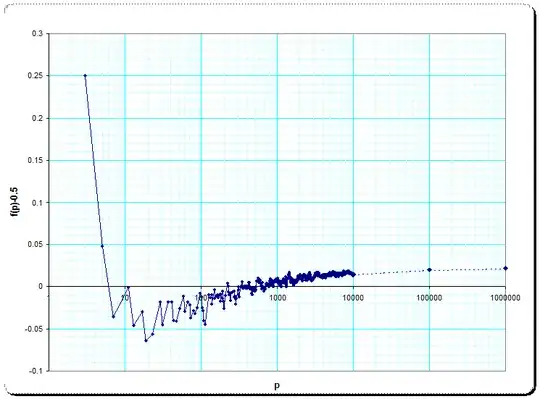
image And the upper & lower hullcurve (upper hullcurve up to $p_N= image2
  • This seems a good fit with my heuristic argument, not ? – mick Mar 25 '23 at 23:36
  • 1
    @mick - please see the update in my answer. I've got a different average quotient. – Gottfried Helms Mar 26 '23 at 16:08
  • Thanks ! Btw I had the idea that since both $10.36$ and $15.077$ are much larger than $7$ and even the ratios $10.36/7$ or $15.077/7$ are relatively much greater than $4/3$ as for the classical collatz , therefore we conjecture that this 7x+1 collatz goes faster into a cycle than the original collatz. How much faster is also a nice question. – mick Mar 26 '23 at 17:54
  • A fascinating observation Gottfried. So we have $p^{\frac{p}{(p-1)^2}}$. ( probably coincidence but that reminds me of the prime twins constant, altough there is the conjecture made by tommy mentioned earlier ) Assuming your observation is correct, do you have an explaination for that heuristic ?? Can we still say the primes work independant ?? – mick Mar 27 '23 at 11:14
  • 1
    @mick - no, sorry. I've dabbled a bit with arguments from the Euler-phi()-function, but didn't find some obvious (and meaningful) relation. Absolutely no idea at the moment. But you might be interested in the derived thread about a possibly existing (or non-existing) limit for $p \to \infty$ see https://math.stackexchange.com/q/4667292/1714 – Gottfried Helms Mar 27 '23 at 11:19
  • 1
    notice the edit. I figured it out. – mick Mar 27 '23 at 20:19
  • 1
    off topic ( temporary message ) , but check out this update :

    https://math.stackexchange.com/questions/4667022/special-numerical-method-for-sqrt-2-with-rational-functions

    I think you like that. ( has your pxp dream thing ) Maybe something for the forum too.

    – mick Mar 29 '23 at 22:16
  • 1
    To be "fair" with the $11n+1$ version, you should also allow division by factors of $7$. This would allow a boundedness conjecture. – Oscar Lanzi Mar 31 '23 at 11:07
  • @GottfriedHelms have you found a cycle that does not contain 1 ?? – mick Apr 05 '23 at 21:51
  • Not with $p=7$. But with $p \in {11,13,17,19}$ we have cycles not containing $1$. And many cycles in the negative numbers, where also $-1$ is not an element. (see my list in https://go.helms-net.de/math/expdioph/primefactor1.htm) – Gottfried Helms Apr 06 '23 at 05:22
  • @GottfriedHelms, I'm curious what you think of the modification to these division exponents that I've posted here. – G Tony Jacobs Oct 05 '24 at 20:45
  • @GTonyJacobs - you mean in your answer? I assume there are good and reliable heuristics (by the writing of your answer) so I take them as given and meaningful. – Gottfried Helms Oct 06 '24 at 07:04
  • @GottfriedHelms, yes that's what I was referring to. I honestly just thought you might be interested; I recognize you as one of the Collatz gurus around here. – G Tony Jacobs Oct 06 '24 at 07:15
  • @GTonyJacobs - I've found energy to take up to your results. Please see my comment in that CHAT resp. the comment at your question. I reproduced your results correctly using your google.doc-writeup, but only by using the transposed of your matrix instead of the untransposed I arrive as well correctly at my results (which I'd got by massive heuristics). – Gottfried Helms Oct 10 '24 at 15:19
3

Regarding those statistics...

After dividing out all $2$'s and $3$'s and $5$'s, the number $n$ in our $7n+1$ will always be a unit, modulo $30$. That is, we will always have

$$n\equiv 1,7,11,13,17,19,23,\text{or }29\pmod{30}$$

After applying $7n+1$ to such a number, we always get something even, and we can divide by $2$ an average of two times, as is well known. However, the number of times we can divide by $3$ and $5$ depend on which $n$ we start with. For example, if $n\equiv 1 \pmod{30}$, then $7n+1$ will not be divisible by $3$ or by $5$.

In that case, after dividing by $2$ as much as possible, we are not equally likely to land in each of the eight congruence classes. In fact, we will have our "next $n$" congruent to $19$ more than half of the time, and it will very seldom be congruent to $23$.

Four of these congruence classes allow for division by $3$, and in those cases, the average exponent is $\frac32$, and two of these congruence classes allow for division by $5$, and in those cases its average exponent is $\frac54$. However, the probability that $n$ is in each congruence class after a previous step has to be calculated from a Markov process, wherein we have to determine transition probabilities between each pair of classes.

For example, starting with $n\equiv 1$, the probabilities that the following $n$ will be congruent to $1, 7, 11, 13, 17, 19, 23, \text{and }29$ are, respectively: $\frac2{15},0,0,0,\frac4{15},\frac8{15},\frac1{15},0$. That's one column of the transition matrix.

It is possible to write down the transition matrix, and calculate the steady state probabilities for each congruence class. In this way, we see that $n\equiv 1\pmod{30}$ with probability $\frac{15802}{120495}$, and all of the other classes have different, equally messy numbers.

Using these steady state values to weight the exponents for $3$ and $5$, we find that the average exponent for $3$ in a division step is not $\frac34$, but in fact $\frac{27334}{40165}(\approx 0.68054)$, and the average exponent for $5$ is $\frac{2889}{8033}(\approx 0.35964)$. That yields an average division ratio of:

$$2^2\cdot 3^{27334/40165}\cdot 5^{2889/8033} \approx 15.071$$

All the gory details can be found in a write-up here: Google doc with full explanation.

G Tony Jacobs
  • 32,044
  • Comments have been moved to chat; please do not continue the discussion here. Before posting a comment below this one, please review the purposes of comments. Comments that do not request clarification or suggest improvements usually belong as an answer, on [meta], or in [chat]. Comments continuing discussion may be removed. – Shaun Oct 07 '24 at 12:58
  • I continued in chat – mick Oct 07 '24 at 22:17
  • I think I have a hint, that your results are different to my results only due to a conceptual/ programmatical bug. If I use your matrix of coefficients for solving for the $\left[p_1,p_2,p_3,...,p_8\right]$ coefficients (according your google.doc-write-up) I get my heuristic exponents if I use your matrix transposed, and get your coefficients if I use your matrix untransposed. So perhaps we have only a simple conceptual or a simple softwareprogram-bug here. – Gottfried Helms Oct 10 '24 at 14:56
  • A related question has been created to this specific point in [markov-chains] (see: tag with that label). The question is at https://math.stackexchange.com/questions/4983799/why-does-this-error-lead-to-a-uniform-distribution – Gottfried Helms Oct 13 '24 at 19:13
1

One aspect seems to have not been explained sufficiently; this is the aspect whether

  • I want to know the theoretical/empirical frequencies of the primefactors after one iteration for (asymptotically) all initial values $a_0 \in \mathbb N \backslash \{2,3,5\} $ and given an average/expected ratio (or average/expected relative frequency).

or

  • I want to count for each such $a_0$ over all the iterates down to $1$ how many primefactors $\{2,3,5\}$ occur on the complete orbit, and find an average of this for all $a_0$ taken.

The first aspect is used in the OP and in my earlier answer with long empirical tables, which give an average of $2^2 \cdot 3^{3/4} \cdot 5^{5/16} $ as an average occurence of primefactors $\{2,3,5\}$

To make the second aspect better understandable (and visible) I show the raw relative frequency table separated for the first $50$ iterates for $N=10^6$ starting numbers $a_0$ from $30 \cdot 10^{20}+1$ (consecutively, but in steps such that only the residue classes $\{1,7,11,13,17,19,23,29\} \pmod {30=2\cdot3\cdot5}$ [=having no primefactor $\{2,3,5\}$] are used).

The first row alone shows exactly the in my first answer (and in the OP's question) given expected-values. The proportions however changes with following iterates. Whether they converge in some way (maybe even cumulated or weighted cumulatively or ... ) to that values of @GTonyJacobs is difficult to say by the given $N$ orbits alone; to reduce the jitter of frequencies I append the same table, but where the measures over the iterations are smoothed by "Eulerian means" of small order - it seems a bit clearer but I still do not want to draw conclusions.

Here are the data:

        raw data rel. frequencies                   smoothed data rel. frequencies
  it  at 2        at 3         at 5       N (*)    at 2       at 3          at 5
======================================================================= =========== 
   1  2.0000030  0.75000200  0.31250000  1000000  2.0000030  0.75000200  0.31250000 (**)
----------------------------------------------------------------------- -----------
   2  2.0001370  0.67710200  0.34037600  1000000  2.0000566  0.72084200  0.32365040
   3  2.0000670  0.67318100  0.36543600  1000000  2.0000776  0.70271864  0.33435024
   4  1.9999820  0.68018000  0.36151200  1000000  2.0000780  0.69191614  0.34292477
   5  1.9996800  0.68434200  0.36173600  1000000  2.0000599  0.68585287  0.34921731
   6  2.0008200  0.67615000  0.35674300  1000000  2.0000386  0.68267106  0.35354688
   7  1.9956350  0.67621600  0.35765600  1000000  2.0000097  0.68109677  0.35634070
   8  1.9899010  0.68239200  0.35525300  1000000  1.9999402  0.68033276  0.35800165
   9  2.0023130  0.68579300  0.36165600  1000000  1.9997904  0.67993893  0.35886861
  10  2.0006800  0.71246600  0.37033400  1000000  1.9995410  0.67971974  0.35921486
  11  1.9655030  0.67757100  0.35404800  1000000  1.9992006  0.67962912  0.35925638
  12  1.9816140  0.65604500  0.35381900  1000000  1.9987947  0.67969304  0.35915788
  13  1.9784280  0.71610600  0.37862500  1000000  1.9983462  0.67995062  0.35903565
  14  2.0745820  0.66982400  0.37216900  1000000  1.9978623  0.68041704  0.35896102
  15  2.0807710  0.68208600  0.36480800  1000000  1.9973328  0.68106897  0.35896731
  16  2.0266370  0.68329900  0.34893000  1000000  1.9967416  0.68184856  0.35906051
  17  1.9346960  0.72523300  0.31545300  1000000  1.9960840  0.68267851  0.35923102
  18  2.0402053  0.66206363  0.38458269   999993  1.9953822  0.68348005  0.35946392
  19  1.9154584  0.62985741  0.37365462   999993  1.9946940  0.68418778  0.35974525
  20  1.9991260  0.71404400  0.35064345   999993  1.9941100  0.68475854  0.36006412
  21  1.9869359  0.71022997  0.26587686   999993  1.9937404  0.68517385  0.36041145
  22  2.0905036  0.58507410  0.27940696   999993  1.9936956  0.68543735  0.36077706
  23  2.0358093  0.62234836  0.33122532   999993  1.9940645  0.68556921  0.36114700
  24  2.0780765  0.68524380  0.33626935   999993  1.9948963  0.68559929  0.36150224
  25  2.1638191  0.59418027  0.38955119   999291  1.9961895  0.68556048  0.36181929
  26  2.1398281  0.70724944  0.34047440   999291  1.9978893  0.68548312  0.36207236
  27  1.9903251  0.62736382  0.33662636   999283  1.9998937  0.68539097  0.36223631
  28  2.0563591  0.80945922  0.28026514   999004  2.0020669  0.68529889  0.36228939
  29  1.9417786  0.70357332  0.46192992   997056  2.0042559  0.68521208  0.36221508
  30  2.2738407  0.65033260  0.42815087   995955  2.0063095  0.68512664  0.36200263
  31  1.9355386  0.70781523  0.34336632   982991  2.0080943  0.68503097  0.36164629
  32  2.0433208  0.57954040  0.34674987   982991  2.0095089  0.68490780  0.36114381
  33  2.1503362  0.64826440  0.31223925   982977  2.0104925  0.68473626  0.36049460
  34  1.9232609  0.87953579  0.27541512   969649  2.0110286  0.68449392  0.35969831
  35  1.8291206  0.71143813  0.34566421   968139  2.0111445  0.68415861  0.35875408
  36  1.6419337  0.88635411  0.34589967   956471  2.0109061  0.68370990  0.35766091
  37  2.0021893  0.74072977  0.42145534   955100  2.0104105  0.68313039  0.35641881
  38  2.1139143  0.93390337  0.34947060   952681  2.0097760  0.68240681  0.35503056
----------------------------------------------------------------------- ---------
  39  2.0550505  0.73992053  0.24300827   928347  2.0091318  0.68153099  0.35350377  (***)
  40  1.8932043  0.79270476  0.36200789   924850  2.0086076  0.68050074  0.35185258
  41  2.0057158  0.54772735  0.40421860   873891  2.0083244  0.67932062  0.35009884
  42  1.8474885  0.85900007  0.34695482   842199  2.0083868  0.67800248  0.34827238
  43  2.1170442  0.52118907  0.45717042   827337  2.0088766  0.67656579  0.34641040
  44  2.0788354  0.63113378  0.36245504   754775  2.0098492  0.67503746  0.34455600
  45  2.0226145  0.67696008  0.37269057   728913  2.0113316  0.67345133  0.34275601
  46  1.9831654  0.72963986  0.25743256   720243  2.0133224  0.67184708  0.34105847
  47  1.9108063  0.59005949  0.43837622   713223  2.0157939  0.67026866  0.33950994
  48  1.8197413  0.52903535  0.29547057   641184  2.0186950  0.66876231  0.33815303
  49  1.9498161  0.43219191  0.38333845   628369  2.0219556  0.66737438  0.33702420
  50  2.0061654  0.67220059  0.33314655   628186  2.0254912  0.66614891  0.33615210

($*$) The $N$ decrease with higher iteration number because iterations leading to some low bound (here $a_k<100$) are stopped to avoid repetitions by cyclicity
($**$) the rel. frequencies as used in the OP
($***$) from here more than $5\%$ of the data missing because the individual orbits reached a value smaller than $100$ (and we want avoid influence by small-value-cycles)

I don't know whether those frequencies converge to @GTonyJacob's values - as I understood those are so to say "ideal" values: derived from eigenvectors which -if I'm not erring here- is sort of assuming infinite iteration for each orbits $a_0,a_1,a_2,...$. Perhaps GTJ may comment on this and makes it more precise.