This does not quite answer your question, as your question concerns $W_1$ instead of $W_2^2$, but since you have not gotten an answer so far i feel like it may be helpful to provide some related results.
The following is an excerpt from Lectures on Optimal Transport (Lecture 8 Section 1) by Ambrosio, Brué and Semola. It asserts that no such bound can hold for the $L_2$ distance between the densities and the $W_2^2$ distance between the associated measures:

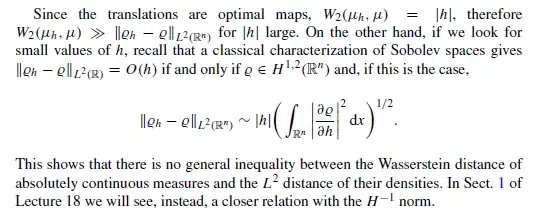
Perhaps you can find a similar argument to show the same result for $W_1$. Once i find anything else relating to your problem, i will edit my answer to provide more information.
EDIT
I have now found a similar argument which shows that no such bound can hold for $W_1$: Let $\mu$ be supported on $[a,b-H]$ with density $\phi$ and for $h<H$ define the shifted measure $\mu_h$ to be the measure with density $\phi_h(x):=\phi(x-h)$. Then all such measures are concentrated on $[a,b]$. Note that just as in the excerpt i posted above, we have $W_1(\mu,\mu_h)=h$. Similarly, if we choose $\phi$ and $h$ such that $\text{supp}\phi\cap \text{supp}\phi_h=\emptyset$, then $$\Vert \phi-\phi_h\Vert_{L_1}=2\Vert\phi_h\Vert_{L_1}=2.$$ Now for any $C>0$ we can pick $h$ small enough such that $$\Vert \phi-\phi_h\Vert_{L_1}=2>CW_1(\mu,\mu_h)=C\cdot h$$ and hence there cannot exist a $C>0$ such that the desired inequality holds for all $\mu,\nu$ supported on $[a,b]$.


