I'm complementing my knowledge of set theory using other sources in addition to the book that normally I use.
Working with the Jech's book (great book, by the way), in one exercise of the first section says the next:
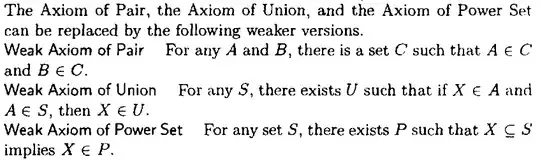
And I need to prove the axiom of pair, union and power set using the weaker versions.
So, my approach for the first one is something like this:
Definition 1: Axiom of Pair:
$ \forall A\ \forall B\,\, \exists C\,\, \forall x\, (\,x \in C \leftrightarrow x=A \vee x=B\,). $
Claim 1: The weaker version of the axiom of pair, implies the stronger version.
Proof: We assume the weaker version of the axiom of pair. Then, if $A$ and $B$ are sets, there exist a set $C$ such that $A\in C$ and $B\in C$.
Let $\varphi(x)$ be the the statement frame "$ x = A \vee x = B $". And we define using the axiom of separation, the set $C^{*}$ as follows:
$y \in C^{*} \leftrightarrow y \in C \wedge \varphi(y)$
So, there exist a set whose elements are exactly the set $A$ and $B$.
Definition 2: The Union axiom:
$ \forall S\, \exists U\, \forall x\, (\,x\in U \leftrightarrow \exists A\, (\,A\in S \wedge x \in A\,)\, ) $
Claim 2: The weaker version of the axiom of union, implies the stronger version.
Proof: We assume the weaker version of the axiom of Union. So, If $S$ is a set, there exists a set $U$, such that $x \in A \wedge A \in S \rightarrow x \in U$.
Let $\varphi(x)\,$ be "$\, \exists A\in S.\, x\in A\,$". We define, using the schema of separation the set $\cup S$ such that:
$y \in \cup S \leftrightarrow y\in U \wedge \varphi(y) $
So,there is a set whose elements are exactly the elements of the elements of $S$.


