1

I am working in Mathcad with the arctangent function of the following form:

$\Theta_1(t)=2\arctan(\frac{y_1(t)}{x_1(t)})$

$\Theta_2(t)=2\arctan(\frac{y_2(t)}{x_2(t)})$

where $x_1(t),y_1(t),x_2(t),y_2(t)$ - time-dependent numerators and denominators.

enter image description here

I want the plot of arc tangents to be displayed without "jumps" and be smooth. To do this, we need some way $±2\pi$ depending on how the numerator and denominator behave But I can't find a universal rule in any way for unwrap. I have already tried many algorithms, but none of them worked correctly everywhere.

For example: first plot shows that $\Theta_1(t)$ needs to be "down" when $sign(x_1(t))=sign(y_1(t))=1$, and where the signs are opposite, nothing needs to be taken away. But this rule will not work on the second plot. There, the first rule will cause a spike at the $0$-crossing point and "raise" the plot where it connects smoothly to neighboring areas.

New result:

enter image description here

ayr
  • 793
  • 1
    The graphs of both $ \Theta_1(t) $ and $ \Theta_2(t)$ look a bit strange, as the range of $ \arctan $ should lie in the interval $ (-\pi/2, \pi/2) $. – Ken Hung Aug 05 '22 at 06:35
  • Sorry, I forgot the $2$ factor before the formulas. I fixed a bug in the topic. – ayr Aug 05 '22 at 06:37
  • 1
    Also what do you mean by fixing the discontinuity? Do you mean you want to make the graph 'smooth' (in certain sense)? Or you want to resolve (i.e. show accurately) the discontinuity? – Ken Hung Aug 05 '22 at 06:38
  • https://ibb.co/GMGsknh I want the plot of arc tangents to be displayed without "jumps" and be smooth. To do this, we need some way $±2\pi$ depending on how the numerator and denominator behave. – ayr Aug 05 '22 at 06:43

2 Answers2

2

I'm not sure how Mathcad plots work, but generally you need to evaluate the function step by step, in some order (usually increasing).

If the function value was $f(t_{i-1})$ in the previous step, then make $f(t_i)$ the value among $\Theta(t_i) +2\pi k, k \in \mathbb Z$, that is nearest to $f(t_{i-1})$.

As you said yourself, you may need to shift the outcome of your primary calculations $\Theta_{1/2}$ by $\pm2\pi$, but you cannot do so without looking at other points in time. The above algorithm gives you a continuous plot, that may in parts wander outside the $[-\pi, \pi]$ range.

Ingix
  • 15,665
  • I seem to understand your suggestion. Yes, it might work. But, I decided to find another, non-iterative way. And I think I found it.

    I used the $atan2$ function. There is a feature in mathcad that connects $atan$ and $atan2$. If $atan$ is calculated as $atan(x/y)$, then $atan2(y,x)$. I also "normalize" $atan2$ to the range $0..2\pi$ with this: https://math.stackexchange.com/a/4169282/656085 Results added to the first message of the topic.

    – ayr Aug 06 '22 at 04:41
1

For given functions $t\in [0,T] \mapsto (x_1(t),y_1(t))\in {\Bbb R}^2\setminus\{(0,0)\}$, I don't think that there is a general local solution to get a continuous function $\Theta_1(t)$. Take e.g. $x_1(t)=\cos(t/2), y_1(t)=\sin(t/2)$, $t\in[0,20\pi]$.

Ideally, you might want that $\Theta_1(t)=2 \arctan(\tan(t/2))=t$ should be the solution. But your software will plot a saw tooth graph with 9 discontinuities. You would have to add more and more multiples of $2\pi$ as $t$ increases. You need to have global information on the graph.

If, however, $x_1(t)$ and $y_1(t)$ comes from solving an ODE, then you may recover a continuous solution $\theta_1(t)$, simply by adding a differential equation for it to your ODE.

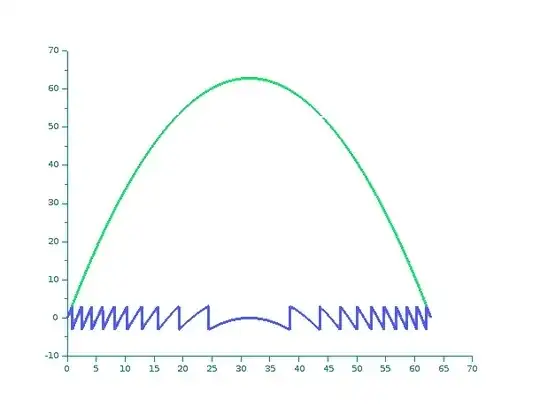
EDIT: Inspired by the post of @ingix, here is a suggestion using vector calculus (in a way it mimics an ODE). I use scilab (I don't know about Mathcad but assume it is close).

If $x,y$ are vectors of length $N$ describing the discretization of a smooth motion winding around the origin. Let $T=atan(x,y)$ be the arctan function taking values in $(-\pi,\pi]$. Let $DT=T(2:\$)-T(1:\$-1)$ be the vector of increments. Most of the values of $DT$ are close to zero but when the arctan jumps the value is close to $\pm 2\pi$. Calculating $R=round(DT/2 \; \pi)$ now gives values in $\{0,\pm 1\}$ and yields precisely the jumps in $T$. Using cumulative sums to recontruct the original path, $$ ST= T(1) + [0; cumsum(DT) - 2\pi \; cumsum(R)] $$ then gives you the angular path, now with discontinuities removed. (You may then multiply by 2 to get your $\Theta$).

As an example I have taken some smooth curve in the plane that avoids the origin, calculated the atan along the curve ( taking values in $(-\pi,\pi]$ and giving the 'saw-tooth' blue curve). Then reconstructed the continuous angle (the green curve) from the blue curve data, using the above formulae.Making the angle continuous
H. H. Rugh
  • 35,992
  • I want to thank you! I've been working with this code for a while and it works really well! But, I began to accumulate cases where the code does not work. Please help me to figure this out. The link contains data called $T$ (as they are designated in this code). https://dropmefiles.com/Hfr30 – ayr Mar 20 '23 at 09:08
  • 1
    @dtn I would need more information about the data. I can see that there are jump discontinuities, but they are not always multiples of $2 \pi$ or even something related to multiples of $\pi$ as far as I can see? (So do not conform to the hypothesis for the method as stated to work). You could, however, extract the discontinuities as above but calculating R by setting it to zero when differences are small. – H. H. Rugh Mar 21 '23 at 11:26