14

This was a question on an old prelim exam in complex analysis: compute

$$\int_0^\infty \frac{\cos(tx)}{x^2 - 2x + 2}\,\mathrm{d}x$$

for $t$ real. I've tried…

  • Residue calculus—it's easy to integrate the similar $\int_0^\infty \frac{\cos(tx)}{x^2+2} \mathrm{d}x$ largely because the integrand is even, but this integrand isn't. Similarly $\int_0^\infty \frac{\sin(tx)}{x^2+2} \mathrm{d}x$ seems hard. Even if the original integral was from $1$ to $\infty$, so the denominator was even about $x=1$, we seem to need this latter, hard integral involving $\sin(tx)$.
  • Mathematica—even for $t=1$, it gives the answer in terms of $$\int_0^z \frac{\sin(t)}{t}\,\mathrm dt \quad \text{and}\quad \int_0^z \dfrac{\cos(t)}{t}\,\mathrm dt,$$ which is not helpful.
  • Looked through Gamelin's Complex Analysis text for inspiration; everything close used even or odd integrands.
  • Googling/searching here, though it's hard to search for such a specific type of integral.

There's a chance there's just a typo on the old prelim, for what it's worth.

  • +1 for one of the best formatted and well explained first posts.. – Nathaniel Bubis Jul 18 '13 at 06:54
  • Decomposing into partial fractions you should get several complex exponential integrals. – Ethan Splaver Jul 18 '13 at 07:11
  • 1
    @Ethan, have you tried? The path to hell is paved with «should»s... – Mariano Suárez-Álvarez Jul 18 '13 at 07:23
  • I don't see why is it easy to integrate from $1$ to $\infty$, is there a typo? – Start wearing purple Jul 18 '13 at 08:24
  • @O.L. The denominator is $(x-1)^2 + 1$. If the limits were $1$ to $\infty$, letting $y = x-1$ gives $y$-limits of $0$ to $\infty$. $\int_0^\infty \cos(t(y+1))/(y^2+1),dy$ is relatively straightforward--use $\cos(t(y+1)) = \mathrm{Re}(e^{t(y+1)i})$ and a circular contour going through the upper half plane, assuming $t > 0$. – Joshua P. Swanson Jul 18 '13 at 09:54
  • @JSwanson But you don't have even function in the numerator. And its odd part (something proportional to $\sin ty$) will still give exponential integrals. That's why I don't see any significant simplification there. – Start wearing purple Jul 18 '13 at 10:44
  • Are you sure you copied this integral correctly? I presume that "old prelim exam"s would not require such knowledge of nonelementary functions. – Argon Jul 18 '13 at 20:18
  • @O.L. Just break it up into two pieces, $e^{tyi}e^{ti}$. The $e^{ti}$ is constant, making the numerator odd, and everything works out. Should I write more details? – Joshua P. Swanson Jul 18 '13 at 22:42
  • 1
    @Argon I'm sure I copied it correctly. As I mentioned in the question, it might be a typo in the exam. – Joshua P. Swanson Jul 18 '13 at 22:44
  • @JSwanson Yes maybe you should write more details, it doesn't seem to work. I am sure that the answer will contain exponential integrals, not much simpler than for $\int_0^{\infty}$. – Start wearing purple Jul 18 '13 at 22:53
  • 1
    @O.L. You're entirely correct, my apologies, and thanks! I've updated the question (see the residue calculus bullet point). If I've done so incorrectly, please let me know. At this point I'm convinced the original problem either had a typo or was just a bad problem. Thank you for your time. – Joshua P. Swanson Jul 19 '13 at 00:03

2 Answers2

8

The integral is even in $t$, so I will assume $t\ge0$. $$ \begin{align} &\int_0^\infty\frac{\cos(tx)}{x^2-2x+2}\,\mathrm{d}x\\ &=\int_{-1}^\infty\frac{\cos(tx+t)}{x^2+1}\,\mathrm{d}x\\ &=\frac1{2i}\int_{-1}^\infty\left(\frac1{x-i}-\frac1{x+i}\right)\cos(tx+t)\,\mathrm{d}x\\ &=\frac1{2i}\int_{-1-i}^\infty\frac{\cos(tx+t+it)}{x}\,\mathrm{d}x\\ &-\frac1{2i}\int_{-1+i}^\infty\frac{\cos(tx+t-it)}{x}\,\mathrm{d}x\\ &=\frac1{2i}\cos(t+it)\int_{-1-i}^\infty\frac{\cos(tx)}{x}\,\mathrm{d}x -\frac1{2i}\sin(t+it)\int_{-1-i}^\infty\frac{\sin(tx)}{x}\,\mathrm{d}x\\ &-\frac1{2i}\cos(t-it)\int_{-1+i}^\infty\frac{\cos(tx)}{x}\,\mathrm{d}x +\frac1{2i}\sin(t-it)\int_{-1+i}^\infty\frac{\sin(tx)}{x}\,\mathrm{d}x\\ &=-\frac1{2i}\cos(t+it)\mathrm{Ci}(-t-it) -\frac1{2i}\sin(t+it)\left(\frac\pi2-\mathrm{Si}(-t-it)\right)\\ &\hphantom{=}+\frac1{2i}\cos(t-it)\mathrm{Ci}(-t+it) +\frac1{2i}\sin(t-it)\left(\frac\pi2-\mathrm{Si}(-t+it)\right) \end{align} $$ This matches what Mathematica computes.

If the integral was over the entire real line, the answer would avoid $\mathrm{Ci}$ and $\mathrm{Si}$. In fact, using contour integration, we get $$ \begin{align} \int_{-\infty}^\infty\frac{\cos(tx)}{x^2-2x+2}\,\mathrm{d}x &=\int_{-\infty}^\infty\frac{\cos(tx+t)}{x^2+1}\,\mathrm{d}x\\ &=\cos(t)\int_{-\infty}^\infty\frac{\cos(tx)}{x^2+1}\,\mathrm{d}x \color{#C00000}{-\sin(t)\int_{-\infty}^\infty\frac{\sin(tx)}{x^2+1}\,\mathrm{d}x}\\ &=\cos(t)\,\mathrm{Re}\left(\int_{-\infty}^\infty\frac{e^{itx}}{x^2+1}\,\mathrm{d}x\right)\color{#C00000}{-0}\\ &=\cos(t)\,\mathrm{Re}\left(\frac1{2i}\int_\gamma\left(\frac1{x-i}-\frac1{x+i}\right)e^{itx}\,\mathrm{d}x\right)\\ &=\cos(t)\,\mathrm{Re}\left(\frac1{2i}\int_\gamma\frac{e^{itx}}{x-i}\,\mathrm{d}x-\frac1{2i}\int_\gamma\frac{e^{itx}}{x+i}\,\mathrm{d}x\right)\\ &=\cos(t)\,\mathrm{Re}\left(\frac1{2i}2\pi i e^{-t}-0\right)\\[6pt] &=\pi\cos(t)\,e^{-t} \end{align} $$ Where $\gamma$ is the contour along the real axis and circling back counter-clockwise around the upper half-plane.

This may have been the intended question.

robjohn
  • 353,833
  • I'm tempted to accept this as the answer since changing the lower limit of integration from $0$ to $-\infty$ makes the problem so reasonable and would be an easy typo to make. I'll probably do so shortly. Thank you for your time! – Joshua P. Swanson Jul 20 '13 at 01:33
7

Note that $$\int_0^\infty \frac{\cos(tx)}{x^2 - 2x + 2}\,\mathrm{d}x$$

can be written as $$\int_0^\infty {\frac{{\cos tx}}{{{{\left( {x - 1} \right)}^2} + 1}}} {\mkern 1mu} {\text{d}}x$$ so $x-1=u$ gives $$\int_{ - 1}^\infty {\frac{{\cos \left( {u + 1} \right)t}}{{{u^2} + 1}}} {\mkern 1mu} {\text{d}}u = \int_{ - 1}^\infty {\frac{{\cos tu\cos t - \sin tu\sin t}}{{{u^2} + 1}}} {\mkern 1mu} {\text{d}}u$$ which means we need to know what $$\int_{ - 1}^\infty {\frac{{\cos tu}}{{{u^2} + 1}}} {\mkern 1mu} {\text{d}}u$$ and $$\int_{ - 1}^\infty {\frac{{\sin tu}}{{{u^2} + 1}}} {\mkern 1mu} {\text{d}}u$$ are.

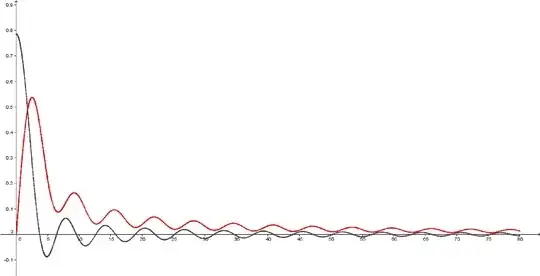
Note that $$\int_{ 0}^\infty {\frac{{\cos tu}}{{{u^2} + 1}}} {\mkern 1mu} {\text{d}}u$$ is not hard, similarily for the other, so we are worried about the remaining part in $[-1,0]$ mostly. By $u\mapsto -u$ we are looing at$$\eqalign{ & \phi \left( t \right) = \int_0^1 {\frac{{\cos tu}}{{{u^2} + 1}}} {\mkern 1mu} {\text{d}}u \cr & \eta \left( t \right) = \int_0^1 {\frac{{\sin tu}}{{{u^2} + 1}}} {\mkern 1mu} {\text{d}}u \cr} $$

In red you can see $\eta$; in grey $\phi$. Note that $$\eqalign{ & \phi - \phi '' = \int_0^1 {\cos tu} {\mkern 1mu} {\text{d}}u =\frac{\sin t}t \cr & \eta - \eta '' = \int_0^1 {\sin tu} {\mkern 1mu} {\text{d}}u=\frac{1-\cos t}t \cr} $$

enter image description here

ADD Recall that $$\int_0^\infty {\frac{{\cos tx}}{{{x^2} + 1}}} {\mkern 1mu} {\text{d}}x = \frac{\pi }{2}{e^{ - \left| x \right|}}$$

I'm trying to remember what the other integral (with $\sin$) evaluates to.

Pedro
  • 125,149
  • 19
  • 236
  • 403
  • Indeed it turns out that $\eta$ involves the exponential integral. – Sangchul Lee Jul 19 '13 at 04:24
  • 1
    @sos440 Ah, here's the Master of integrals to save us all! – Pedro Jul 19 '13 at 04:36
  • @sos440 What can I do to get as good as you at recognizing integrals? I have tried everything except changing my name to sos450. –  Jul 19 '13 at 05:20
  • @PeterTamaroff Perhaps this is what you are looking for with $\sin$: http://math.stackexchange.com/a/69059/27624 – Argon Jul 19 '13 at 05:44
  • I guess the integrand is meant to go from $-\infty$ to $\infty$ then there is a closed form for the integral. – N3buchadnezzar Jul 19 '13 at 12:32
  • Note that $$\int_{-1}^\infty\frac{\sin(tu)}{u^2+1},\mathrm{d}u=\int_1^\infty\frac{\sin(tu)}{u^2+1},\mathrm{d}u$$ and $$\int_{-1}^\infty\frac{\cos(tu)}{u^2+1},\mathrm{d}u=\pi e^{-|t|}-\int_1^\infty\frac{\cos(tu)}{u^2+1},\mathrm{d}u$$ This only makes the "integrals we need to know" simpler looking. However, I think that $$\int_0^\infty\frac{\sin(tu)}{u^2+1},\mathrm{d}u$$ requires some special functions (e.g. $\mathrm{Si}$). – robjohn Jul 19 '13 at 12:47
  • I find the vast difference in complexity between $\int_0^\infty \frac{\sin tx}{x^2+1}\mathrm{d}x$ and $\int_0^\infty \frac{\cos tx}{x^2+1}\mathrm{d}x$ remarkable. I had never noticed how limited we seem to be as a general rule (with plenty of exceptions) to doing contour integrals with even functions. – Joshua P. Swanson Jul 20 '13 at 01:29
  • @JSwanson Sorry for underestimating the $\sin$ integral, it is complicated, yes. – Pedro Jul 20 '13 at 01:30