8

Consider the following first order ODE: $$\frac{\operatorname{d}\!y}{\operatorname{d}\!x} = x^2 - y^2$$ Despite the fact that this ODE has a very simple expression, it is not solvable in terms of elementary functions. (We need the so-called Bessel function $J_u(z)$, where $u \in \mathbb{R}$ and $z \in \mathbb{C}$.)

I've used AutoGraph to plot the direction field and to plot several integral curves.
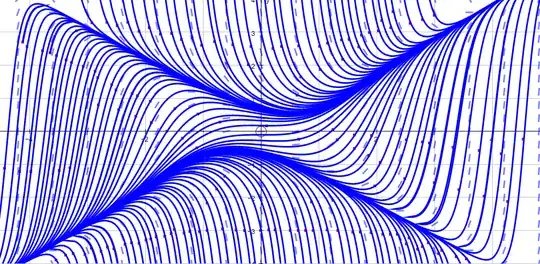
enter image description here

There is a clear separation of the plane. Your eye will no-doubt pick out two very heavily coloured curve-like regions. The underlying curves form a bifurcation set: choosing points on either side give qualitatively different integral curves through those points.

Is there a general way to find an equation or a parametrisation for the bifurcation set? Or do we have to be able to solve the ODE explicitly?

If it isn't possible to find the bifurcation set explicitly, then is there any way to find other information, e.g. how many regions the bifurcation set separates the plane into? (In my example, the plane is separated into three regions.)

Addendum: Here's a plot to show that the lines $y = \pm x$ ($x^2-y^2=0$) have no local significance to the integral curves. They lines $y=\pm x$ do seem to be asymptotes for some of the integral curves.
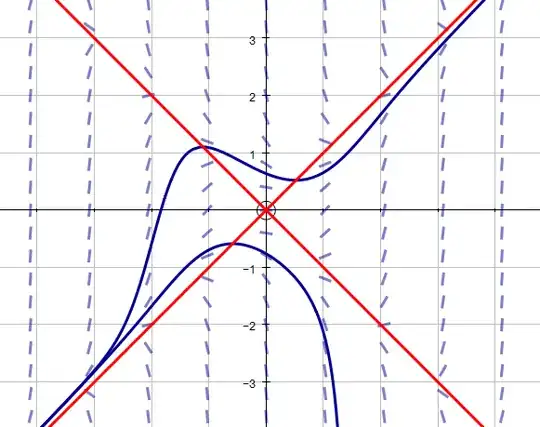
enter image description here

Fly by Night
  • 32,886
  • 1
    I'm not sure about bifurcation and stuff, since usually those diagrams look completely different, but as for the "separation of the plane", you can find those lines by solving fixed point problem, for any ODE $dy/dx = f(x,y)$ you need to find points where $f(x,y) = 0$. In your case $x^2 = y^2$, or $y = \pm x$ lines are fixed points. The thing is solution that starts in one region will never cross those lines, as you might notice in your plot. – Kaster Jul 13 '13 at 23:47
  • @Kaster That was my first idea. But then I quickly realised that $x^2-y^2 = 0$ simply gives the points with a horizontal direction element. Moreover, you can see from the picture that the curve-like regions are not symmetric about either the $x$-axis or the $y$-axis, like the lines $y=\pm x$ would be. – Fly by Night Jul 13 '13 at 23:53
  • 1
    A note: those are not bifurcation sets. A bifurcation point is a point where the solution of the ODE is not unique. – Daniel Robert-Nicoud Jul 14 '13 at 00:14
  • @Flybynight you're right, some solutions indeed cross $y = \pm x$. – Kaster Jul 14 '13 at 00:15
  • 1
    @FlybyNight It's funny, that because of that catastrophic transition at the interface, the full picture like you provided is impossible or quite problematic to obtain by numerical methods :) – Kaster Jul 14 '13 at 00:30
  • @Kaster I'm sorry, but I didn't understand. What did you mean by "...transition at the interface..."? – Fly by Night Jul 14 '13 at 00:32
  • @DanielRobert-Nicoud I come from singularity theory, where a bifurcation set (aka a perestroika) is a set of parameter values which give degenerate system states. For example, consider the set of cubics $x^3+ax+b$, where $a,b, \in \mathbb{R}$. The bifurcation set is given by the cusp $4a^3+27b^2=0$. Points "inside" the cusp give cubics with three distinct real roots while points "outside" the cusp give cubics with a single real root. Points on the cusp have a repeated root. The name "bifurcation set" is very natural to me in this situation. Forgive my cross-curricular nomenclature. – Fly by Night Jul 14 '13 at 00:33
  • 1
    @FlybyNight well, I tried to get the same family of curves numerically by varying initial condition, but so far I got solutions only for single region, and when initial condition approaches the value that corresponds to other region solution I got singularity and simulation just blew up. – Kaster Jul 14 '13 at 00:35
  • 1
    Well, I know bifurcation points from a course where we treated a bit Hopf-bifurcation. The argument is related to your question, take a look if you're interested. If I find something I'll let you know. Nice question btw. – Daniel Robert-Nicoud Jul 14 '13 at 00:38
  • @Kaster Thank you very much for trying to crack the problem. Which numerical method(s) are you using? Would it be possible to write down a formal expression for a numerical solution and then to look for when these numerical solutions blow up? If we can find out when the numerical methods fail, we might have a clue about these special curves. – Fly by Night Jul 14 '13 at 00:39
  • 1
    @FlybyNight I just solved IVP using matlabs ode45. I'm not sure about details, I think it's somehow related to RK method. – Kaster Jul 14 '13 at 00:51
  • @FlybyNight ODE: $y'=x^2-y^2$ is the form of Riccati equation: $$ y'(x)=q_0(x)+q_1(x)y(x)+q_2(x)y^2(x). $$ In this case, we have $q_0(x)=x^2$, $q_1(x)=0$, and $q_2(x)=-1$. You might want to try to reduce to a second order linear equation. The solution is maybe in the term of Bessel function. – Tunk-Fey Apr 06 '14 at 07:27
  • @FlybyNight I'm really sorry my friend, I didn't see this question was an old post. – Tunk-Fey Apr 06 '14 at 07:31

1 Answers1

3

Solving of $\frac{dy}{dx}=x^2-y^2$

Let $y=\frac{F'}{F}$

$y'=\frac{F''}{F}-\frac{F'^2}{F^2}=x^2-\frac{F'^2}{F^2}$

$$F''-x^2 F=0$$ The general solution of this parabolic cylinder ODE is : $$F(x)=c_1D_{-1/2}(\sqrt{2}x)+c_2D_{-1/2}(i\sqrt{2}x)$$ where $D_\nu(x)$ is the parabolic cylinder function. Alternatively, it can be expressed with Bessel functions of order $\pm\frac{1}{4}$

$$y(x)=\frac{F'}{F}=\frac{c_1\left( x D_{-1/2}(\sqrt{2}x)-\sqrt{2} D_{1/2}(\sqrt{2}x)\right) + c_2\left( -x D_{-1/2}(i\sqrt{2}x)-i\sqrt{2} D_{1/2}(i\sqrt{2}x) \right) }{c_1 D_{-1/2}(\sqrt{2}x)+c_2D_{-1/2}(i\sqrt{2}x)}$$

Note that there is only one independant constant $C$ by simplification with ether $C=\frac{c_1}{c_2}$ or $C=\frac{c_2}{c_1}$

I fact, the purpose of is the asymptotic behaviour of $y(x)$.

The asmptotic expansion of the parabolic cylinder function is : $$D_{-1/2}(X)=e^{-X^2/4}\sqrt{X}\left(1-\frac{3}{8}\frac{1}{X^2}+O\left(\frac{1}{X^3} \right) \right)$$

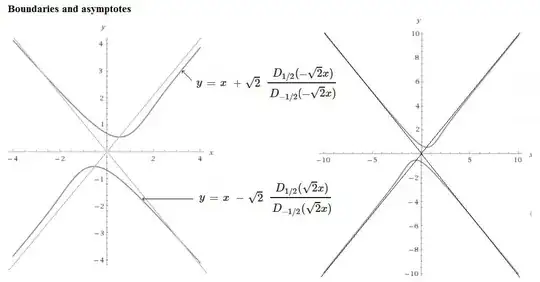
Applying this formulas to the above equations $F(x)$ and $F'(x)$, then $y(x)=\frac{F'}{F}$ is an arduous task which leads to $$y=\pm \left(x-\frac{1}{2x}-\frac{3}{8x^2}+O\left(\frac{1}{x^3} \right)\right) $$ The asymptotes are $y=x$ and $y=-x$

Of course, one must no confuse the asymptotes with the asymptotic or "boudary" curves (figure below) : $y=x$ and $y=-x$ are asymptotes of both boundary curves and integral curves.

enter image description here

NOTE :

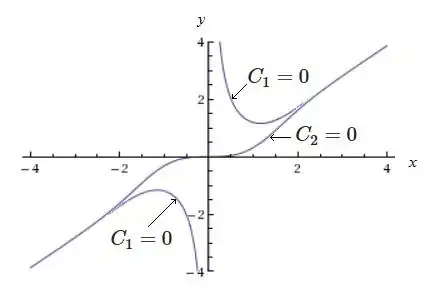
The parabolic cylinder functions are related to some Bessel functions. So, it is possible to express $y(x)$ on equivalent forms with ether one or the other of those two kind of special functions. The choice of the parabolic cylinder leads to simpler calculus as far as we are studying the asympotic behaviour because the asymptotic series expansion is easier. On the other hand, it involves complex coefficients $c_1$ , $c_2$. So, the formula with the parabolic cylinder functions is not pleasant to use if we want to compute particular values in the real range of $y(x)$. For this different purpose, the formula with Bessel functions is more convenient : $$y(x)=\frac{\left( C_1\left( x^2 I_{-3/4}(x^2/2)+x^2 I_{5/4}(x^2/2)+I_{1/4}(x^2/2)\right) + C_2\left( x^2 I_{3/4}(x^2/2)+x^2 I_{-5/4}(x^2/2)+I_{-1/4}(x^2/2)\right) \right) }{2 x \left(C_1 I_{1/4}(x^2/2)+C_2 I_{-1/4}(x^2/2) \right)}$$ The symbol $I$ denotes the modified Bessel functions of the first kind.

For example, the figure below shows the particular curves corresponding to $C_1=0$ and $C_2=0$ respectively.

enter image description here

JJacquelin
  • 68,401
  • 4
  • 40
  • 91
  • You seem to have misunderstood my question. The integral curves foliate the plane into three regions. These regions are separated by two curves. I wanted to find the equation, or a parametrisation, for these curves. My original post includes an image of the lines $y=\pm x$ and some integral curves, and the integral curves cross these lines. The lines $y=\pm x$ are not the boundary curves that I seek. – Fly by Night May 30 '15 at 18:23
  • You seems to have misunderstood my answer : I gave the analytic solution. Also, I answered to your assumption : <<They lines $y=\pm x$ do seem to be asymptotes for some of the integral curves>> , The prove is given. In order to make more clear my first answer, see the recent addition which shows the asymptotes and the asymptotic curves. – JJacquelin May 31 '15 at 07:47